I. INTRODUCTION – THE GREAT MENTAL SPLIT
America has always been a pluralistic society. From its earliest beginnings as a distinctive nation — Dutch merchants trading with the Lenni Lenape tribes in New Amsterdam, Catholic gentry in Maryland, Scotch-Irish frontiersmen in the Appalachians, and freed or escaped African ex-slaves intermingling with Native American tribes — the country has been shaped by waves of both voluntary and forced migration, religious dissent, linguistic variety and an uneasy, albeit fruitful, coexistence.
And yet, in the present moment, one could be forgiven for thinking that multiculturalism is a recent ideological invention, discovered sometime in the 1980s and managed ever since by trained professionals with Ivy League credentials.
This confusion is no accident. Ever since ‘multiculturalism’ – in ironical quotes – became a politically and ideologically charged buzzword starting in the late 1980s, both the word and the concept have become subject to the friction and distortions of America’s deepening political polarization. Yet the expression itself, when it is shorn of ideological overtones, accurately describes essential and longstanding aspects of the American experience.
In early 21st century America, however, multiculturalism as a lived psychological and social reality has effectively split into two forms: one lived and one imagined. The topic of this week’s post is America’s two multiculturalisms and how they became distinct.
The Managerial and Institutional Versus the Practical and the Lived
One is a top-down, institutionalized ideology — a theory-laden project advanced by universities, corporate HR departments, media platforms, and government agencies. The other is a lived, bottom-up experience — the kind of rough-hewn, often wordless negotiation that takes place in neighborhoods, schools, churches, corner stores, and workplaces.
The first kind of multiculturalism is managerial, performative, and deeply concerned with optics. The second is pragmatic, occasionally clumsy, but more durable than its architects in the first camp would ever guess.
This post is an attempt to draw a clear line between America’s two forms of multiculturalism. It is also a defense — not of any nostalgic idea of ethnic harmony, but of the American capacity to build something plural and peaceful out of messiness, improvisation, and imperfect coexistence.
It will argue that the real story of multiculturalism in America today isn’t happening in Diversity, Equity and Inclusion (DEI) reports or college seminar rooms. It’s what is happening in Queens bodegas, Los Angeles hospitals, Houston school districts, and Midwestern suburbs where second or third generation Vietnamese-American kids play on the same soccer teams as Mexican, Somali and white, European-American kids…and nobody thinks all that much about it.
To tell this story properly also requires acknowledging a stubborn truth: assimilation hasn’t disappeared, though its form has changed.
People still adjust to broadly Anglo-American cultural norms — often voluntarily — even as they preserve many aspects of their heritage. The melting pot hasn’t been replaced by a salad bowl or mosaic; it’s just cooking at a slower temperature, and with different ingredients.
Meanwhile, both the political Right and political Left routinely misread this process — with the Right declaring it an unmitigated ‘disaster’, and the Left mistaking it for a ‘revolution’.
Multiculturalism in America doesn’t need more theorizing. What it needs is a better and more accurate description.
So — let’s begin.
II. THE ELITE VERSION OF MULTICULTURALISM
The multiculturalism that most Americans hear about — especially if they work in white-collar sectors or attend college — isn’t the form of multiculturalism that they live on a day-to-day basis. Instead, it is an abstract and curated ideal, manufactured and maintained by elite institutions: universities, major corporations, philanthropic foundations, media conglomerates, and large nonprofits.
Elite multiculturalism is moralized, theoretical, and tightly managed. It thrives in places where culture is something intangible. It is something to be discussed, categorized, and audited — not lived through or negotiated informally.
The elite version of multiculturalism is often less interested in the unpredictable messiness of actual pluralism than in the illusion of control over it.
Elite multiculturalism replaces culture with “identity,” people with “demographics,” and communities with “affinity groups.” It treats race, ethnicity, religion, gender, and sexuality not as organic aspects of human life, but as fixed and legible categories — each in need of managerial recognition, symbolic validation, and careful procedural handling.
Elite multiculturalism is fundamentally bureaucratic: multiculturalism as flowchart.

Of Bureaucracies and Buzzwords
At the university level, this can take the form of mandatory DEI training sessions, land acknowledgments read by tenured faculty, and an ever-expanding proliferation of student centers and grievance offices.
In the corporate world, it manifests as annual heritage months, inclusive marketing campaigns vetted by consultants, and press releases issued after internal controversies that read like hostage notes from middle management. Everyone is instructed to “bring their whole selves to work,” provided their “whole self” conforms to the rotating expectations of brand-conscious institutions.
This model of multiculturalism is not merely prescriptive — it is performative. It places enormous emphasis on language: which terms are acceptable, which phrases are deprecated, which mistakes must be followed by apology and reeducation. Culture, in this framework, becomes a matter of etiquette and offense, not of deep structures or lived commitments. It is something to be celebrated symbolically, but only in safely approved doses.
Worse, elite multiculturalism often misunderstands the very thing it claims to champion.
Symbols and Their Manipulation
Its proponents routinely mistake formal diversity for social cohesion, and symbolic gestures for substantive integration. It prioritizes representation over reciprocity, inclusion over interaction, and visibility over genuine solidarity. In doing so, it often encourages a form of solipsistic identity awareness rather than shared civic belonging.
Perhaps the most revealing aspect of this approach is that it has little confidence in the society it presumes to reform.
The implicit message behind much institutional multiculturalism is that Americans cannot be trusted to live together peacefully unless they are carefully taught how to do so — by highly trained professionals. This betrays a lack of faith in ordinary people and their capacity for tolerance, curiosity, and adaptation.
In this way, elite multiculturalism is less a celebration of pluralism than a nervous attempt to contain it. It is less about letting cultures mix and evolve on their own terms than about policing the conditions under which those interactions may occur. And perhaps most importantly, it is out of step with how Americans live their day-to-day lives in neighborhoods, local religious congregations of every faith, and in smaller, non-elite companies.
That is where we turn our attention next.
III. THE LIVED VERSION OF MULTICULTURALISM
If the elite version of multiculturalism is formal, supervised, and largely symbolic, the lived version is informal, intuitive, and deeply real. Lived multiculturalism is not administered from above but worked out from below — in apartment buildings, on soccer fields, in storefront churches and suburban strip malls.
It doesn’t always advertise itself as “multiculturalism,” and often avoids the word entirely. But it has a quiet logic of its own: pragmatic coexistence, negotiated over time, largely free from institutional choreography.
Walk through neighborhoods in Queens, the San Gabriel Valley, or Dearborn, Michigan, and you’ll find ethnic pluralism that would bewilder a Harvard DEI office. Not just diversity of skin tones or surnames, but diversity of moral systems, family structures, culinary habits, languages, and religious norms — all coexisting with only the most occasional friction.
Korean grocers in Black neighborhoods; Mexican and Filipino nurses caring for elderly white retirees; halal food trucks serving Orthodox Jews in Brooklyn; Pakistani and Dominican flags flying side by side at city festivals. No declarations. No seminars. Just life.
Crucially, these relationships are not static. They change.
Second-generation children speak perfect English and lose their parents’ accents; they attend school together, play on the same basketball teams, marry across ethnic lines. Over time, cultural boundaries blur, not because anyone decrees it, but because they have a shared stake in the same local institutions: schools, transit systems, housing markets, fast food jobs, sports leagues.
These are not always sentimental bonds — they are often transactional. But that doesn’t make them less real.
Coexisting More Peacefully Than Ever
This kind of pluralism has always been present in the United States — but it has rarely been as peaceful as it is now. A century ago, during the last great wave of immigration, multiculturalism was far more violent and territorial.
Irish and Italian street gangs in Boston and New York enforced ethnic boundaries with fists and clubs. A Jewish kid wandering into a Polish or Anglo-Saxon neighborhood might face either taunting or a beating. Catholics and Protestants routinely viewed one another with suspicion. In cities like Chicago, Los Angeles, and St. Louis, ethnic violence between newly arrived groups was not uncommon.
That kind of territorialism still exists in some pockets of the country — but it has softened, thinned, and lost much of its political charge. Indeed, one of the great underreported stories of early 21st-century America is just how little communal violence there has been, despite the massive demographic change of the past 50 years.
Between 1900 and 1930, when immigration from Southern and Eastern Europe peaked, America experienced frequent interethnic riots, violent labor disputes, and routine clashes between immigrant groups and older populations.
In contrast, the last 30 years — during which the foreign-born population has surged to its highest level since the 1920s — have seen remarkably little ethnic violence. There are flashpoints, to be sure, often exaggerated by the media. But the broader picture is one of surprising calm.

Growing up – and thriving – amidst America’s Two Multiculturalisms
Your Neighborhood Is My Neighborhood
Today, Americans are far less likely to define neighborhood turf by ethnicity alone. Interethnic violence, once a routine feature of American urban life, has declined dramatically. In most cities, a Vietnamese family can open a sandwich shop in a largely Latino area, and nobody bats an eye. A Nigerian or Bangladeshi Uber driver can live in a mostly white suburb, and few neighbors care, provided the lawn is trimmed.
This does not mean everything is idyllic. Frictions still exist: cultural misunderstandings, resentments over resources, language barriers, competition for jobs and housing.
But these frictions tend to be localized and self-contained. They are not symptoms of some larger national unraveling, as right-wing alarmists often suggest. Nor are they signs of systemic oppression or hostility, as some left-wing critics claim. More often, they are just the normal negotiations of coexistence in a large, complex society.
Call It ‘Creative Hybridization’
Assimilation, too, has not disappeared. It has simply changed form. It is no longer the blunt-force model of early 20th-century America, where new arrivals were expected to abandon their native languages and customs almost entirely.
Instead, it now operates as a kind of cultural overlay: new Americans adopt the dominant codes of behavior — speaking English, navigating bureaucracy, understanding American-style individualism — while retaining the many elements of their heritage that don’t interfere with broader participation.
A Korean-American teenager may speak to her grandmother in Korean, stream K-dramas and listen to K-pop at home, and still act, dress, and think indistinguishably from her Irish- or Black-American classmates. A Salvadoran family may attend Spanish-language Mass on Sundays but grill hot dogs for the Fourth of July.
The more important fact is that Americans, across lines of ancestry and class, increasingly expect — and accept — this kind of creative hybridization.
It no longer scandalizes anyone that a Vietnamese restaurant might serve avocado toast, or that a Puerto Rican-Jewish couple might send their child to a bilingual Montessori school and name her Harper. For most Americans, cultural purity is not a priority — livability is.
The demand is not that you erase your background, but that you show up, get along, and try not to make too much noise. That’s not utopia, but it is peace.
Why? Partly because American society has evolved — less ethnically tribal (though more politically so), more fluid, more accustomed to heterogeneity.
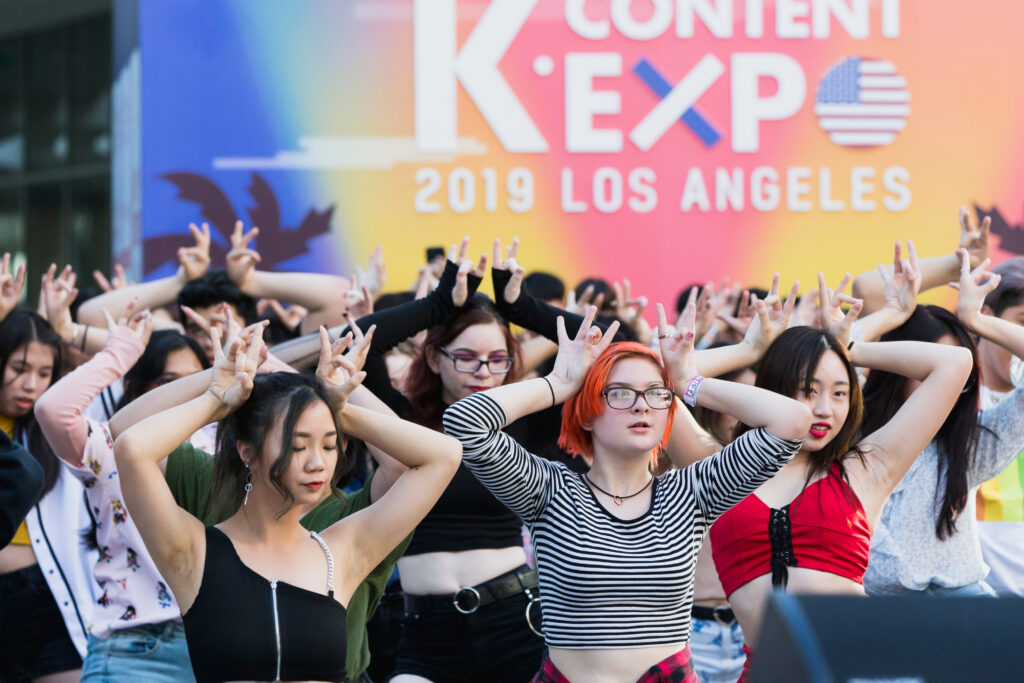
American K-Pop Fans at a music event in Los Angeles, 2019
But also because most people, contrary to the assumptions of our elite commentators, don’t need special coaching to live peacefully among difference. They need decent schools, affordable groceries, safe streets, and steady work.
Multiculturalism, at the level where life is actually lived, is not a theory. It’s a series of daily negotiations — and Americans have become very good at negotiating.
IV. THE PERSISTENT REALITY OF ASSIMILATION
For all the talk in elite circles about “celebrating difference” and “honoring heritage,” the underlying gravitational pull of American life still bends toward assimilation. It is less aggressive than it once was, less aggressively insistent on conformity, and more flexible about what it means to be “American.”
But the process remains inescapable. In practice, most immigrants — and their children — continue to adopt the dominant norms of speech, behavior, and self-understanding that structure life in the United States.
This is not the melting pot of the early 20th century, with its sharp heat and pressure. It is slower, cooler, and more elective. But it is still assimilation, even if it now prefers to call itself “integration” or “cultural hybridity.”
And in truth, Americans remain far more assimilationist than we like to admit — even those who claim otherwise. You cannot have a national culture built on individualism, mass consumer capitalism, and pop-cultural saturation without also producing a powerful homogenizing effect.
The Mechanisms Are Subtle, and Everywhere
The mechanisms of this softer assimilation are everywhere. The public school system, even in its uneven state, still teaches most American children a common civil religion: English fluency, secular legalism, the rhythms of the school calendar, basic civic myths, and a shared vernacular of holidays, customs, and habits.
The American workplace, particularly in the service economy, imposes a standard code of behavior — punctuality, politeness, customer orientation, interpersonal detachment.
Television, advertising, and digital media reinforce a common set of references and desires. There is a reason that a teenager in Phoenix, Arizona and one in Paterson, New Jersey are likely to know the same celebrity gossip, wear similar clothes, and share memes in the same dialect of online sarcasm.
None of this requires coercion. It functions through exposure, repetition, and incentive.
Assimilation today is not a forced march; it’s more like an escalator. It works because life gets easier when you ride it.
English proficiency makes it easier to navigate healthcare, legal documents, and social services. A grasp of middle-class American manners improves job prospects. Knowledge of mainstream pop culture creates social currency across lines of race, class, and geography.
Even immigrants who cling tightly to their home traditions quietly acknowledge this. They are not rejecting America; they are managing the pace and terms of their entry.
What the Extremes Fail to Understand
This voluntary dimension of assimilation is often misunderstood by both political extremes.
On the Right, there is a tendency to romanticize the “old days” of highly pressured assimilation — a period remembered as one of forced name changes, Anglo conformity, and stern public schooling — as if cultural coercion was a mark of national strength.
But that vision leaves out how much resentment, resistance, and ethnic antagonism it produced, and how much richer American culture became once the pressure eased.
On the Left, meanwhile, there is often a willful blindness to the fact that assimilation is still happening at all.
Many progressive activists treat the concept as either suspect or obsolete, as if any expectation of cultural adjustment were an act of oppression. But this ignores what is plainly visible: second-generation Americans, whatever their heritage, continue to become culturally American — and do so without sacrificing their dignity or rejecting their parents’ values wholesale.
Adopt What You Can, Keep What You Must
Assimilation, in this sense, is not disappearance. It is addition. You keep what you can, adopt what you must, and translate the rest.
This process has been accelerated by one crucial fact: America’s cultural mainstream is less tied to ‘whiteness’ – so-called – than ever before. That is, in part, what makes 21st-century assimilation more tolerable to more people.
When hip-hop becomes the dominant form of popular music for young people across all ethnic groups, when Korean and Mexican food are default options in white suburbs, and when Kamala Harris’s multiracial background is treated as unremarkable — assimilation no longer means becoming like the old stock. It means becoming American in a way that reflects the country as it actually exists now.
America’s Two Multiculturalisms
That shift should not be mistaken for a total absence of hierarchy or exclusion. Some accents still carry stigma; some names still provoke suspicion; some customs still mark one as foreign.
But the boundaries of “normal” have widened, and the gatekeepers are less sure of their authority. What remains surprisingly constant, however, is the desire — not just to be tolerated, but to belong. Not just to coexist, but to participate. This desire powers assimilation more than any policy ever has.
And it’s here that the lived multiculturalism of America quietly overlaps with its assimilative tradition. The goal is not to flatten cultural differences, but to make them manageable — to turn friction into familiarity.
To make it possible for a Bangladeshi nurse, a Guatemalan cook, and a Polish plumber to share the same street, the same workplace, and maybe even the same extended family as a result of the steady rise in inter-ethnic and interracial marriage. To give them enough in common to keep the wheels turning — and to leave the rest alone.
That project, however imperfect, still works. And it works not because of official guidance, but frequently in spite of it.
Until next time, we remain –
Greymantle