INTRODUCTION: BETWEEN IRONY AND CONVICTION
Over the past four decades, Satanic aesthetics and occult-infused posturing have crept steadily from the margins of Western subcultures into the mainstream of fashion, music, film, and avant-garde performance. What once belonged to shadowy corners of the counterculture now enjoys a curated, glamorized presentation on Instagram, the red carpet, and TikTok.
The line between irony and conviction, costume and belief, has grown increasingly thin.
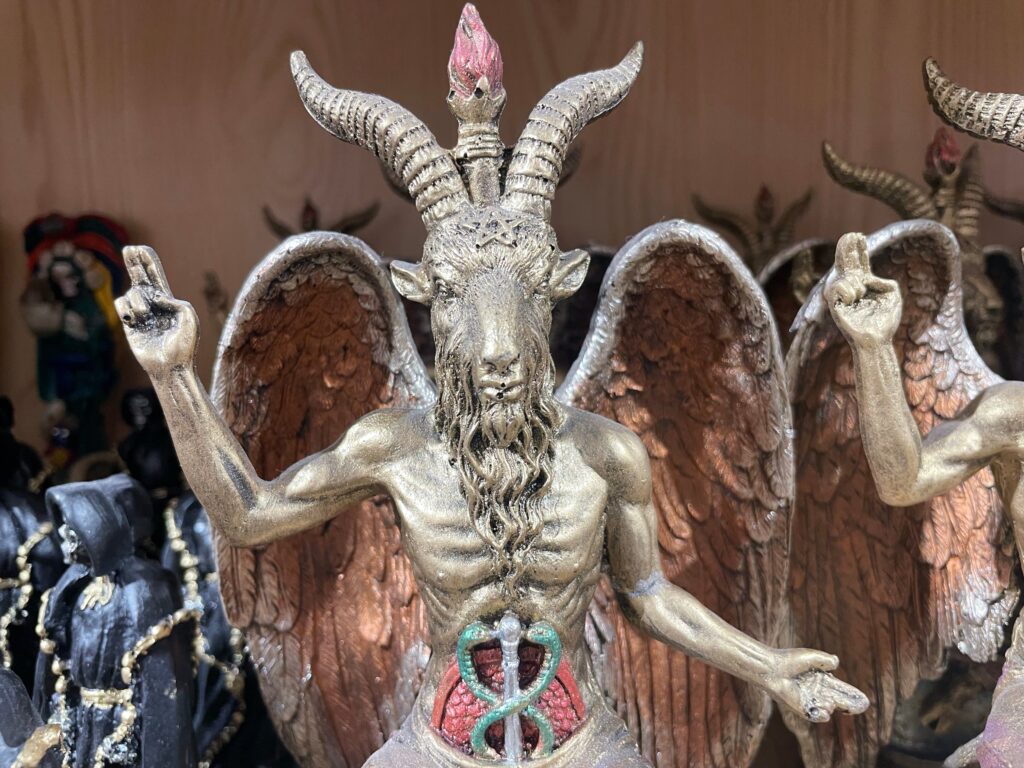
Today, one can see an ornate Baphomet choker in the front row at Paris Fashion Week, or a Luciferian ode embedded in a high-budget pop video. Pop artists like Lil Nas X, Billie Eilish, and Doja Cat flirt openly with infernal imagery, while rock acts such as Ghost, with their papal anti-pope attire and Satanic mass aesthetic, revel in liturgical parody.
High fashion houses including Gucci, Balenciaga, and Vetements have taken turns channeling demonic, esoteric, or explicitly occult motifs. The effect is disorienting, provocative—and precisely calibrated to both elicit outrage and project seductiveness. We have dubbed this phenomenon ‘The Sinisterian Impulse’.
This isn’t just shock for commerce’s sake. Beneath the spectacle lies a sensibility with deeper cultural roots and emerging ideological heft. This movement—less an organized religion than a worldview, less a cult than a style—is what Greymantle has dubbed Sinisterianism.
SINISTERIANISM – A WORKING DEFINITION
Greymantle defines Sinisterianism as follows: a set of loosely organized Western counter-cultural movements aggressively opposed to all forms of traditional authority and committed to shattering moral and sexual taboos via personal acts of transgression, use of ritual magic, and production of music, art and fashion aimed at challenging Abrahamic sacred orders.
Sinisterianism embraces both overtly Satanic groups, imagery and/or magical formulae, as well as what Greymantle terms ‘Satanism-adjacent’ movements, sensibilities and styles.
Adherents of Sinisterianism, accidentally or otherwise, share a loose network of aesthetic references and anti-moral intuitions rooted in the transgressive traditions of LaVeyan Satanism, Crowleyan ceremonial magic, the ethos of 1970s glam rock and the post-human spiritual politics and techno-industrial aesthetic of artists such as Genesis P-Orridge and Nine Inch Nails.
Artistically heterogenous, but informed by the same underlying worldview and metaphysical outlook, adherents of Sinisterianism include a growing number actors, musicians, film directors, screenwriters, fashion designers, social media influencers and their erstwhile followers – both online and in physical reality – from all walks of life.
In what follows, we briefly trace the history of and themes common to this worldview and summarize the careers of three central figures in commodification and popularization of Sinisterianism, which seems increasingly embedded in contemporary avant-garde art, celebrity rebellion, and millennial ennui.
Through these figures, we see not merely the democratization of the Satanic image, but its commercialization, glamourization and – dare we say it – gentrification. As always, our aim is to analyze and understand the motivations of people and movements in the context of their societies and times, and informed by patterns discernible in what we term as ‘deep history’.
Our topic for exploration today is of ‘the Sinisterian impulse’, particularly the infiltration of occult aesthetics into popular culture. This is the first of a planned series of posts about this phenomenon.
I. THE LONG SHADOW OF THE OCCULT
The history of modern Western occult movements and figures is a parade of theatrical gestures cloaked in revolutionary ambition.
In the early 20th century, Aleister Crowley cast himself as the Great Beast, reveled in taboo-breaking rituals and blasphemous outbursts, while preaching a do-what-thou-wilt libertinism that would later be repackaged for the Woodstock generation.
Anton LaVey’s Church of Satan in the 1960s was less metaphysical and more performative—a celebration of self-interest and theatrical blasphemy wrapped in Nietzschean drag.
These movements never broke through directly into the mainstream. Their influence was sub rosa in nature – more a covert influence on certain counter-cultural artists than a notable popular movement in their own right. Their ideas and aesthetics, however, lingered in the subcultural unconscious, surfacing in the 1980s with industrial music, extreme fashion, and fringe magazines before curdling into something more ambient in the 1990s and 2000s.
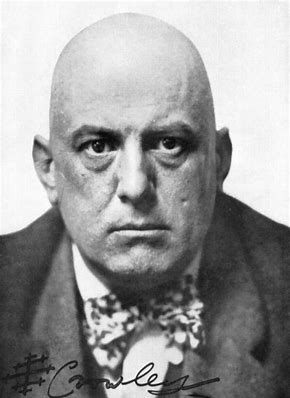
Aleister Crowley in the mid-1920s
With the rise of the internet, especially Tumblr and early YouTube, a new visual and ideological vocabulary took root. The devil stopped being a metaphor and started becoming a vibe. The COVID-19 pandemic, digital acceleration, and collapsing institutional religious faith in the majority of Western nations have only deepened the allure of the occult.
What was once fringe is now familiar. The Satanic is no longer underground—it is artisanal. For a brief survey of Luciferian chic in fashion and pop music, Greymantle recommends this linked article. It summarizes the eruption of this aesthetic in the 2020s as well as ever I could.
II. P-ORRIDGE, MANSON, AND SWINTON: A SELECT SINISTERIAN TROIKA
If Satanic imagery has only become chic in the 2020s, it is equally true that the Sinisterianism has been marching toward this moment for several decades. The red-lit sigils and Luciferian posturing have been two generations in the making. A brief review of the lives and careers of three artists – two popular and one fringe – that Greymantle views as critical to the development, incubation and popularization of Sinisterianism follow. These three lives, two of which are still far from over, illustrate the pull of the sinister in practice.
GENESIS P-ORRIDGE: MUSICAL PROPHET OF POST-HUMANISM
Genesis P-Orridge (original name: Neil Andrew Megson, 1950-2020), for those who have never heard of him (he identified as a ‘they’ later in life) was a highly controversial figure in avant-garde music, performance art, and occultism for half a century. P-Orridge’s work should be inextricably linked to “sinister” and “Satanic-adjacent” themes due to his repeated and quite explicit engagement with the occult in his boundary-pushing personal life and artistic practices.
As a co-founder of the performance art collective COUM (“cum” – get it?) Transmissions, an acronym for Cosmic Organicism of the Universal Molecular, P-Orridge was the architect of a deeply disturbing and extreme form of spiritual and artistic rebellion. During the years in which they were active (1969-76), COUM Transmissions staged performance art exhibitions and happenings that included multi-media presentations, music and ‘acts of transgression’.
To give the flavor of some of their more intense performances, the collective projected images of prostitutes, serial killers, Nazi Party functionaries and rusty knives on a backscreen behind the stage while members of the collective pleasured each other with sex toys to the tones of hard rock music. This is one of the wilder examples of COUM’s theatrical aesthetic, but is typical of the generally freewheeling and shocking style that COUM employed in their live shows.
One such show at London’s Institute for Contemporary Art in 1976 garnered so much negative press that the COUM collective ultimately thought it a better idea to disband than to continue. However, the members of COUM had also apparently reached a parting of ways for personal and artistic reasons unrelated to the bad press – they were ready to move on to bigger and better things, so to speak.
COUM, Chaos Magic and Psychic TV
Shortly after the dissolution of COUM Transmissions, P-Orridge founded the industrial music group Throbbing Gristle with two other COUM members, followed six years later by the rock band Psychic TV. Throbbing Gristle soon garnered a large underground following and became influential within the burgeoning techno music scene, becoming an important foundational influence for later industrial music artists such as Ministry and Nine Inch Nails.
During the late 1970s and 1980s, even as P-Orridge pioneered techno music, he continued hone his skills at media subversion and engage in avant-garde gender experimentation. Through Thee Temple ov Psychick Youth (TOPY), a kind of occult-focused successor group to COUM Transmissions dedicated to Chaos Magic, P-Orridge fused magical rituals with performance art, pornography, and what we might now call ‘influencer branding’.
Ostensibly a theatrically minded manifestation of the Chaos Magic subculture, Thee Temple ov Psychick Youth was, in actuality, more of an offshoot of Thelema, the magical and philosophical system created by Aleister Crowley in the early 20th century. TOPY described themselves as an esoteric order dedicated to ritual and sex magic. The group’s public statements and books – of which they published several – are replete with Thelemic references and tropes. They even copied Crowley’s spelling of magic as “magick”.
TOPY still exists in some form in the UK, the US and Australia, but Genesis P-Orridge parted ways with the occult order he co-founded in 1991. His former associates insisted on the removal of their co-founder and sometime leader for shortcomings related to ‘abuse of power’, ‘authoritarian tendencies’ and ‘attempting to establish a cult of personality’.
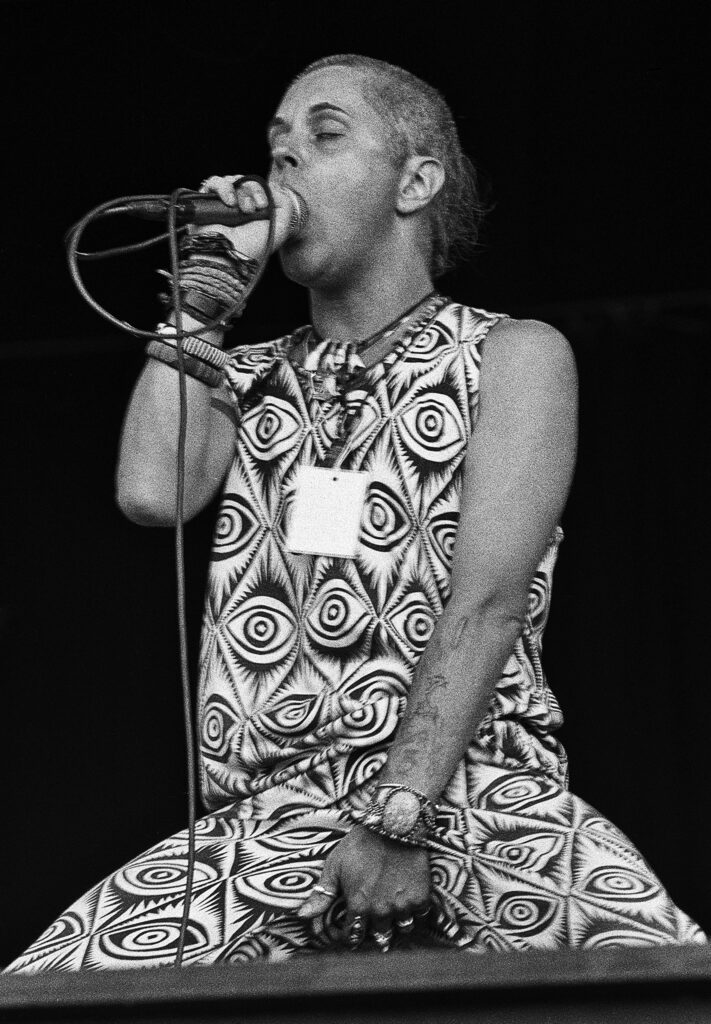
Genesis P-Orridge performing live with Psychic TV, late-1980s
During the same period in the 1980s as he founded TOPY and Psychic TV, P-Orridge became friendly with Anton LaVey of the Church of Satan when the two met during a lecture tour LaVey conducted in England. LaVey soon appeared on one of Psychic TV’s studio albums reciting the Lord’s Prayer backwards.
Over their nearly 30 years together as a working band, Psychic TV recorded the song “Always Is Always” by Charles Manson and composed two songs dedicated to Process Church of the Final Judgement co-leader, Robert De Grimston.
Pandrogyny, or Surgical Addiction?
Perhaps more radical than his musical and magical output were P-Orridge’s experiments with long-term bodily modification through surgery.
P-Orridge and his romantic partner in later years, Jacqueline Breyer (aka Lady Jaye Breyer), in 1995 launched the “Pandrogyny” project—an attempt to merge their bodies and identities into one through plastic surgery and psychic intention. The goal was to transcend individuality, biological sex, gender identity, and even death itself. In place of what we would now regard as gender identity politics, P-Orridge offered a kind of magical (and medical) dissolution of the self.
During the course of the pandrogyny project, P-Orridge and Breyer reportedly spent upwards of $200,000 on cosmetic surgery, hormone injections, breast implants, cheek and chin implants, eye plumping, nose jobs and tattooing. Beginning in the mid-1990s, P-Orridge also began to use gender neutral and ‘third gender’ pronounces to refer to himself, such as ‘h/she’ and ‘they’. P-Orridge was the first popular music artist to do so. He died of leukemia in 2020.
P-Orridge’s work prefigures much of today’s online occultism, gender experimentation, and affective extremism. His work and life also exhibited many of the darker traits of Sinisterianism: cultic manipulation, narcissism, and a ruthless disdain for boundaries. By the mid-2020s, techno music, occult chic, transgenderism and ‘pronoun use’ would permeate left-leaning spaces within Western societies. Genesis was, you might say, present at the creation of all the above.
MARILYN MANSON: GASLIGHTER IN THE CATHEDRAL
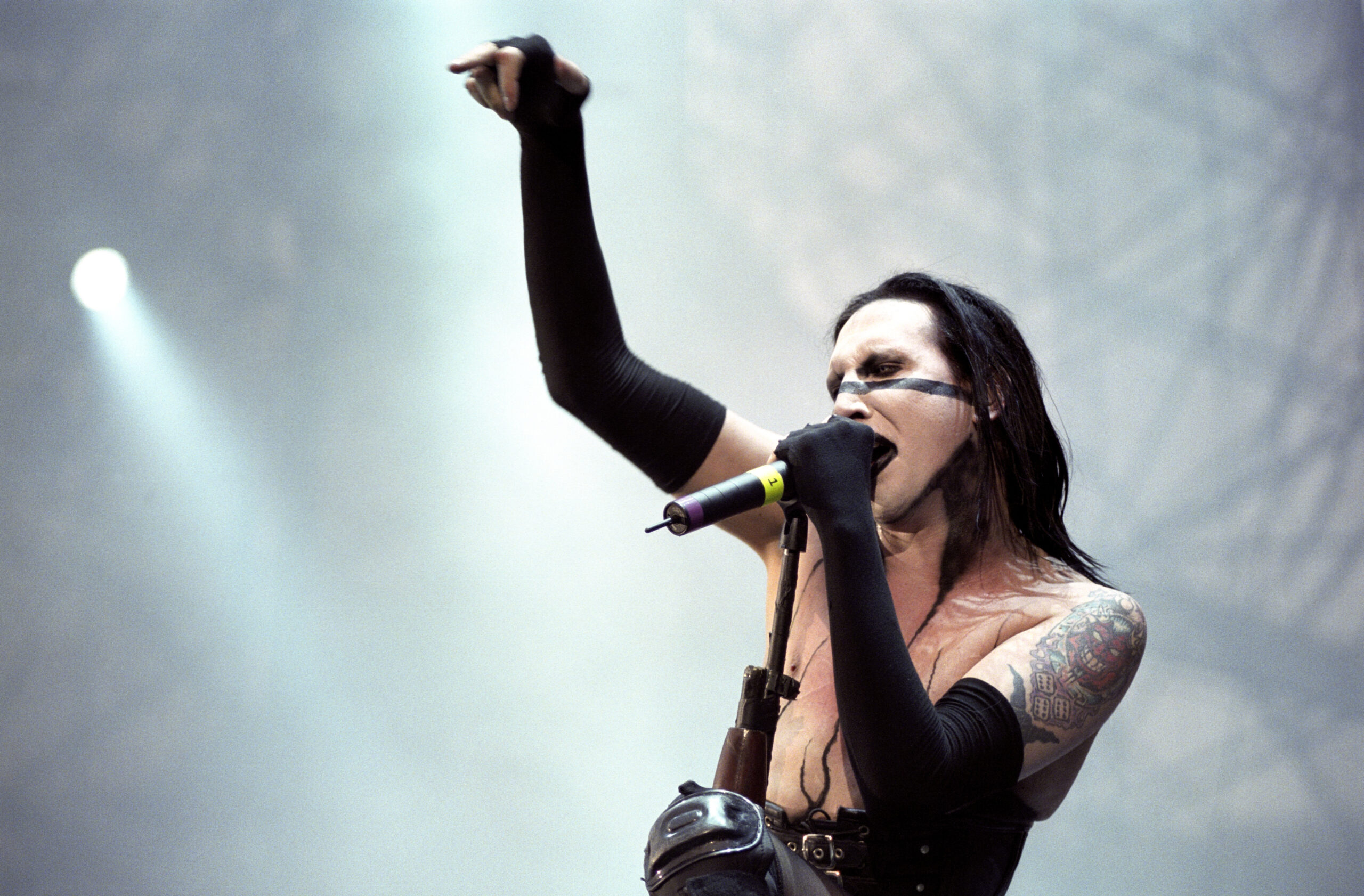
Marilyn Manson emerged in the 1990s as the embodiment of a new American boogeyman. Styled as the Antichrist Superstar, he wielded shock rock tactics drawn from Alice Cooper, KISS and Anton LaVey but filtered them through an ironic, postmodern MTV-era lens. With albums like Mechanical Animals, Golden Age of the Grotesque, and Eat Me, Drink Me, and his sold-out live shows, Manson represented a new plateau in taboo-pushing in 1990s America.
But what distinguished Manson was not just his theatricality, but his opportunism. Manson’s image and public rhetoric leaned leftist and progressive even as it was maximally transgressive. During the late 1990s and Geoge W. Bush-era 2000s, Manson sold himself as an icon of queer-aligned rebellion against small-minded and repressive religious conservatism.
Yet, over time, Manson’s personal conduct and private affinities revealed a disturbing authoritarian streak. Multiple ex-lovers (note: all female) have described Manson as psychologically abusive, sexually coercive, and obsessed with control. He used gender-bending aesthetics and the language of liberation publicly while reportedly behaving like a garden-variety domestic tyrant – and worse – privately.
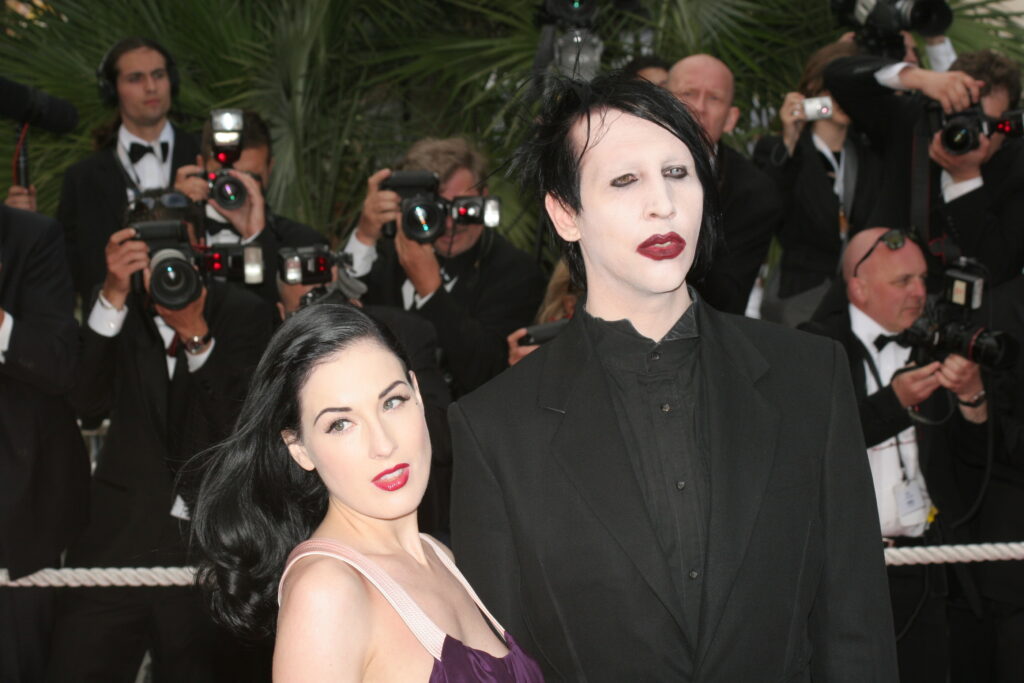
Anti Christ Superstar: Marilyn Manson walks the red carpet at Cannes, late 1990s
In his intimate life, Manson apparently surrounded himself with Nazi kitsch and invoked sadomasochistic domination not merely as theater, but as praxis. Far from being an unfairly reviled and misunderstood icon of rebellion against repressive social norms, Manson has come to exemplify the moral void at the heart of so much Sinisterian posturing.
It is essential to emphasize that Manson didn’t merely borrow LaVey and Crowley’s style—he has also lived out their creed of domination, manipulation, and theatrical nihilism to the fullest. Manson isn’t a misunderstood tragic hero. In fact, we now understand his true nature all too well.
It is ironic that a rock star who came to prominence with shock-jock antics and cross-dressing would get caught up in the #MeToo movement’s reaction to the sexual abuse of women by prominent men in the American music industry. Ironic, perhaps, but fitting that Manson is now publicly compared to R. Kelly and Harvey Weinstein.
If Satan does eventually rise from the Pit to rule the Earth, he probably won’t be doing so in drag. Thanks at least for that, Marilyn!
TILDA SWINTON: ANDROGYNOUS HIGH PRIESTESS OF CINEMATIC TRANSGRESSION
Tilda Swinton’s career is a case study in the aestheticization of otherness. From her early work with British art-film director Derek Jarman through her mainstream breakout in “Orlando” and her otherworldly turns in films like “Constantine,” “I Am Love”, “Only Lovers Left Alive,” “Dr. Strange”, “We’ve Got to Talk About Kevin”, “Snowpiercer”, and Luca Guadagnino’s 2018 remake of Dario Argento’s “Suspiria,” Swinton has projected a cold and enigmatic mystique.
It began to catch on with cinema goers around the turn of the century. Since the year 2000, Swinton has been both a bankably popular and artistically in-demand actress working with top-flight directors such as Wes Anderson, Cameron Crowe and Joel and Ethan Coen.
Swinton’s popular success notwithstanding, it is as a mainstay of fantasy, horror and occult-themed dramas that Swinton may be remembered. In Greymantle’s view, Swinton’s sexual androgyny, aloof and haughty detachment, and penchant for high-art horror have rendered her the 21st century’s cinematic high priestess of elite transgression.
In “I Am Love“—which Greymantle regards as the key film in the trajectory listed above—Swinton plays a woman so consumed by repressed desire and bourgeois constraint that she ultimately breaks with her past in an act of pure existential escape, entirely heedless of the monumental damage her rebellion inflicts on her family and loved ones.
“I Am Love” functions as the spiritual cousin and thematic precursor to the more overtly occult “Suspiria,” in which Swinton plays multiple characters, including literally two immortal witches and an octogenarian male psychotherapist. The themes of hidden power, feminine monstrosity, and mystical initiation tie both her performance in “Suspiria’ and her larger body of work to a long lineage of occult-inflected art. The gender-bending dimensions of Swinton’s performance as both male and female characters of varying ages and dispositions warps viewer perceptions and shatters expectations of the normal and the rational.

Tilda Swinton in her element – early 2020s
Swinton doesn’t overtly identify as a Satanist or as a devotee of any occult school, but she plays witches, fallen angels and immortal vampires impeccably. Swinton’s roles have repeatedly channeled occult imaginary with uncanny precision: the possession of secret knowledge, gender transgression, elegant cruelty, and the subversion of human, and humanist, norms.
We will explore the thematic content of Swinton’s films as well as what is known about Swinton from her public statements and positions in far greater detail in a later post. For now, our rationale for including her in this sampling of Sinisterian figures is that Swinton typifies the covert movement of the Sinisterian ethos and aesthetics into popular and high culture from the artistic fringes and marginal subcultures.
III. SINISTERIANISM TODAY: A FASHION FOR DAMNATION
The occult in 2025 is less a belief system than a luxury aesthetic. The pop-cultural Satan is a branding tool: edgy, aestheticized, monetizable. Artists like Lil Nas X (see his infamous “Montero” video, complete his lap dance for Lucifer), Billie Eilish (whose early videos trafficked in gothic nausea and demonic possession), and Doja Cat (who has embraced horned imagery and blood rituals onstage) have made Satanism chic.
The band Ghost parodies Catholicism with inverted reverence, staging Satanic masses as arena spectacles. Fashion houses incorporate inverted crosses and arcane symbolism into couture. The designer Rick Owens, among others, openly embraces paganism and esoteric inspiration. Even children’s shows and toy lines have taken on eerie, haunted aesthetics once reserved for the occult fringe.
This isn’t just a marketing gimmick, however. It reflects a cultural exhaustion with moral clarity and a desire to flirt with transgression without any pretense of accountability. In the absence of shared belief, Satan becomes the perfect anti-hero: stylish, solitary, and sarcastic. Sinisterianism feeds this impulse. It promises power without principle, transformation without constraint, and aesthetics without ethics. It is the spiritual grammar of a decadent era.
IV. CONCLUSION: THE POLITICS OF THE INFERNAL
What does it mean that Satan is now a lifestyle brand? That occultism has become a prestige aesthetic? That our most visible cultural figures—artists, fashionistas, pop stars—openly traffic in blasphemy as a sign of virtue?
Sinisterianism offers a seductive myth: that by embracing darkness, we become free. But it also reveals a deep cultural fatigue. It speaks to our suspicion of meaning, our allergy to constraint, our craving for spectacle over substance. And in its most dangerous incarnations—like the careers of Manson or P-Orridge—it provides cover for the same old types of human predation and self-harm dressed in holy (or unholy) robes.
If this new aesthetic order has a prophet in popular entertainment, it may well be Tilda Swinton, murmuring unknowable rites in a Milanese ruin in “I Am Love”. Or perhaps it’s Marilyn Manson, alone now in disgrace, his crimes not just exposed but legible. Or Genesis P-Orridge, half-remembered but echoed in every posthuman influencer fusing gender, identity, and ritual.
As we’ve suggested before in these pages, Sinisterianism is a movement hardly found not only in the entertainment industry and among the progressive left, but has powerful adherents on the political right, as well. Previously, we have argued that U.S. President Donald Trump shares certain uncanny similarities with Aleister Crowley and is as much a practitioner of Chaos Magic – albeit tailored to different audiences – as any 1970s British occult adept.
So prominent historian of the occult Gary Lachman would argue. And so we agree.
Sinisterianism is here to stay—for now. But whether it remains an aesthetic flirtation or curdles into something even more organized, institutionalized, and dangerous may depend on how seriously we take the devils we’ve invited in.
Until the next time, I remain –
Greymantle