INTRODUCTION: SHAME TAKES A HOLIDAY
As working stand-up comedians go, it’s hard to beat Gary Gulman.
In Gulman’s various comedy acts, specials, and his memoir “Misfit: Growing Up Awkward in the ‘80s,” he talks about how his childhood was ruled by deep feelings of shame over things small and large.
As a child, Gulman was made to feel awful by adults for relatively inconsequential things like not returning a library book on time. He also felt shame about deeper personal issues such as his extreme emotional sensitivity and pervasive feelings of depression he sometimes experienced — feelings which he suppressed and felt shame about due to the stigma then associated with mental illness.
The subtext of many of Gulman’s stand-up comedy performances is that he sustained a lot of emotional damage from the unrelenting pressure exercised by adult authority figures, including parents and teachers, who would constantly berate him about his apparent faults, resulting in intense feelings of shame. These recollections are only funny because Gulman has the ability to make light of his pain with twenty-twenty hindsight, and because he ended up surviving his difficult upbringing to become successful today.
In 2025, American society has become more willing to give individuals the benefit of the doubt when it comes to their personal foibles and failures, a stark contrast to the last century.
Alcoholism is now considered a disease rather than the result of character defects. Fat-shaming is off limits. Doing terribly at school might mean you are ‘learning disabled’ or ‘neurodiverse’, and not a dummy. And divorce is just one more choice to make in life, not a sign that you have done something wrong in the eyes of God.
Many popular writers of self-help books like Brene Brown and John Bradshaw now assert in their work that feelings of shame tend to grow rather than reaching a healthy resolution. Shame leads to more shame and ultimately to self-destructive behavior. Rather than embracing shame to help change maladaptive behaviors, these writers argue that shame is something we should avoid altogether.
We can all agree that, in many regards, societal changes in attitude toward shame have brought about some positive developments. Good does not automatically come from making your fellow human beings feel humiliated over behaviors that they may — or may not — be able to fully control. With that being said, there are some areas in life where feelings of shame can serve as a deterrent to risky behavior.
Gambling is one of those behaviors. In this week’s post, we focus on some downsides of the retreat of shame in America as these specifically relate to the risks of legalized gambling. Our post is titled, “Gambling Without Shame: How Legalized Gambling Captured America”.
GAMBLING WITHOUT SHAME – THE UTILITY OF SHAME
Let’s face it, there may be a beneficial evolutionary function associated with shame.
If the Neanderthal dude of forty thousand years ago felt ashamed that he was unable to light a fire by rubbing two sticks together when a snowstorm was approaching, perhaps it motivated him to try harder and eventually cause a spark and a flame — thereby allowing him and his tribe to avoid freezing to death.
Perhaps the hygiene of Neanderthal Man likewise improved partly out of feeling shame for behavior that the larger group deemed inappropriate or gross and this led to less disease and greater rates of survival.
Yes — I’m speaking of pooping in the community living area.
But back to post-modern times.
In 2025, a large proportion of the behaviors we engage in happen online, as we type onto our iPhones or laptops. We chat with friends, we shop and play games, without being literally “seen” by other members of society. It has therefore become much easier to get through our days without being judged by our peers or authority figures.
Living without the judgement of others can sometimes be a great thing. Why shouldn’t people feel more comfortable buying sensitive medications or sex toys or ‘guilty pleasure’ books without going to a brick- and-mortar store and getting funny looks from other customers. Living under conditions of greater personal anonymity can mean less stress, social anxiety and social friction, which can be beneficial.
But again, as mentioned above, there are some specific areas of life wherein we should be glad to have other people judging us – like when we are gambling.
THE RISE AND RISE, AND RISE AGAIN, OF LEGALIZED GAMBLING
Gambling has become more popular than ever in America. Part of this popularity stems from the fact that gambling – once restricted to Atlantic City, New Jersey and Las Vegas, Nevada — has largely been legalized throughout the United States. Forty-eight of our fifty states now permit legal gambling. Only Utah and Hawaii still forbid it.
But the legality and availability of casino and slot machine gaming aren’t the only reasons why the industry has exploded in America. Gambling has become a seventy billion dollar a year industry in the U.S. due in large part to the fact you can now gamble online on any personal device that you own. You are alone and anonymous. No social mockery is possible.
The developers who create casinos have also hit on a formula to make gambling appear to be something cool, a ‘fun and harmless’ activity rather than a dangerous vice or a way for a person to lose huge amounts of cash in a short amount of time (which, of course, it still is) – those are the ways in which gambling was viewed in America prior to the year 2000.
We’ll get to online gambling in a minute. Let’s look at brick-and-mortar casinos first.
AMERICA’S CASINOS: THE SADDEST PLACES IN THE CITY
For most of the history of Las Vegas, the insides of casinos were not glamorous places. Some private poker rooms – like the one at the Bellagio Hotel – were spaces full of energy but those rooms were usually populated by high and medium rollers, and mostly by men. Ninety-five percent of the inner space of a casino, where the public gambled, consisted of one sad, dingy area after another.
The non-stop ringing of slot machines was a torturous auditory experience for anyone passing through a casino, and the machines themselves looked like relics from bygone eras with the player’s goal to get “triple cherries” or “triple bars.”
Up until the early 2000s, little had changed in how these analog machines – the so-called “one armed bandits” – were made and designed for at least fifty years. Dim blinking lights and dated stock images of cowboys and sexy girls – mainstays of the slot machine since the 1920s – didn’t make Las Vegas or Atlantic City gambling seem very attractive.
Neither did the people who populated the casino floors.
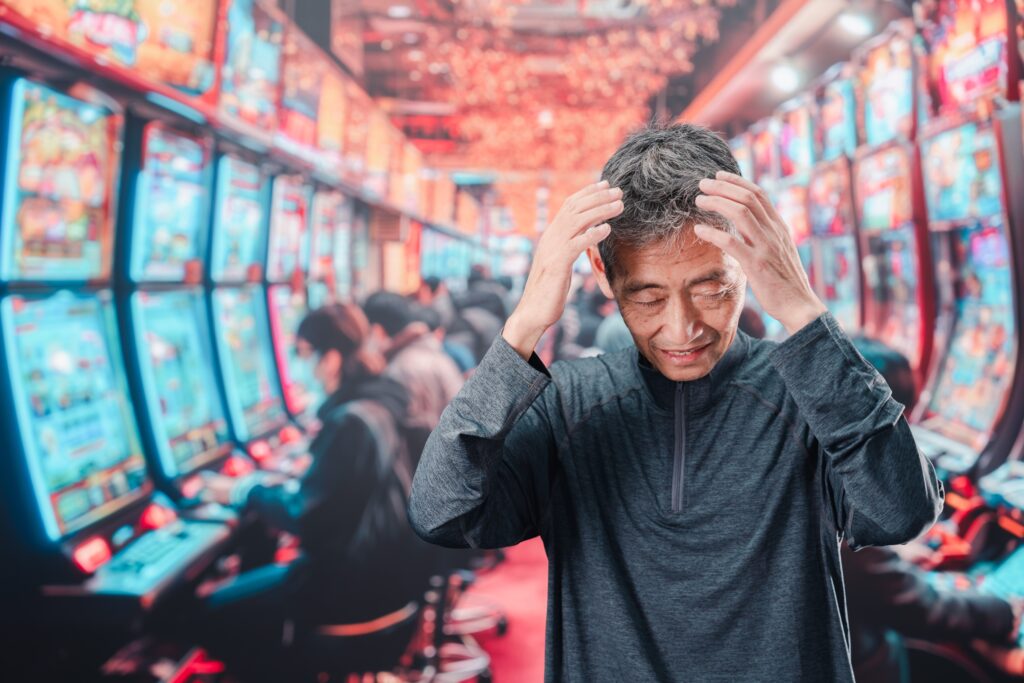
Above: Sensory overload. The well-documented sensory crushing bubble of the slot floor in a casino.
Gambling at casinos during the late 20th century seemed like an activity done — not by attractive, upwardly mobile young people out for a fun night on the town — but rather by graying, middle aged, often midwestern, frequently obese, barely mobile folks desperately hoping to change their station in life by hitting one jackpot against all odds.
These desperate people were trying to push out of their minds the fact that the money they were blowing on the slot machines and roulette tables could have been better spent buying groceries or medicine.
I’ve spent time in Vegas for work, and I’ve always had fun if the trip was two or three days long. But if it was a week-long trip, I’d inevitably become sad over the human wreckage that I could see happening in real time on the casino floor. I wanted desperately to shake some of those people back to reality, but I doubted that it wouldn’t do any good. They were in too deep.
Most importantly, the deep shame that I knew I would feel if I started to gamble, knowing that I was throwing away precious cash for no real reason, kept me from spending more than a few minutes at the slot machines. I was always aware that there was something slightly…abnormal about using my recreational time to drop coins into slot machines until I had no coins left. That awareness didn’t always stop me from engaging in brief bouts with the slot machines, but it usually did.
Up until the mid-1990s, it was possible to be aware of the treachery of gambling because it was essentially the only thing worth doing in Vegas.
Sure, finding other forms of entertainment was possible. The big hotels and casinos have featured stand-up comics, magicians and a select group of middle-brow entertainers since the 1940s. Our parents and grandparents could remember when ‘The Rat Pack’ ruled Vegas evenings in the early 1960s when Frank Sinatra, Dean Martin, Sammy Davis Jr. and company crooned to weekend gamblers from New York and LA.
Atlantic City and Las Vegas have always had their share of smarmy, show biz ‘razzle dazzle’, but it tended to serve as a colorful garnishment to the main dish: compulsive gaming. Perhaps if you visited Las Vegas in the 1970s you might catch Wayne Newton performing at The Desert Inn, but you weren’t there to see Wayne Newton – you were in Vegas to gamble.
In addition, most people who go to Vegas only to gamble are walking cautionary tales about the addictive dangers of gambling. When you were in Vegas or Atlantic City back in the day, seeing these desperate people made you keep your guard up and swear not to game too much, if at all. Gambling can be fun, but ultimately, it’s very dangerous. This unspoken message always circulated like a foul stench in the air at casinos.
FROM SLEAZE PITS TO HUBS OF FAMILY FUN
At some point, however, the developers and planners of Las Vegas casinos began figuring out how to get people to come to Vegas without seeing gambling as a danger to stay away from. The trick was to hide the gambling beneath layers of illusion.
By the late 1990s, Steve Wynn and his competitors realized it wasn’t great business to use the money coming in from gaming to merely add more slot machines. Since the turn of the century, the prevailing strategy of the casino owners has been to make casinos destinations for families and other groups who are looking to enjoy a good time away from home — beyond just gambling.
Famous chefs like Wolfgang Puck, Gordon Ramsey, and Joel Robuchon were brought in to open world class restaurants. The hotel buffets were spiffed up by adding gourmet selections. And the city was turned into the entertainment capital of America (rivaling Los Angeles by the late 2010s) with the creation of risqué, but slick live productions, Cirque du Soleil and extended pop music residencies by the likes of Adele, Katy Perry and U2.
In addition to newer and larger swimming pools, some casinos have added water parks to give the kids something fun to do while their parents are inside the casino…gambling away their college savings. Amusement rides and kids’ theatrical shows compliment the strategy of drawing entire families to Las Vegas. The unspoken message is that Vegas is now a ‘family friendly’ destination.
Perfect for the current, occasional gambler – and for future gamblers.
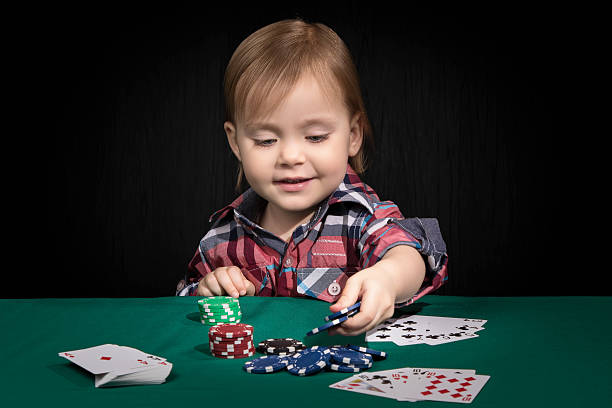
With the crowds looking younger, cooler, and less desperate, the amount of shame people could feel spending an hour or two at the poker table decreased. People now feel as if they aren’t doing anything destructive at all by blowing their money on craps.
The money spent on gambling is far from the only thing people spend money on in Vegas (or at any gambling ‘destination’ of which there are now several) these days: there is also a great meal, a great Cirque du Soleil show, tickets to see Adele…and a fabulous hotel room!
Somehow it feels less embarrassing for tourists to know that blowing their money at the roulette wheel wasn’t the only thing they did in Vegas for five days. In other words, gambling at Vegas became much more acceptable once it became a smaller part of ‘the overall Las Vegas experience’.
What happens in Vegas stays in Vegas – right?
It’s all a grand plan by casino developers and their marketing staffs to focus on Ultimate Fighting Championship (UFC) bouts and Barry Manilow concerts, drawing fans to casinos who will gamble away large amounts of money — but not as the main event.
It’s a bit like how the National Football League (NFL) franchises know they will sell a lot of beer at football games, even if the players are the main draw. You don’t have to produce commercials for NFL games urging sports fans to come to Gillette Stadium to drink beer, but the beer is certainly available and quite liberally imbibed.
THE STRATEGY BEHIND LEGALIZED GAMBLING’S EXPANSION
As gambling has become legalized nationwide and casinos have popped up everywhere, shifting the emphasis away from gaming as the main event to focus on ‘entertainment’ has continued to be the casino promoters’ main strategy. This strategy, in fact, has held the key to the gaming industry’s expansion across the United States since the 1980s.
Case in point: the gaming industry in New York State.
Recently, on June 27, 2025, applications were due in New York City for developers to submit proposals for building up to three new casinos in the Big Apple. These proposals will be assessed and by the end of the year there will be plans announced about which casinos will be erected in the city, and where.
It already appears – surprise, surprise – that the casinos are not going to be placed in areas where gambling will be the only thing to do.
One casino is likely to be placed near to Citi Field where the New York Mets play and where hotels and restaurants will open in an area of Queens currently populated by seedy auto body shops. This locale, eagerly promoted by billionaire and NY Mets owner Steve Cohen, will feature multiple other activities; casino gaming will be one of the major forms of entertainment on offer…but will not be emphasized in the marketing plan.
Coney Island, Brooklyn is another location where a casino might be built; the same strategy is at play. There’s the amusement park, the historic beachfront and boardwalk, the Nathan’s Hot Dog eating contest.
There’s enough to do to lure tourists so that gambling won’t feel like the seedy main event — it’ll only be a seedy side dish.
But brick and mortar casinos aren’t for everyone, even the ones with Michelin-starred restaurants, star-studded musical residencies and over-the-top magic shows (David Copperfield, anyone?).
As an anonymous alternative, online gambling has become a huge new pastime for people who also like to bet on sports. While brick and mortar casinos are still the largest income makers of the gambling industry, online sports betting made $7.4 billion dollars in 2025 and is rapidly expanding.
ONLINE GAMING, ANONYMITY AND THE ‘VIDEO GAME ECONOMY’
As mentioned above, when you are alone on your device, there’s really no need for self-consciousness or shame. You can register for a sports betting app, connect it to your bank account and start funding your bets.
And much like the way casinos have diversified beyond gambling, the sports betting apps aren’t just offering a way to bet. The online gaming platforms are also positioning themselves as a new way to watch and to follow sports events.
In the same way that Major League Baseball (MLB) and NFL apps give you real time stats and scores as games progress, DraftKings will also provide its users with real time scores, updated odds and a variety of ‘interesting’ betting options that users can take. Call it a natural extension of what has been dubbed ‘the video game economy’.
And if you weren’t ashamed to be placing big bets on games before the games started, just wait until you are wrapped up in the middle of a game and your adrenaline and dopamine is pumping. Users will begin to conflate the betting with the game itself, almost as if it were one seamlessly fun activity.
That’s entirely intentional, and a prominent example of the tech industry’s influence on gaming. As companies like Meta and X have learned what keeps users engaged, and as video game makers have figured out ways to keep players online for longer amounts of time, they have applied their insights into the creation of similar programming for online betting apps.

Above: Adrenaline Rush. The dopamine high of online gaming is considerable.
Gamblers’ attachments to their favorite or most admired players will likely affect their judgement about certain outcomes they can bet on. It’s a perfect storm of excitement. And guess what? Online gamblers don’t have to see the old lady with a large cup full of quarters at a slot machine with a cigarette dangling from her lips to serve as a cautionary tale to make them run for the hills.
All this excitement, in addition to the design of the apps which are built to keep you on the app and the impressive spokespeople who promote sports betting apps like Jamie Foxx, Derek Jeter, and LeBron James, keep your mind from telling you that this type of activity is damaging and dangerous and something you should feel ashamed of.
Unlike casinos, which hang signs around the gaming floor with phone numbers you can call if you think you have a gambling addiction, similar warnings are less visible or present on an iPhone-based gambling app. Yes, they are there, I’m sure, by force of law, but users don’t really see it like they do when they withdraw wads of bills from the casino ATM.
‘OPTIONAL’ SHAME – GAMBLING WITHOUT SHAME
The online sports betting companies appear to have completely won over their anonymous clientele and figured out a way to keep them from feeling shame. Part of the way they have done this is by making feelings of shame ‘optional’.
Many online gaming apps allow users to enable the software to essentially help them feel self-conscious and ashamed about what is happening — if they so choose. But the user first needs to act, consciously and independently, to make this happen.
For example, users can program into their gambling apps notifications that pop up every fifteen or thirty minutes telling the user to reflect on the havoc they are wreaking on their bank account. In essence, the apps provide the user with an option to have the app tell them: “be ashamed, be very ashamed.”
But it’s only an external prompt. Actual feelings of shame must be generated by the user himself for this control mechanism to work.
Users can also program “account limits” into their accounts which stop them from betting more than a certain amount of money. Ultimately, they can even use self-exclusion tactics allowed by some of these apps that give users the option to ban themselves permanently from the app.
But getting to that point will require the user to experience emotions of deep terror and shame at the financial destruction they are bringing upon themselves and their family. Not prompts from the application, but real emotions.
CONCLUSION: THE BURDEN AND THE NECESSITY OF SHAME
It is perhaps the wisest course of action for we human beings to go through our days remembering that we are all essentially flawed people.
Human beings are especially vulnerable to excessive risk-taking when they are on a winning streak, both in life and in the action of gambling. Many of us feel invincible at such moments.
But feeling good about oneself, and banishing feelings of shame, isn’t always the healthiest attitude for all situations.
As I have argued above, it is prudent to keep in mind that no matter how great things may feel, we are often moments away from varieties of catastrophe that can leave us mired in deep and unmitigated shame, should we not act to avoid such a catastrophe.
Shame can be harmful under many circumstances, but shame can also save your dignity and your life.
That’s a good thing.
Gideon Evans
July 23, 2025
**********************************
Gideon Evans is a screenwriter, playwright and film producer based in Brooklyn, New York.
Previous Greymantle articles written by Gideon Evans include: