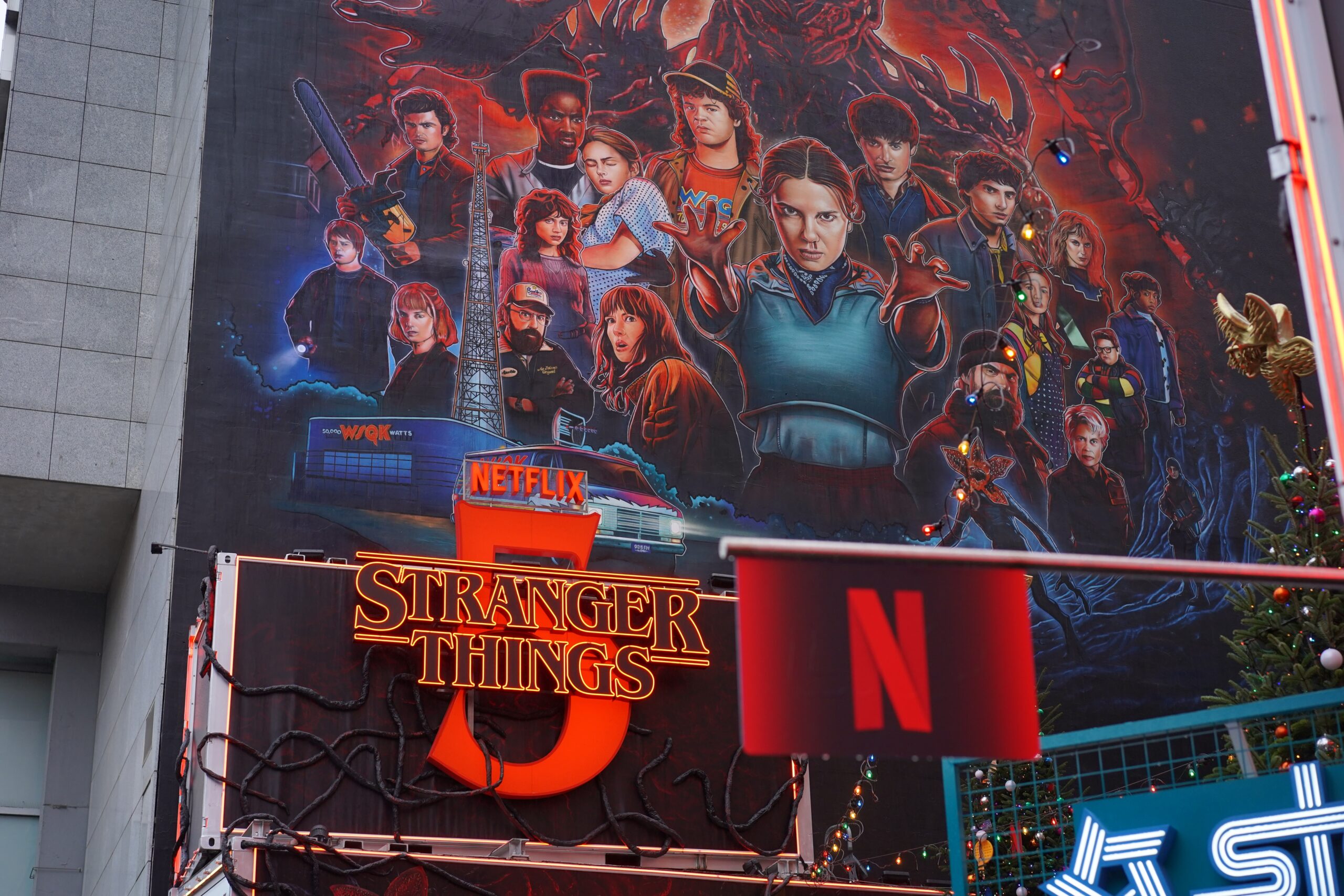
I. Introduction: Why This Show, Why It Worked, and Why It Arrived When We Needed It
For a commentator more often preoccupied with geopolitics and the darker corners of modern political life, Greymantle nevertheless counts himself among the many millions of people who spent part of the December 2025 holidays binge-watching the final episodes of Stranger Things.
Like most viewers, I had heard the advance hype about the finale, the emotional payoffs, and the sheer scale of what the Duffer Brothers were attempting. And I will confess, without embarrassment: I loved it.
There is something faintly strange—and genuinely wonderful—about the fact that in a decade as anxious, polarized, and often joyless as the 2020s, a large and culturally diverse audience could rally around a television series so unapologetically steeped in pop-culture excess. Stranger Things is like a giddy cinematic realization of the 1960s pop ditty the ‘Monster Mash‘ — a wild and thoroughly pleasurable ride through American genre films with a collection of monsters as fellow passengers.
Stranger Things is loud, sentimental, frightening, funny, indulgent, derivative, and proudly so. And yet it worked. Not sporadically, not ironically, but consistently—and often gloriously.
More than that, it became a shared cultural experience. People who agree on very little else managed to bond over it sincerely and enthusiastically, regardless of differences in politics, religion, age, or identity. That alone makes the series worth examining, as Greymantle has likewise examined the deep cultural relevance of horror movies in previous articles on this site last May and December.
At first glance, Stranger Things should not work nearly as well as it does. It is drenched in 1980s pop kitsch—arcades, BMX bikes, synths, Dungeons & Dragons, Cold War paranoia, and monsters that look as though they escaped from the back pages of a dog-eared Stephen King paperback. And yet its appeal spans generations.
In the Greymantle household, the show’s popularity among Gen Z viewers—many of whom were born decades after the era depicted—has itself become a minor source of debate.
If you didn’t grow up in the early 1980s playing D&D in basements while listening to Journey, New Order, or The Clash, why does this world feel so emotionally legible? Is Stranger Things a show for children, for adults reliving their childhoods, or for something even stranger in between?
We lack the market research to answer those questions definitively. But we can still ask a more interesting one: why did this show work so well, so broadly, and for so long?
The answer is definitely not originality. Stranger Things is not an innovative work in the conventional sense. It is a pastiche—and often a blatant and completely shameless one.
Its success lies elsewhere. It lies in generosity: generosity of feeling, generosity of memory, generosity of fear, and generosity of pleasure.
Stranger Things succeeded because it offered comfort without cynicism, nostalgia without denial, horror without cruelty, and community without irony. For much of the past decade, that turned out to be exactly what people were looking for.
II. Nostalgia Without Denial – Loving the 1980s Without Lying About Them
One of the most persistent misunderstandings about Stranger Things is that it presents the 1980s as a simpler or happier time. It does not. What it presents—lovingly and with care—is the pop culture of the 80s, not the decade itself. The distinction matters a lot.
The show is openly nostalgic about the era’s aesthetic and emotional texture: the music, the clothes, the analog technologies, the rhythms of childhood before smartphones and social media. But it is notably unsentimental about the underlying reality.
Hawkins, Indiana is not a pastoral idyll. It is an anxious and fractured community, beset by social and class divisions, scarred by grief, and shadowed by forces far beyond the control of its inhabitants.
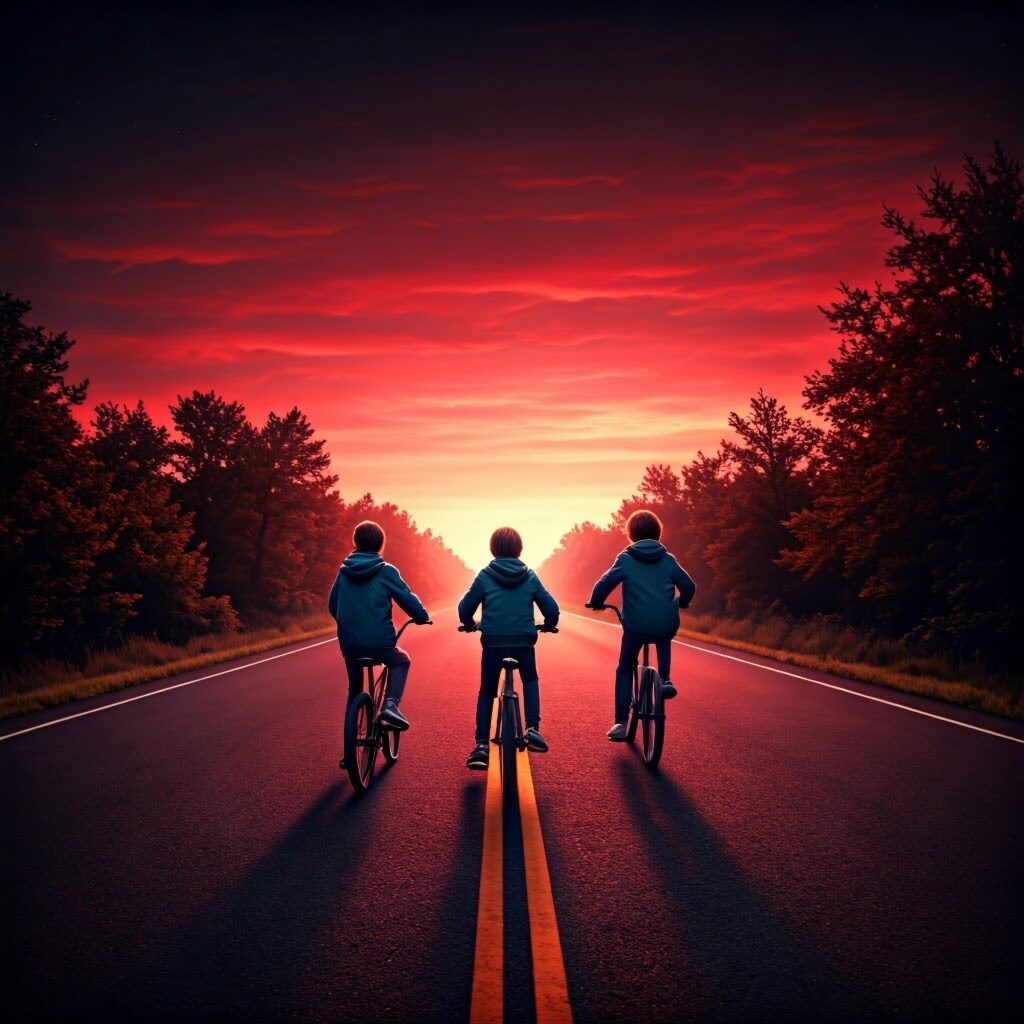
That tension—between surface vibrancy and underlying dread—mirrors the lived experience of the early 1980s. This was the final, dangerous phase of the Cold War, when nuclear annihilation was a persistent anxiety rather than an abstract historical memory. Espionage, paranoia, and mistrust of government institutions were not fringe concerns; they were mainstream.
Stranger Things absorbs this unease and translates it into fantasy. Soviet agents, secret laboratories, classified experiments, and interdimensional breaches stand in for very real fears about state power, technological hubris, and the suspicion that adults—especially powerful ones—were recklessly playing with forces they did not fully understand.
The series’ recurring references to MKUltra, psychic experimentation, and government secrecy draw from genuine historical material. The CIA’s real-world Cold War experiments with mind control, remote viewing, and behavioral manipulation were stranger than much fiction.
By weaving these elements into its narrative, Stranger Things grounds its supernatural horrors in a recognizably human one: institutional irresponsibility.
The show is equally clear-eyed about domestic life. The spike in U.S. divorce rates that began in the late 1960s shaped the childhoods of Gen X in ways that were still being processed in the 1980s. The Byers family, Max’s home life, and the emotional isolation of several characters reflect that reality without melodrama. These children are not growing up in intact, stable worlds. They are improvising.
Bullying, too, is depicted with uncomfortable accuracy. The cruelty faced by Mike and his friends, and the racial hostility directed at Lucas, reflect an era in which such behavior was more openly tolerated.
Stranger Things does not excuse it. It simply refuses to pretend it wasn’t there.
And then there is Vietnam.
Jim Hopper’s war experience—his exposure to Agent Orange during his military service in Vietnam and his suspicion that it contributed to his daughter’s death—is no decorative backstory. It roots the character in a generational tragedy that was still raw in the early 1980s and only beginning to be discussed openly.
In short, Stranger Things is nostalgic without being dishonest. It loves the pop culture of the 1980s precisely because that culture functioned as an escape valve—for its characters and, implicitly, for its viewers. Music, movies, roll playing and video games, and shared stories offered meaning and comfort in a world that often felt frightening and unstable.
By allowing pop culture to play that same role for contemporary audiences, Stranger Things quietly aligns past and present. The monsters may be fictional, but the anxieties are not.
III. Originality Was Never the Point – Why Pastiche Became a Strength Rather Than a Weakness
Compared to many of television’s most celebrated series, Stranger Things is not particularly original. It does not reinvent narrative form, nor introduce some new moral vocabulary. It makes no attempt to hide this.
In fact, the show’s lack of originality is one of its central virtues.
The fingerprints of earlier films and books are everywhere—sometimes subtle, often glaringly obvious. The Duffer Brothers have never denied this, nor should they.
Their intention was not to innovate in isolation, but to synthesize. Stranger Things is a deliberate act of cultural aggregation: a weaving together of dozens of familiar tropes, images, and story beats into a single, coherent artistic vision.

That is why accusations of derivativeness consistently miss the point. The Duffers were not trying to escape their influences. They were inviting the audience to recognize them.
The show functions much like a tribute album. Each track borrows heavily from earlier artists, but the pleasure lies in the arrangement, the sequencing, and the emotional continuity. Recognition becomes part of the viewing experience. You do not need to catch every reference to enjoy the overall effect—but catching them adds a layer of delight.
More importantly, this approach lowers the barrier to entry. Viewers do not need to master an unfamiliar mythology or decode an abstract narrative architecture. The grammar of Stranger Things is already embedded in the collective imagination. We know how this kind of story works. That familiarity creates comfort—and comfort creates trust.
The Duffers’ relationship to influence is refreshingly free of anxiety. There is no strained effort to disguise borrowing as innovation, no ironic distancing from the material. The show steals openly, gleefully, and with unabashed affection from its predecessors. It assumes that love of earlier films and books is not something to be apologized for, but something to be shared.
In a media environment saturated with self-conscious subversion and meta-commentary, Stranger Things offered something unexpectedly radical: sincerity. It trusted that audiences still enjoy being swept along by a story that knows exactly what it is and is unembarrassed by that knowledge.
That trust was amply rewarded.
IV. The Emotional Center – The Monsters Worked Because the People Did
The true genius of Stranger Things is not found in its monsters, its mythology, or even its lovingly recreated 1980s aesthetic. It is found in the relationships between its characters.
The Duffer Brothers created a group of characters who feel immediately recognizable, emotionally accessible, and—crucially—worth spending time with.
They then placed those characters inside a wildly overstuffed narrative blender of Cold War paranoia, interdimensional horror, bodily mutilation, and apocalyptic stakes. That combination should not work. And yet it does, because the emotional center holds.
Horror is not a genre typically associated with warmth. What Stranger Things does differently—and better than most television horror—is infuse its terror with affection. The series cares deeply about its characters, and that care is contagious.
The friendships among the core group of children are the show’s beating heart. Their loyalty, bickering, humor, and awkward tenderness feel lived-in rather than engineered. The dialogue captures the way adolescents actually speak: the rapid-fire exchanges, the improvised slang, the coded language that marks belonging. For older viewers, this registers as recognition; for younger viewers, as authenticity.
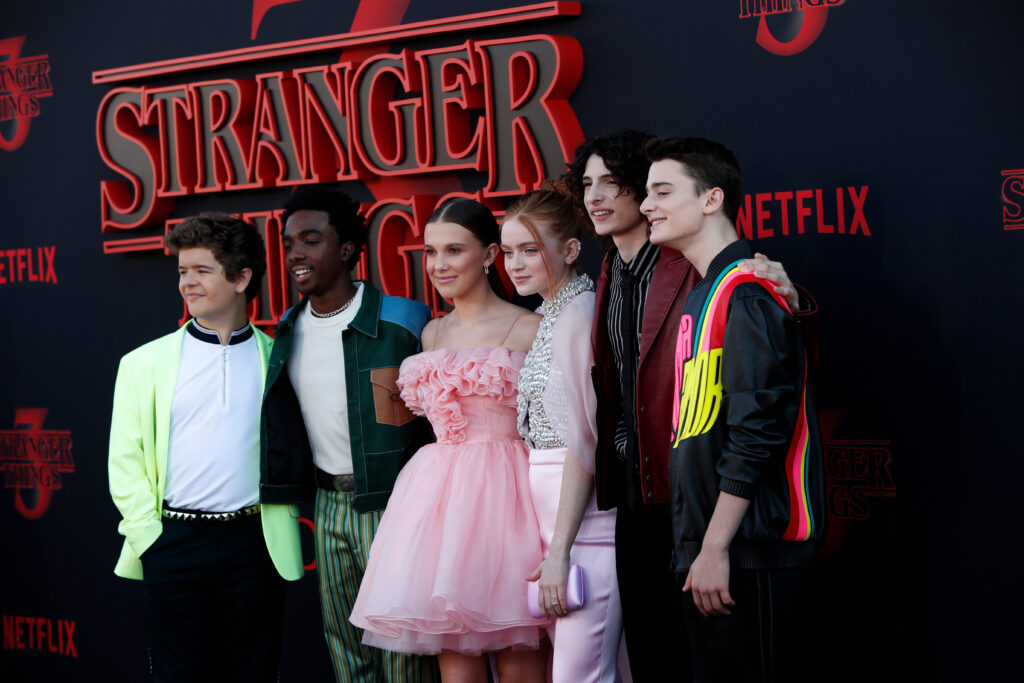
Equally important is the show’s portrayal of adults. The adults in Stranger Things are flawed, damaged, and often overwhelmed—but they are not cynical caricatures. Jim Hopper’s grief, Joyce Byers’ desperation, and the weary competence of secondary figures like Dr. Owens, Karen Wheeler, and Murray Bauman convey a sense that adulthood is hard, confusing, and lonely, but far from meaningless.
What makes this all the more impressive is that Stranger Things achieves emotional warmth without defanging its horror. The show contains genuine body horror and psychological terror. Children die. Bodies and minds are broken. Innocence is not preserved.
But the cruelty never feels gratuitous. Fear is balanced with humor, and despair is regularly punctured by sincere emotional connection and solidarity. This emotional generosity creates a powerful bond not just among the characters, but between the show and its audience.
Viewers are invited not merely to observe Hawkins, Indiana, but to belong to it. That sense of simulated belonging—rare in contemporary mass culture—is one of the show’s great achievements.
V. The Monster Mash — Borrowed Monsters, Shared Memory
Part of the pleasure of watching Stranger Things—especially for viewers with even a passing familiarity with late-20th-century genre film—is the recurring spark of recognition. The show does not merely borrow from earlier works; it invites the audience to notice that it is borrowing. Recognition becomes part of the fun.
At its deepest level, Stranger Things draws from the tradition of cosmic horror associated with H.P. Lovecraft. The Upside Down is not simply another dimension, but an intrusion of something alien, hostile, and fundamentally indifferent to human life. The Mind Flayer, in particular, embodies this idea: The Mind Flayer does not rage or gloat at humans; it merely consumes and controls them. Humanity is incidental.
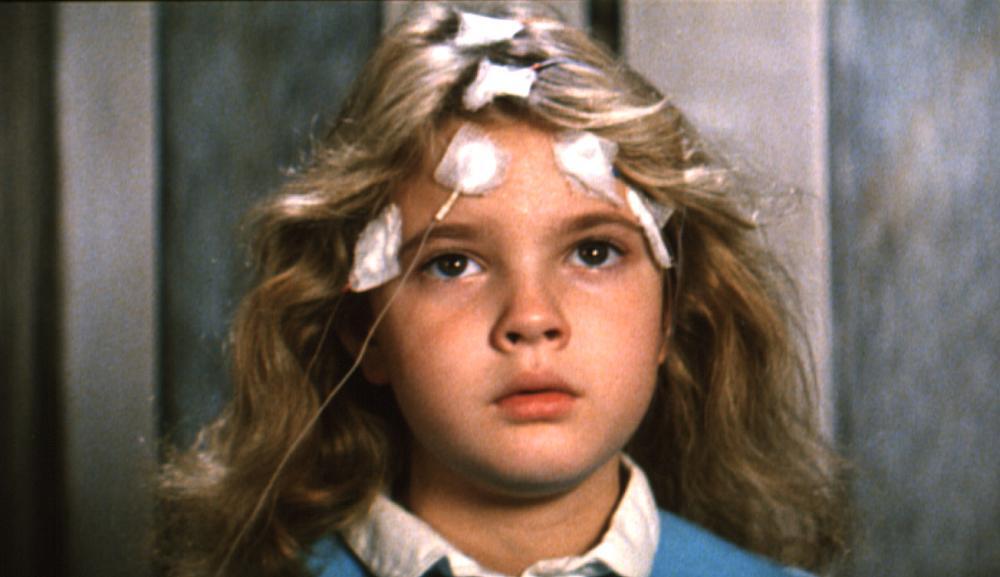
Running alongside this cosmic indifference is the unmistakable influence of Stephen King’s early novels—It, Firestarter, Carrie, The Shining, and ’Salem’s Lot.
Like King, the Duffers place extraordinary horror inside recognizably ordinary communities. Hawkins, Indiana is not a fantasy setting; it is a small town with all the familiarity and claustrophobia that implies. Eleven’s story, in particular, feels like a deliberate synthesis of Firestarter and Carrie: a gifted child brutalized by authority, whose extraordinary psychic powers are as much a curse as a weapon.
Steven Spielberg’s influence looms large, especially E.T.: The Extraterrestrial and Close Encounters of the Third Kind. The emphasis on childhood vulnerability, absent or overwhelmed parents, and awe tempered by fear is pure Spielberg. So is the conviction that spectacle should never eclipse character.
Richard Donner’s The Goonies supplies much of the show’s tonal DNA: the bickering camaraderie, the sense of kids navigating danger beyond adult supervision. The casting of Sean Astin as Bob Newby in Season 2 felt less like a cameo than a benediction.
The Duffers drew on the films of John Carpenter to contribute atmosphere and menace, while David Cronenberg’s movies supply the moist viscera. Carpenter’s The Thing informs the show’s obsession with bodily invasion and paranoia, while Cronenberg’s body horror visited in films like Scanners, Videodrome and The Fly echoes whenever human forms are bent, invaded, or repurposed by the Mind Flayer.
In the later seasons, Wes Craven’s A Nightmare on Elm Street becomes an increasingly obvious touchstone. Vecna’s design and psychological cruelty recall Freddy Krueger, while the shift toward mental and unconscious vulnerability marks a tonal evolution for the series.
Greymantle’s point here is not to catalogue every influence exhaustively, but to note how confidently the Duffers combine them. Stranger Things functions less as a single adaptation than as a curated memory palace of late-20th-century genre storytelling.
Crucially, the show never pretends this borrowing is accidental. The theft is intentional. It is the successful synthesis itself that is the achievement.
VI. Conclusion: Why We’ll Miss It—and Why It Mattered
There is very little that large numbers of people agree on anymore. Shared cultural reference points have become rare, fragmented by algorithms, politics, and taste silos. In that environment, Stranger Things feels like something of an anomaly: a television series that managed, for nearly a decade, to bring people together around a common source of pleasure.
It did so not by being original, but by being generous. Not by sneering at the past, but by engaging it with affection and intelligence. Not by denying fear, but by wrapping it in humor, friendship, and memory.
We will miss new seasons of Stranger Things. But the Duffer Brothers are probably wise to quit while they are ahead. The story has been told; the emotional arcs have landed. That the franchise will continue in some form is unsurprising, and perhaps even welcome. But the original series now stands as a complete artifact of its moment.
For much of the past decade, audiences needed something that was frightening but not nihilistic, nostalgic but not dishonest, and communal without being preachy. Stranger Things delivered all of that and more, season after season.
For that alone, it deserves to be remembered fondly—not just as a successful Netflix series, but as a rare cultural experience that reminded people how much fun it can be to be scared together.
Until the next time, we are —
Greymantle