

Some say the world will end in fire
Some say in ice
From what I’ve tasted of desire, I hold with those who favor fire
But if it had to perish twice
I say that for destruction ice is also great
And would suffice
- Robert Frost, ‘Fire and Ice’, circa 1920
It is a truth universally acknowledged in Westeros that romantic love is a dangerous thing — more likely to topple dynasties than to secure happily-ever-after endings. George R.R. Martin, unlike most contemporary authors, seems unusually committed to proving his point. And not once or twice, but many times over, and with a focus bordering on obsession.
Hence the title of this week’s post: The Anti-Romantic: George R.R. Martin’s Tragic Vision of Love.
In Martin’s A Song of Ice and Fire novels and their television adaptations, romantic love is not merely a complication to the ‘game of thrones’, but an emotionally obsessive state of mind that narrows – rather than enlarges – perception, destabilizes social and political order, and often leads to the demise of those involved. And yet, we find ourselves drawn to Martin’s portrayals, not because they offer comfort, but because they feel disturbingly real.
Destructive romances play a weightier role in Martin’s work than serving merely as clever plot devices. Fatal love recurs with such frequency, carries such terrible consequences, and is so often at the center of major plot twists and character revelations that readers come to suspect that romantic love as a harbinger of doom is central to Martin’s worldview – and perhaps not only as a literary artist.
Greymantle views Martin’s treatment of romantic and sexual attraction to be narratively compelling and emotionally seductive, but unpersuasive outside the specific social and political context Martin creates in his novels. Moreover, Martin’s perspective is contestable in terms of how human relationships have tended to evolve, both in antiquity and in the modern world.
Taking the Outlier View
Martin’s deeply pessimistic take on romantic love is unusual and noteworthy considering his immense popularity. Martin has often been referred to as ‘America’s Tolkien’ since the breakthrough success of ‘A Game of Thrones’ in 1996. His A Song of Ice and Fire (ASOIAF) series of novels, set principally in the fictitious neo-medieval continent of Westeros on an unnamed world, have been a huge success, selling over 50 million copies and having been translated into over 20 languages.
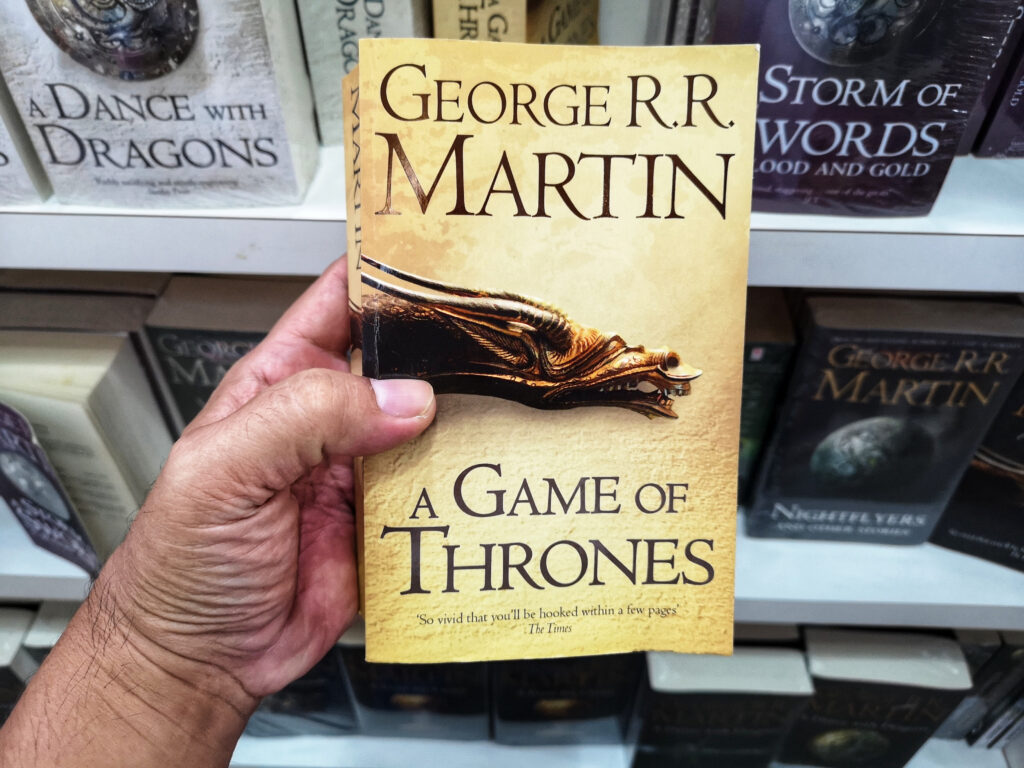
Martin’s negative view of eros sets him apart from most major writers in the fantasy genre.
Among his direct competitors, Diana Gabaldon and J.K. Rowling, authors of the successful Outlander and Harry Potter series of novels respectively, take a markedly more positive view of sexual attraction and romantic love. Gabaldon and Rowling portray these forces as positive drivers of character development and maturation that also help to cement relationships and nurture families.
Famed Lord of the Rings author, J.R.R. Tolkien, to whom Martin is frequently compared, went even farther by making the pursuit of romantic love a central moral virtue, along with duty and self-sacrifice. Tolkien gave romantic love a degree of redemptive power in his tale of Beren and Luthien from The Silmarillion, where the unlikely romance between a mortal man and an immortal elven princess (characters apparently modeled on Tolkien and his wife!) becomes the linchpin upon which the salvation of Middle Earth turns.
Rather than imitating Tolkien, Martin draws his inspiration from darker, or perhaps we can say ‘disillusioned’ fantasy and historical subgenres in contrast to Rowling and Gabaldon.
Romantic love typically doesn’t enter the classic adventure stories of Clark Ashton Smith or Robert E. Howard, both of whom Martin holds close to his heart. The dysfunctional relationships and cruel liaisons featured in the novels of Stephen R. Donaldson and Michael Moorcock are clear forerunners of Martin’s destructive romances. Maurice Druon’s The Accursed Kings series of novels – another noted favorite of Martin’s – inform his views on the impossibility of love coexisting with competing political interests.
Martin’s Influence Has Risen as Love’s Cache Has Waned
Martin’s identity as a fantasy author who came of age during the 1960s and 70s, as his homages to Donaldson, Druon and Moorcock in his ASOFAI novels make clear, continues to shape the inner concerns of his work. He isn’t stuck in the past, however. Rather, Martin’s perspective on love and sexuality has moved closer to the center of cultural discourse over time.
If we couple Martin’s rising literary influence with the social trends of the last 20 years – declining marriage rates, falling fertility, political polarization of the sexes, and a decline in religious belief across the Western world, the region where Martin’s work is most popular – he emerges as a dark prophet of romantic love’s declining social cache.
Did Martin anticipate these social changes, which reflect above all a change in societal attitudes toward the desirability of romantic attachment? Or has his work both influenced and accelerated these trends among Gens Y and Z? How philosophically contestable are his views?
Before we can attempt to answer these questions, some of which we’ll tackle in a future post, we’ll focus first on understanding Martin’s philosophical outlook toward romantic love, and how that outlook is expressed in the A Song of Ice and Fire novels and their Game of Thrones television adaption, for which Martin served as one of the lead writers.

A World Where Love Fails
Three snatches of dialogue spoken by characters in the Game of Thrones television adaptation – each at a critical plot point – frame this worldview.
The 102-year-old Maester Aemon of the Night’s Watch, on the eve of the romantically attached Samwell Tarly’s first major battle, warns Sam that: “Love is the death of duty.” Maester Aemon’s words return portentously in the final episode of series, spoken by Tyrion Lannister to an agonized Jon Snow in the lead-up to the scene that serves as the climax for the entire series.
The conniving Petyr “Littlefinger” Baelish, standing in the Eyrie, declaims to Sansa Stark with uncharacteristic sincerity: “In a world where people could love as they wished and not be ruled by duty, Catelyn would have been my wife, and you would have been my daughter.”
And Lord Varys, the world-weary eunuch spymaster to the Iron Throne, remarks to Prince Oberyn Martell: “When I look at what people do in the name of desire, I am not unhappy to have been made a eunuch.”
Three quotes, three voices, but one unifying message: erotic/romantic love, in Martin’s universe, is a source of chaos, confusion and pain, and best approached with extreme caution — if at all.
Martin’s perspective sets him apart from most other authors writing in the fantasy genre and make the adaptations of his work decided cinematic outliers.
The Foundational Tragedy: Rhaegar and Lyanna
At the center of Martin’s great anti-romantic fantasy is a love affair readers never actually witness except as a momentary flashback: the one between Prince Rhaegar Targaryen and Lyanna Stark. Their love, filtered through a dozen unreliable narrators, catalyzes a civil war, destroys a dynasty, and kills both lovers.
Martin’s genius here is subtle: he doesn’t need to show us the romantic fireworks. The narrative consequences for all involved are vivid enough.
After providing readers with subtle hints in the first five books of A Song of Ice and Fire, Martin eventually reveals that the public narrative built around the civil war that brought down the royal house – Rhaegar Targaryen’s abduction, rape, and murder of Lyanna Stark in a shocking breach of etiquette and marriage treaties – was a near-total fabrication.
In truth, Rhaegar and Lyanna fell madly in love and ran away together, inadvertently resulting in the execution of Lyanna’s father by the King of Westeros (i.e. Rhaegar’s father) on false charges of treason, sparking civil war. Once war began, Rhaegar was obliged to take up arms to defend his dynasty. The Targaryens and their allies were defeated, the royal family betrayed and massacred, and thousands of commoners died in a war that claimed the lives of Rhaegar and Lyanna, as well.
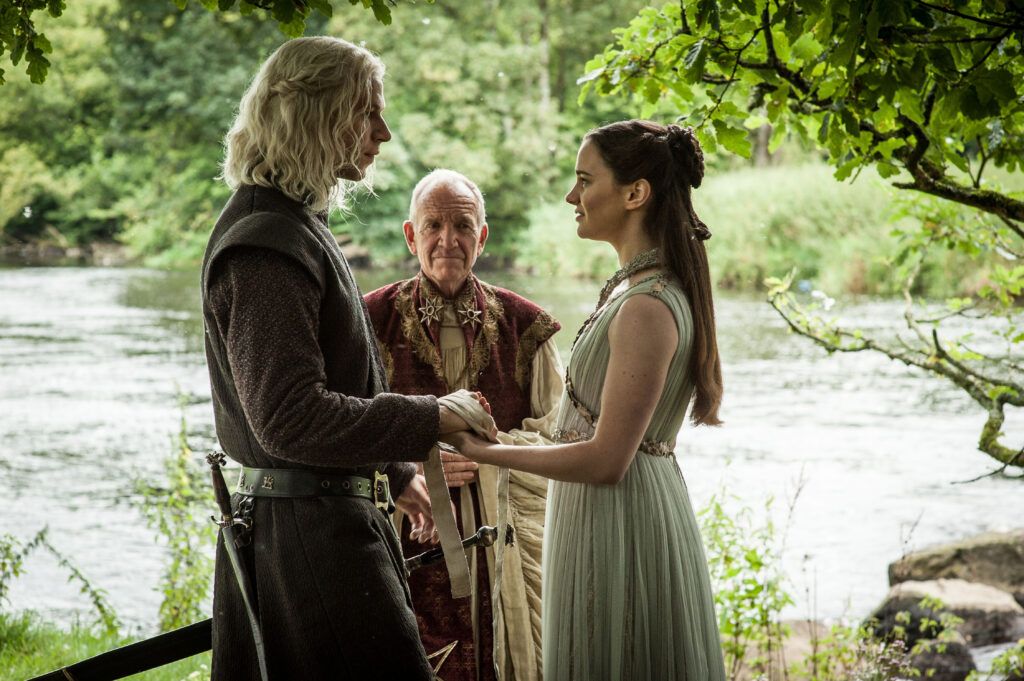
Compare Rhaegar and Lyanna’s doomed romance to the Arthurian tale of Uther Pendragon and the Lady Ygraine, where abduction, rape and coercion precede a great dynastic destiny. King Uther does, in fact, abduct and rape the Lady Ygraine but is punished for his crime — cut down by rebellious nobles and Ygraine’s outraged kinsmen.
The child born of Uther’s rape, however, redeems the brutal act of his creation with his entire existence. King Arthur rises above his station as a bastard child born of rape to become the bravest and most virtuous King of English myth: the builder of Camelot, founder of the Knights of the Round Table, and guarantor of a legendary era of justice, peace and prosperity.
Rhaegar and Lyanna, by contrast, act with intention, daring to live and love freely together — yet the result is unimaginably worse. Even when freely chosen, romantic love can be apocalyptic in Westeros.
Obsession and Possessiveness as the Norms of Eros
The tragic pattern of the foundational romance repeats itself across Martin’s entire epic through numerous romantic liaisons that are far less ideal than Rhaegar and Lyanna’s towering passion – situations often conceived with a gleeful perversity geared to shock the reader.
Petyr Baelish’s decades-long obsession with Catelyn Stark — and her sister Lysa’s obsession with him — illustrates Martin’s belief that adolescent passion can calcify into a pathological fixation, resulting in varied forms of personal and political havoc.
Petyr schemes to rule as king with Catelyn and their future children at his side. But first he must eliminate Catelyn’s current husband, Ned Stark, and her and Ned’s male children. Petyr betrays Ned in hopes of taking down both the Starks and the Lannisters. This act sets in motion a brutal war that claims thousands of lives, including Catelyn’s and his own – Petyr’s immense talent for scheming notwithstanding.
Jaime and Cersei Lannister’s incestuous liaison likewise depicts erotic love as identity-erasing obsession, skewed and asymmetrical, with consequences measured in repeated betrayals, wars, and the moral bankruptcy of their family line.

The brother-sister romance also functions as a clever way of dramatizing the extent to which the twins act out of submerged filial loyalty to their father, Tywin, who wants to place a Lannister on the throne at all costs. So, along with an obsessive sexual attraction and an unnaturally strong sibling bond, the twins’ warped love for their father supplies more leaven for their passion. For Jaime and Cersei, it’s twisted love all the way down.
And then there’s the Red Wedding. Robb Stark’s fateful marriage to Jayne Westerling (Talisa Maegyr in the TV adaption) serves as a cautionary tale that combines adolescent impulsiveness with political naïveté — the ultimate intersection of love and catastrophe.
Much like Rhaegar and Lyanna’s passion, Robb and Talisa’s romance is consensual, egalitarian and mutually respectful, but contains an element of moral corrosion because it leads Robb to break a solemn and politically vital oath to a crucial ally, Walder Frey. This results in Robb and Talisa’s murder and the massacre of the Stark army by Walder Frey’s henchmen.
A pattern emerges. Martin’s lovers almost uniformly behave in an obsessive, imprudent, and socially unwise manner. By contrast, the characters who survive and gain the reader’s admiration are bound not by passion but by duty, oaths of fealty, and obligations to something larger than themselves, e.g. the Night’s Watch, Brienne of Tarth, and the Brotherhood Without Banners.
Duty as Moral Substitute
What fills the vacuum left by romantic transcendence in Martin’s world is not nihilism, but duty. Time and again, when erotic attachment proves destabilizing or catastrophic, the narrative retreats to obligation — to oath, office, or command. Love may ignite the crisis, but duty is there to clean up the wreckage. Love is dangerously compelling; duty is stabilizing.
The character of Ned Stark is the clearest example. His marriage to Catelyn Tully is one of the few relationships in the series that resembles something stable and mutually respectful. Yet even here, emotional and sexual intimacy is subordinated to obligation.
Ned’s defining moral choice is not romantic but paternal and political: he conceals Jon Snow’s true parentage out of loyalty to his sister and out of fealty to a dead friend. His emotional life is tightly disciplined by responsibility. In Martin’s moral arithmetic, whatever nobility Ned possesses derives less from passion than from his immense self-control.
Jon Snow sharpens the pattern. His brief romance with the wildling Ygritte represents one of the saga’s rare moments of tenderness, but it is unsustainable precisely because it conflicts with Jon’s primary loyalties and oath of allegiance to the Night’s Watch.
“I am the sword in the darkness” is not poetry. It is renunciation. When forced to choose, Jon returns to duty, and Martin’s narrative implicitly ratifies that choice. Jon’s later entanglement with Daenerys only reinforces the point. Personal romantic attachment clouds judgment, and obligation restores it — even if that restoration can take the form of betrayal and murder.

This pattern suggests something unsettling. In the absence of redeeming love, duty becomes a moral substitute — not warm, not redemptive, but stabilizing. It is the thin ligament holding civilization together. If anything resembles virtue in Westeros, then it attaches not to desire but to discipline. Love destabilizes political order. Duty – however grim and thankless – preserves it.
Eros versus Agape: The Historical Context
Martin’s treatment of erotic love becomes clearer — and more interesting — when placed against a longer civilizational arc.
For much of Western antiquity, erotic attachment between the sexes was not presumed to be either ennobling or morally elevating. It was powerful, destabilizing, and socially dangerous. It had to be controlled by strict rules and solemn marriage rights and kinship obligations.
Greek tragedy offers no shortage of illustrations of what happens when those rules are broken.
In Hippolytus, Phaedra’s illicit desire destroys a household and ends in a suicide and false accusation. In Medea, wounded erotic pride culminates in a mother’s murder of her own children. Passion in these works is not redemptive in the least, but catastrophic.
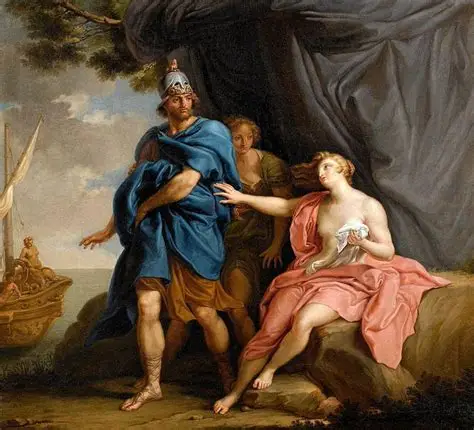
Roman literature is scarcely more sentimental. In the Aeneid, Dido’s love for Aeneas is tragic precisely because it conflicts with statecraft. Aeneas must abandon Dido to fulfill his national duty. The poem leaves little doubt about which principle deserves allegiance. Erotic attachment is real, intense, and human — but subordinate to civic and family obligations.
What altered this inheritance in the West was not medieval courtliness but Christianity, most specifically Christianity’s innovative fusion of eros with agape — an erotic attraction mingled with self-giving, sacrificial love and the object of sanctifying the beloved.
The Christian moral imagination reframed marriage as covenant rather than transaction. Desire was not abolished, but was morally leavened – and directed toward fidelity, permanence, and mutual sanctification. Over many centuries, this unique synthesis produced the Western ideal of romantic love — something always aspirational to some degree, and often violated — a romantic love that could be both personally fulfilling and socially stabilizing.
Martin’s fictional world conspicuously lacks – and it might be most accurate to say, rejects – this synthesis. In Westeros and Essos, there is eros in abundance: lust, obsession, jealousy, possessiveness, sexual bargaining. But there is almost no agape to transfigure it.
In Martin’s universe, erotic attachment rarely matures into durable, self-giving love. Instead, it remains acquisitive and combustible. Lovers cling, manipulate, betray, and destabilize regimes. Even when romantic affection is genuine, it is costly. And when love becomes politically relevant, it is rarely ennobling.
A Reversion to the Pre-Modern/Pre-Christian
The general absence of positive romantic love in Martin’s work is striking because modern Western audiences have been formed by a lingering post-Christian romantic ideal — even those who no longer consciously subscribe to its theological premises.
We expect love to humanize. We expect intimacy to soften power. We expect romance, at minimum, to offer consolation. Martin persistently denies those expectations. In that sense, Martin’s literary work aligns less with Tolkienian romanticism than with the broader aesthetic of contemporary prestige television.
Series such as The Sopranos and Breaking Bad similarly treat intimate relationships as sites of psychological manipulation, ego, and corrosion rather than transcendence. Erotic life becomes an arena of power struggle, not moral elevation. The bedroom is continuous with the battlefield and the boardroom.
There are few moments in A Song of Ice and Fire — or in Game of Thrones — where romantic attachment strengthens a political order or refines a character’s virtue. More often, it exposes weakness or accelerates collapse.The result, however, feels less like a rebellion against late-modern romanticism than a reversion to something older.
In that respect, Martin’s imaginative anthropology resembles the pre-Christian world more than mental make-up of viewers and readers the post-Christian West who consumes his work. Erotic love, severed from agape, returns to its ancient status — vivid, intoxicating, and dangerous.
Martin does not sermonize. But the pattern is consistent enough to suggest not an accident, but a considered philosophical outlook.
The Anti-Romantic: Biographical Speculations
It is tempting, of course, to wonder why Martin treats romantic love in this way. We might speculate, gently, about the influence of his upbringing.
Born in Hoboken and raised in Jersey City, New Jersey during the 1950s and ’60s, George R. R. Martin grew up in a port-city subculture marked by economic decline and social roughness. These were communities where sexual dynamics were transactional, violence both casual and frequent (think: Last Exit to Brooklyn), and fractured social ties were part of everyday life.

Erotic love as an ennobling force was rarely, if ever, modeled in these environments. Relations between the sexes were romantically unsentimental to the extreme. Add to this background the broader cultural context of the 1960s and 1970s – the Sexual Revolution’s peak with its unusual mix of liberatory idealism and naive permissiveness, and it is easy to see why Martin might distrust the melding of eros and agape.
This period of unique sexual upheaval produced fantasy authors ranging from Stephen R. Donaldson (The Chronicles of Thomas Covenant) and Piers Anthony (The Magic of Xanth) to the more infamous John Norman of the Slaves of Gor school. For these writers, love remained dangerous, desire cruel or destabilizing, and self-restraint rare, as were affectionate and stable relationships.
Given these influences, perhaps Martin simply never learned — or chose not to imagine — a form of romantic love that can educate and ennoble.
In a sense then, Westeros is a laboratory in which Martin allows unschooled eros to run free as in the port cities of his childhood. The results are predictably grim.
The Question of ‘Why Now’?
All of this is not to say Martin is completely wrong about the hazards of desire. His portrayals are psychologically persuasive, narratively compelling, and consistently applied.
Yet by universalizing the pathological and marginalizing love’s potential to nurture, teach, or ennoble, Martin presents a vision that can feel sharply, and often cruelly, limited. He understands desire, obsession, and eros — but he refuses, or is unable, to imagine the transformative possibilities of a love informed by agape.
It is tempting to treat this as mere genre realism — a grim corrective to fairy tales. But the deeper question is cultural. If modern Western societies have inherited the Christian synthesis of eros and agape, they have also, in recent decades, grown increasingly unsure of its durability. Marriage is delayed, relativized, or treated as provisional. Permanence is suspect. Self-fulfillment outranks covenant.
In such an atmosphere, Martin’s anthropology may feel less like a provocation and more like recognition. His perspective does not so much attack the romantic ideal as assume its fragility. Love, untethered from any transcendent obligation, reverts to appetite and power. The stability that recent centuries (i.e. since the 12th century AD) expected from marriage is missing.
If Martin’s vision resonates so widely, then, it may be because it reflects a civilization uncertain of whether romantic love still has the capacity to act as a civilizing force.
Greymantle’s Dissent
There is, however, a difficulty with Martin’s anthropology of love: it does not fully accord with observable reality.
Even in the contemporary West — after half a century of sexual revolution, liberalized divorce law, ubiquitous pornography, collapsing religious authority, and a culture that prizes self-expression over restraint — more than half of marriages endure. And many endure not merely as legal shells, but as recognizably affectionate partnerships.
One continually encounters couples who have weathered financial strain, illness, child-rearing, professional disappointment, and yet still exhibit a kind of settled tenderness toward one another. The romantic fever of youth cools, but it does not always curdle. Sometimes it even matures.
Outside the West, the evidence is even less congenial to Martin’s grim worldview. In societies where marriage remains structurally central (e.g. Central and South Asia) — whether religiously grounded or culturally reinforced — one finds countless examples of long-standing unions marked by loyalty, shared purpose, humor, and genuine warmth.
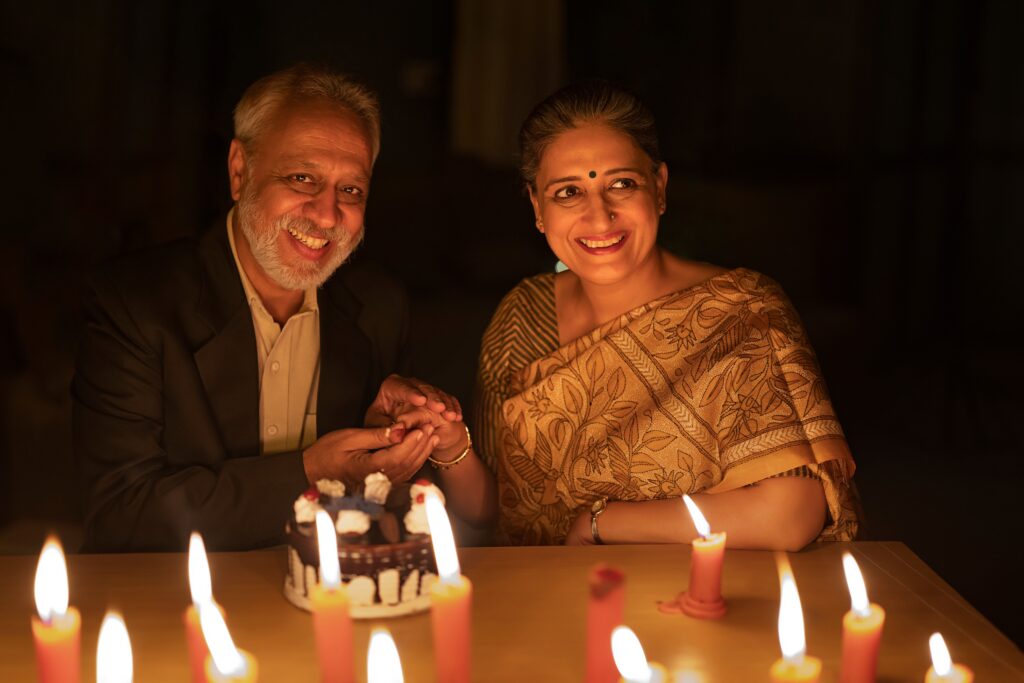
Not fairy tales. Not operatic passion. But durable affection. Eros, in these contexts, does not dissolve order. Rather, it is quietly absorbed into it.
This does not mean that romantic love is harmless, or that it never destabilizes. Of course it can. History and literature offer ample warnings.
But to treat eros as primarily corrosive, and to elevate and even fetishize duty as its necessary moral counterforce, is to universalize what may in fact be a more contingent experience. For many people, romantic attachment does not shatter the self but integrates it. It does not compete with obligation but rather deepens and enriches it.
Which raises a delicate possibility. Artists are acute observers of human failure, but they are also participants in it. It is not implausible that Martin’s relentless suspicion toward romantic transcendence reflects not merely civilizational commentary, but his own individual temperament and life history.
Some personalities experience romantic passion as especially destabilizing, even traumatic — an emotional state that overwhelms judgment and reason. If one’s formative experiences of love were chaotic, humiliating, or disappointing, the conclusion that eros is fundamentally unreliable may feel less like theory.
This is not an indictment of the author. It is merely an acknowledgment that worldviews emerge from lived experience. Find a critic of some social phenomenon and one sometimes detects the faint odor of personal bitterness — not always, but often enough to notice.
The point is not to psychoanalyze George R. R. Martin. It is simply to observe that his fictional universe treats romantic love with a severity that far exceeds what many ordinary marriages, quietly persisting across decades, would seem to justify.
Martin is correct that love untethered from other obligations can be volatile. But the counter-evidence suggests that love and obligation are not natural enemies. In many lives, they are close allies.
The fact that such alliances are less narratively sensational than betrayal or war may explain their relative absence in epic fantasy. But it does not prove their fragility or non-existence. If Martin’s work reminds us that passion can destroy kingdoms, contemporary life quietly reminds us that it can also build households — and keep them standing.
Happy Valentine’s Day.
Greymantle






One Response