On February 28, 2026, the United States and Israel launched what is now unmistakably a war against the Islamic Republic of Iran. The initial wave of airstrikes, cyber operations, and follow-on attacks were not symbolic gestures or calibrated signals meant to restore “deterrence.” They were systematic blows against Iran’s military infrastructure, missile forces, and the remaining skeleton of its nuclear program.
The war is now one week old.
And barring a truly extraordinary reversal of fortune, the Islamic Republic itself is about to fall.
Its missile launchers are being systematically destroyed, its nuclear research sites obliterated, its navy sunk, its repressive apparatus and leaders targeted and liquidated one by one. Its Supreme Leader, Ayatollah Ali Khamenei, has been assassinated. His son and successor, Mojtaba, may not survive this weekend.
Let us be precise about the prediction: there is roughly a 98 percent probability that the Iranian regime will collapse in the coming weeks. The timeline may stretch to a month or two, but the outcome is now very difficult to avoid.
Don’t say we didn’t warn you – the endgame for Iran is here.
Greymantle’s 15+ Months of Forecasts Pointed Here
Readers of Greymantle’s Politics and Culture should not find our Iran forecast particularly surprising. We have been warning that the Islamic Republic was approaching its terminal phase for well over a year.
In December 2024, in a post titled “Bibi’s Michael Corleone Moment,” we argued that Israeli Prime Minister Benjamin Netanyahu was entering the phase of his career in which Israel would begin settling long-delayed geopolitical scores with its enemies. That analysis focused primarily on Israel’s strategic patience after the Gaza war and its long-standing confrontation with Iran’s regional network of militias.

Several months later came the more explicit forecast: “Endgame: 5 Reasons Iran’s Regime Will Fall in 2025” published on February 28, 2025 – exactly one year before the present war’s commencement.
In that article we laid out the structural weaknesses that were steadily hollowing out the Islamic Republic—economic decay, environmental degradation, water scarcity, generational hostility toward clerical rule, elite fragmentation, strategic overreach abroad, and the slow erosion of the regime’s coercive apparatus.
Then, in June of last year, we wrote “Weeks, Not Months: Why the Iranian Regime May Not Survive the Summer.” In retrospect, that prediction was premature — but only slightly.
The regime now appears likely to fall within two to three weeks, meaning the forecast missed the precise timing by perhaps four months—not an unreasonable margin of error when dealing with the collapse of a forty-six-year-old revolutionary state.

If we wanted to make an even stronger case for Greymantle’s predictive accuracy regarding Iran – at least directionally, even if the precise timing was not always 100% accurate – we would point you back to our posts “The Darkest Hour Is Just Before the Dawn” (October 31, 2023) and “The Gaza War: An Elemental Contest of Wills” (November 30, 2023) that we published in the autumn of 2023.
It’s in those articles that we bucked the establishment view that Israel couldn’t win, or didn’t have the will to win, a prolonged military conflict against Hamas, Iran and Iran’s proxies. We have been saying that Israel and its principal ally, the U.S., could and would win for 28 months.
Iran’s January Bloodbath – The Point of No Return
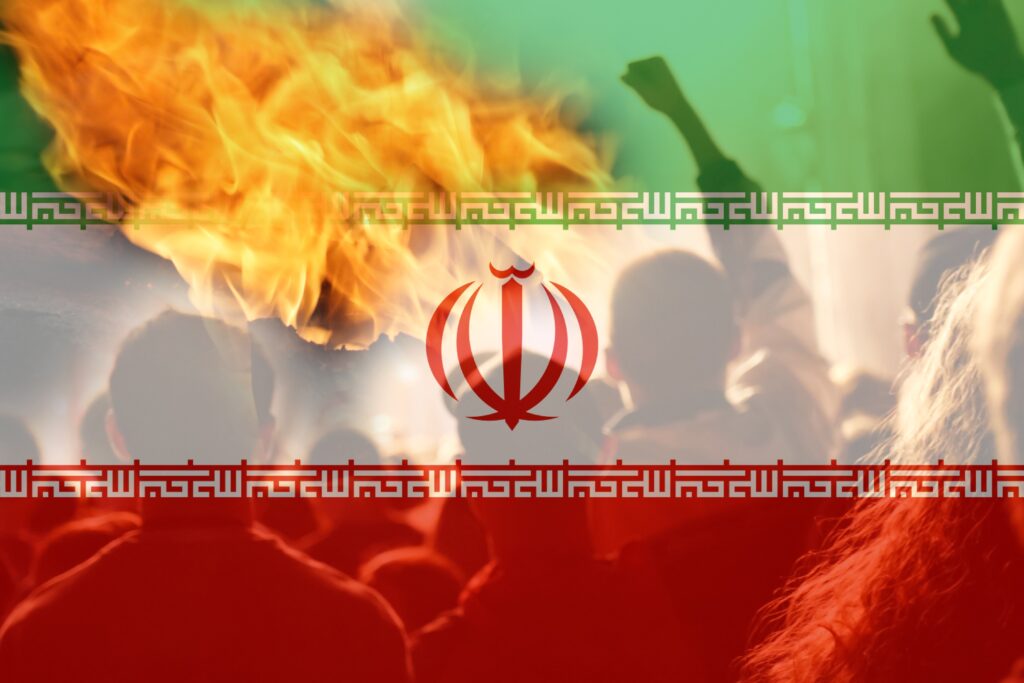
When historians pinpoint the moment when the Islamic Republic crossed the point of no return, they will likely settle on the massacres of January 2026.
Iranian security forces, backed in part by imported Iraqi Shiite militia units, opened fire on millions of demonstrators who had taken to the streets across the country. What followed was not a routine episode of authoritarian repression. It was a bloodbath.
Reliable numbers are difficult to obtain—unsurprisingly, the regime has not been eager to publish an accurate body count—but even the most conservative estimates place the number of dead at around 6,800. Other tallies compiled by human rights groups and opposition networks range much higher, from 15,000 to as many as 35,000 victims.
A plausible higher end estimate puts the death toll somewhere near 30,000 Iranians killed in 72 hours.
Authoritarian regimes often survive violence against protesters. But they survive it only when two conditions hold: the security forces remain loyal, and a portion of the population still believes the regime possesses some legitimate authority.
The January massacres shattered both assumptions.

When a government must rely on foreign militias to gun down its own citizens, it is already advertising its weakness. And when tens of thousands of civilians are killed in full view of the nation, the regime’s moral authority—such as it was—evaporates almost overnight.
The Islamic Republic survived many crises over the decades. But January 2026 appears to have broken something fundamental inside the system.
A State Already Running on Fumes
Even before the massacres, the Islamic Republic was showing clear signs of exhaustion.
Iran’s economy has stagnated for years under the combined weight of sanctions, corruption, and breathtaking levels of administrative incompetence. A young, urbanized, and increasingly secular population has grown deeply hostile to the clerical elite that governs the country.
At the same time, Tehran’s long-running strategy of projecting influence through regional militias has begun to unravel. What once looked like a formidable “axis of resistance” now resembles a collection of battered proxies, political liabilities, and expensive commitments that have revealed themselves to have been – all along – a colossal waste of money.
For two decades the regime sold its regional ambitions as proof of Iran’s rising power. Increasingly, they have come to look like evidence of imperial overstretch.
The regime entered 2026 economically weak, politically brittle, and socially hated by much of its own population. January’s massacres finished the job of destroying the last vestiges of its legitimacy.
Why the War Came Now
Against that backdrop, the decision by President Donald Trump and Prime Minister Netanyahu to launch strikes on February 28 was not as sudden as it might appear.
For years Israeli leaders have warned that Iran’s nuclear ambitions and regional networks represented a long-term existential threat. Washington, by contrast, has oscillated between diplomacy, sanctions, and occasional limited strikes. But there is a basic strategic rule that tends to govern these decisions: you strike when your adversary is weakest.
The Islamic Republic is now weaker than it has been at any point since its founding in 1979. Its own population is openly hostile. Its security services are under strain. Its regional position has deteriorated. And its leadership is visibly divided over how to respond to what is an existential crises.
Under those circumstances, external military pressure does not necessarily strengthen the regime through nationalist backlash. Instead, it can accelerate the internal collapse that was already underway.
That appears to have been the overarching strategic calculation in both Washington and Tel Aviv. And so far, the logic looks sound.

An Uncomfortable American Detail
There is, however, an awkward constitutional detail worth mentioning.
President Trump did not seek congressional authorization before launching the February 28 strikes. That pattern—presidents initiating military operations without explicit legislative approval—has become disturbingly common in American politics over the past several decades.
But launching a major war against a regional power without meaningful congressional deliberation pushes the trend further still. Even when presidents make strategically correct decisions, the erosion of institutional checks and balances should make Americans uneasy.
A healthy republic does not normally wage wars by executive fiat.
Still, that institutional concern is not the central story unfolding in Iran today. The central story is the collapse of a regime that has been weakening for years.
The Final Phase
History is full of regimes that appeared stable until suddenly they were not.
The Shah’s monarchy in 1979. The Soviet satellite states in Eastern Europe in 1989. Numerous governments during the Arab Spring that disintegrated far faster than outside observers expected.
The Islamic Republic increasingly looks like it is entering that category.

Its economic base is weak. Its legitimacy has evaporated. Its coercive institutions are under strain. And now its military infrastructure is being systematically degraded by two of the most capable armed forces in the world.
Regimes facing that combination of pressures rarely survive for long. Which brings us back to the prediction made at the beginning of this essay. There is roughly a 98 percent probability that the Islamic Republic will collapse in the coming weeks.
If that forecast proves correct—and we believe it will—readers of Greymantle’s Politics and Culture should remember that this outcome did not suddenly appear out of thin air.
Since the aftermath of the October 7 massacres in 2023, this blog has repeatedly argued that Israel would not simply absorb the attack and return to the uneasy strategic stalemate that had existed beforehand. The Israeli public, whatever its frustrations with Prime Minister Netanyahu, would rally behind the government in what it perceived—correctly—as a war of national survival.
We also argued something else that many commentators were reluctant to say aloud: that Netanyahu himself, having been profoundly humiliated by Hamas, Iran, and their patrons, would not rest until those responsible paid a devastating price.
History suggests that leaders who are personally humiliated by catastrophic attacks rarely respond with moderation. Instead, they respond with vengeance. From the moment of the October 7 atrocities—the worst massacre of Jews since the Holocaust—it was always unlikely that Israel would allow the architects of that attack to continue operating indefinitely.
The same logic applied in Washington.
When Iranian operatives were implicated in the assassination plot against Donald Trump during the summer of 2024, the odds that a future Trump administration would simply “move on” from that episode were extremely low. Presidents have long memories when it comes to attempted assassinations.
Put these threads together—Israel’s war of survival, Netanyahu’s determination to settle accounts, and Trump’s own grievances with the Iranian regime—and the strategic trajectory becomes fairly obvious.
Which is precisely what this blog has been arguing for more than two years. The Islamic Republic is now discovering something that regimes throughout history eventually learn: actions have consequences, and sometimes those consequences arrive all at once.
As the old saying goes, the chickens have finally come home to roost. And when the clerical regime in Tehran finally collapses in the coming weeks—as we believe it will—remember that this outcome was not unpredictable.
Don’t say we didn’t warn you.
Until the next time, we are –
Greymantle