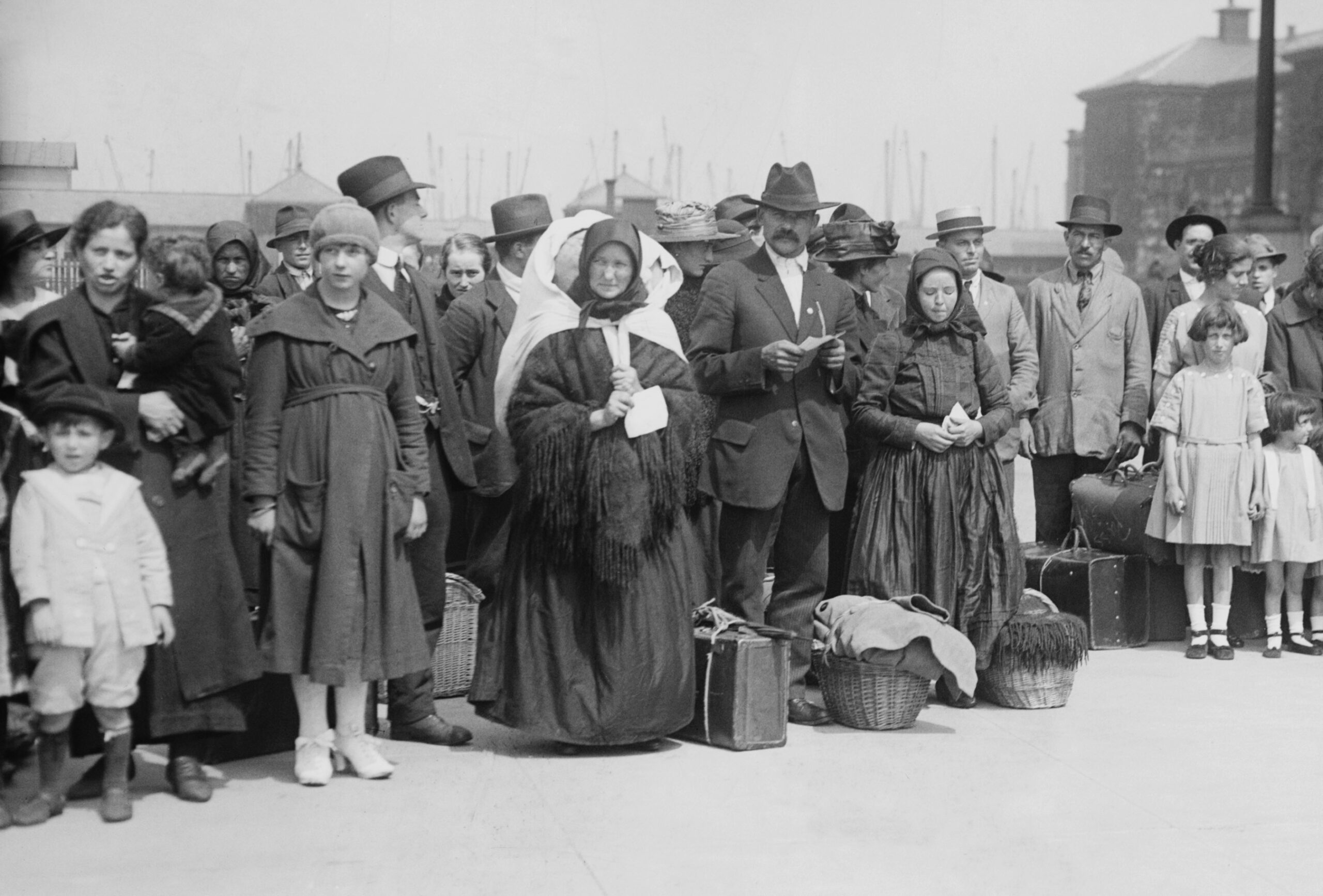
For a country that takes pride in being a “nation of immigrants,” the United States is surprisingly bad at passing good immigration legislation.
In the single instance when Congress created a set of quotas which actually worked, those quotas were unapologetically racist.
Additionally, the same quota system failed to provide U.S. immigration authorities with the requisite flexibility to allow into the U.S. a small number of potential migrants who had the most compelling reasons for admittance: namely, that their only alternative to entering the U.S. was either a long stay in a concentration camp, or death.
The 1924 National Origins Act, which tightened a set of quotas that had been introduced into the U.S. immigration system three years earlier, did one thing extremely well, however: it reduced overall immigration dramatically. In that narrow but important sense, the 1924 Immigration Act wasn’t all bad.
The 1924 Immigration Act Closed the Door for 40 Years
For over forty years, the National Origins Act, alternatively known as the Johnson-Reed Act or the Immigration Act of 1924, put in place country-specific quotas which led to a steady decline in the portion of the U.S. population that was foreign-born.
The percentage of foreign-born Americans dropped from 15% just before the Act’s passage to an all-time low of less than 5% in 1970, five years after the quotas were finally dropped.
Legal immigration into the U.S., as measured by the number of foreigners obtaining lawful permanent resident status, had averaged nearly a million people per year in the decade preceding the First World War, i.e. the decade before 1914.
After the 1924 Act was adopted, however, the number of permanent new residents was limited to less than 336,000 per year and was in practice generally much lower – often in the 100,000 to 200,000 range per annum – for the next forty years.
Fewer immigrants came to the United States between 1931 and 1971—7.3 million—than had arrived in America in the first decade of the twentieth century alone. This represented the most dramatic change to U.S. immigration levels since the nation’s founding.
100 Years Later, America Stands at A Similar Crossroads
Since 1970, the percentage of foreign-born residents in America has risen steadily, reaching an all-time high of 16% in January of 2025. At the start of the year, the foreign-born population in the U.S. totaled 53 million—also a record. The percentage number of foreign-born Americans in 2025 is eerily similar to its proportion exactly one hundred years earlier, perhaps an example of history speaking in rhymes.
One notable difference between the composition of immigrants in 1924 and 2024-25, however, is their legal status.
Approximately 14 million of current U.S. immigrants have entered the country without legal authorization. Of this 14 million, six million were initially shielded by temporary legal protections against deportation, while the remaining eight million were not. All 14 million appear to be theoretically subject to legal deportation under the Trump administration’s present immigration framework.
How the 1924 Act’s Quota System Worked
Only a white supremacist can look back with unalloyed fondness at the quota system put in place in 1924. The intention of these quotas was to keep America’s population majority white. And not just of majority white Europeans, but a specific kind of white European. Not just any Europeans — but the right kind of Europeans.
The National Origins Act was, for its own time, a kind of prototypical Make America Great Again legislation in that the Act aspired to roll back the U.S.’s ethnic profile to something its authors perceived as being closer to what it had been at the time of the nation’s founding in 1776.
The general idea of the Act was to impose country-by-country immigration quotas based upon the nations from which the ancestors of native-born Americans had originated so that the nation’s ethnic makeup would remain relatively static going forward.
The Act was able to achieve this effect by deriving its quotas not from the most recent U.S. census at the time of the Act’s passage — the 1920 census —but from the 1890 census, which reflected the ethnic composition of America before the enormous, three-decade wave of legal immigration from southern and eastern Europe that began in the early 1890s and lasted until the early 1920s.
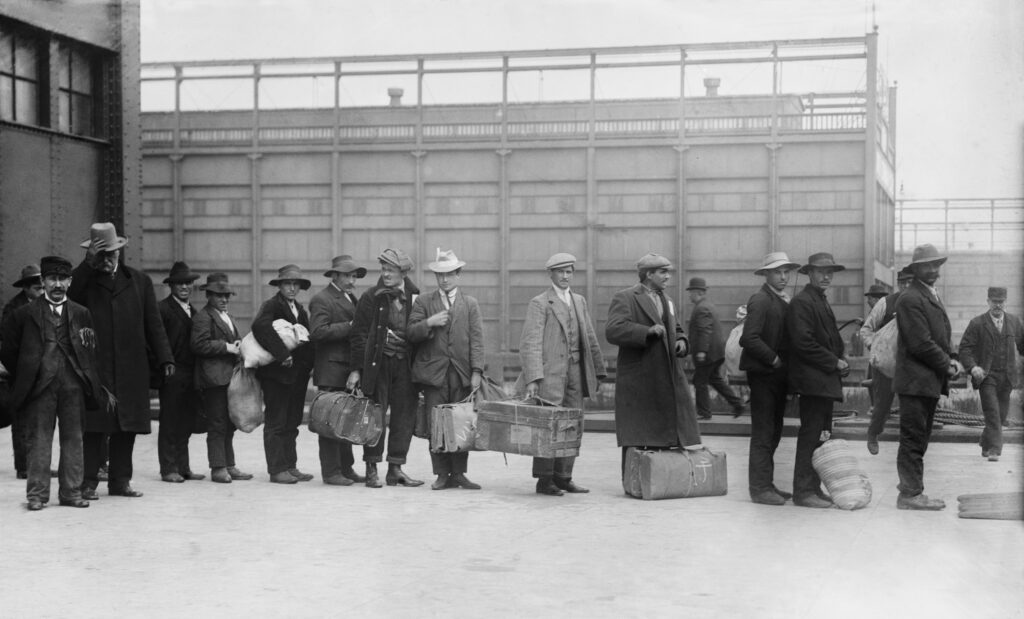
Countries located in the Western hemisphere had one set of restrictions, which were in fact highly restrictive, but less so than for nations in other parts of the globe. Asian countries and peoples were subject to an even more punitive set of immigration restrictions, as were people descended from “slave immigrants” (i.e. Black Americans), who were simply excluded from the 1890 census counts altogether for the purposes of the 1924 Immigration Act.
People whose ancestors originated from what some contemporary U.S. politicians might term “shithole countries,” in other words, were simply not invited to immigrate to the U.S. at all. The number of immigrants arriving from Africa, the Middle East and Latin America was parlous indeed between 1924 and 1965, amounting to only a few thousand a year at most.
As Washington Congressman Albert Johnson, the chief architect of the 1924 Immigration Act, declared when it was signed into law: “The day of unalloyed welcome to all peoples, the day of indiscriminate acceptance of all races (into the U.S.), has definitively ended.”
The Role of Eugenics in the 1924 Debates
For historical perspective, it is noteworthy that Congressman Johnson happened to be a member of an influential private organization called the Committee on Selective Immigration that was highly active in the early 20th century. The Committee had close links to a larger association known as the Eugenics Committee of the United States (ECUS), itself an affiliate of the Eugenics Record Office in Cold Spring Harbor, NY.
The report of the Committee on Selective Immigration published in January 1924, from which the 1924 Act passed later in the year took its ideas out of whole cloth, drew heavily upon the ideas of ECUS and made no attempt to hide its view that ethnic groups originating from outside of northwestern Europe were biologically inferior.
The report read, in part: “On the whole, immigrants from northwestern Europe furnish the best material for American citizenship and the future upbuilding of the American race. They have…higher average intelligence, are better educated, more skilled, and are, on the whole, better able to…appreciate and support our form of government.”
From our perspective in the early 21st century, the pseudoscientific racial ideas embedded in the report’s language are striking, but what is also notable is from where this type of early 20th century eugenic thinking originated: in many cases, from otherwise “progressive” and ‘’forward-thinking’’ American social reformers, most of them hailing from the Ivy League-educated upper classes.
The period from 1910 to 1939 was an era when Margaret Sanger’s journal Birth Control Review featured articles advocating for laws that would “prevent the outbreeding of superiors by inferiors” and Sanger herself would say that the eugenics and birth control movements “should be, and are, the right and left hand of one body.”
Several years earlier, in 1905, President Theodore Roosevelt had told the National Congress of Mothers that ‘(white) Americans needed to up their birthrates because they otherwise faced “race suicide” in a couple of generations.’
A Perceived Threat to America’s Social Cohesion
To put these sentiments into some perspective, America’s old social and political establishment had lived with the sense that it was under siege for a good thirty years prior to the passage of the Johnson-Reed Act in 1924.
During the last thirty years of the 19th century, close to 12 million people immigrated to the United States, surpassing the total number of persons who had immigrated to the American colonies and then to the United States (excluding the forced migration of enslaved Africans) prior to 1865.
In the early twentieth century, 13 million new immigrants would arrive in the fourteen years prior the First World War. By the start of the twentieth century, more than 400,000 Bostonians, out of a population of 560,000, had at least one foreign-born parent. The magnitude of these demographic changes, and the speed at which they were occurring, inspired a deep sense of unease, particularly among the city’s elite.
It is therefore not surprising that a group of young Harvard graduates founded the highly influential Immigration Restriction League back in 1894. The Immigration Restriction League was in some ways the Heritage Foundation of its day. Several of its members basically wrote the text of the 1924 National Origins (aka Immigration) Act.
In New York, the social situation and elite cultural anxieties were much the same. The patrician Madison Grant, head of the Bronx Zoo, was writing books with titles such as The Passing of the Great Race, which argued that ‘all the best people’ were of northern European heritage, including Christopher Columbus, a swarthy Italian with some Jewish ancestry who apparently didn’t know he was of northern European heritage!
Nordics, as Madison Grant called this “race,” should practice “racial hygiene” because mixed marriages would lead to the birth of “degenerate” children.
The misuse of the word ‘hygiene’ by excitable intellectuals never seems to go out of vogue. In the early 20th century, the word was abused in the term “racial hygiene” while today Americans are subject to endless advice about our “mental hygiene” and “sleep hygiene”.
Madison Grant was figuratively holding Congressman Johnson’s hand as he penned the 1924 legislation – Grant was the chairman of the Committee on Selective Immigration.
U.S. Immigration Restrictions Have a Long and Complex History
The tradition of coming up with reasons for keeping various groups of people deemed undesirable out of the United States – often for reasons that, in retrospect, seem quite embarrassing – goes way back. Before the founding of the nation, in fact.
None other than the great Benjamin Franklin was writing about the ‘grave threat’ German immigrants from Bremen and the Rhineland posed to Pennsylvania in the 1750s, a good twenty-five years before there even was a United States.

Chinese people were banned from becoming U.S. citizens for the sole reason…that they were Chinese for over 60 years, starting with the Chinese Exclusion Act of 1881 and ending with the Magnuson Act of 1943.
American laws that have explicitly excluded immigrants from various nations over the years have tended to reflect the nation’s fears, both rational and irrational.
John Adams, for instance, was scared of Europe’s extreme revolutionary ferment seeping its way into the U.S. in the late 1790s; the 1798 Aliens Act allowed Adams to deport any alien considered “dangerous to the peace and safety of the United States” or who was actively conducting “treasonable or secret machinations against the U.S. government”, such conduct being very broadly defined under the Act
The Aliens Act was allowed to lapse soon after Adams left office, however.
Restrictions on who may come into this country have at times barred convicts, lunatics, idiots (once again, a term very broadly defined) or any person “unable to take care of himself without becoming a public charge.” Those with “loathsome and dangerous contagious diseases” such as syphilis and tuberculosis have likewise been banned at various times.
The first American immigration law to target a specific political ideology was the Anarchist Exclusion Act of 1903. A “white slave traffic act” was passed in 1910. In 1915, a literacy test for prospective immigrants was created. Quotas based on nationality were first introduced in the Emergency Quota Act of 1921, which were subsequently tightened and backdated in 1924.
The 1924 Act Was, if Nothing Else, Effective
Whatever else we may say about them, the 1924 Immigration Act’s highly restrictive system of immigration quotas worked extremely well.
Over the next forty years, the United States became steadily less and less a nation of immigrants, or at least recent immigrants. The number of foreign born in the United States dropped from about 15 million when the act was passed to under 10 million when President Lyndon Johnson (no relation to Albert Johnson) abolished these quotas in 1965.
At that point Republicans, as usual, were complaining about the immigration system. Their main complaint in 1965 —not enough immigrants were being let into the United States!
Citing their contribution to economic growth, the Republican presidential platform of 1960 that Richard M. Nixon ran upon called for a doubling of the number of legal immigrants allowed to enter the country every year in the coming decade.
Back to the Future: The New Era of Immigration Restrictiveness
Since the 1924 quota system ended, U.S. immigration policy has been a tangle of good intentions, unintended consequences, and inconsistent enforcement. Only one person has managed to virtually shut immigration down, and that person is President Donald Trump.
President Trump can accurately say that in his second term he has already reduced the number of immigrants in the United States. By June 2025, the foreign-born population in the United States, according to Pew Research, had already dropped by more than a million, its first decline since the late 1960s.
It’s amazing what you can do when you take an existing atmosphere of unease regarding recent high immigration levels and turn it into an atmosphere of outright fear.
The Department of Homeland Security now boasts that it has been very successful at removing “illegal aliens” under Mr. Trump. An October press release claims its two enforcement arms, ICE and CPB, have removed over half a million people from the U.S. since January 2025.

The DHS recently declaimed as follows: “Rioters and sanctuary politicians have not deterred ICE and CPB in their mission to protect the homeland from those who have no right to be in America. Day-in and day-out, DHS law enforcement is removing the worst of the worst criminal illegal aliens from our communities, including rapists, pedophiles, drug dealers, and more.”
The DHS claims 70% of ICE arrests are of people charged with or convicted of a crime in the US.
The DHS has released no information to back these figures, however. The libertarian Cato Institute, no friend of either liberals or unfettered immigration, says that only 7% of those arrested by ICE since January have serious criminal convictions. Not having immigration papers, the crime presumably committed by most of these detainees, is usually a misdemeanor.
An Old Uneasiness Returns
Do Americans really believe that a majority of undocumented immigrants are rapists and murderers?
We doubt it, but this gullibility nevertheless speaks to an underlying unease with the profound demographic transformation that has occurred in America since the old restrictions were loosened. As in the early 1920s, nearly 60 years of high immigration levels from all over the world, including Asia, Latin America and the Middle East, had transformed America’s ethnic profile by the early 2020s — a source of consternation for many.
Immigration levels since 1965 have clearly made the U.S. somewhat less ‘white’ and more multicultural. This process has both enriched America economically and culturally, but has also, some feel, de-centered America’s core, Anglo-Saxon culture. Combined with a broad array of societal changes (e.g. feminism, technology-mediated individualism), some (e.g. Vice President Vance) fear that the nation’s social cohesion has been greatly diminished.

In the same way that the Boston Brahmins’ short-lived – but powerful – belief in so-called ‘Nordic superiority’ spoke to a similar unease with rapid demographic change, the present public nervousness associated with high immigration levels will very likely only be checked when immigration itself is checked.
If the hot-button issue of immigration can be taken out of the political discussion, then we as a nation might finally be able to move on to other things.
The Great Wedge Issue
How different groups of voters viewed undocumented immigrants was the great wedge issue of the 2024 election.
Pew Research found that, on the eve of the election, an overwhelming majority (92%) of Trump supporters believed that the substantial numbers of immigrants living in the country illegally had made crime significantly worse, a belief shared by more than one-third (37%) of Harris supporters.
In 2024, most Trump supporters said anxiety over immigration was a very important reason for their voting for Donald Trump over Kamala Harris. It is no surprise, then, that Mr. Trump personally deep-sixed the last, best attempt at immigration reform eight months prior to the election. It was simply too powerful an issue to be resolved and taken off the table.
If Trump wanted to be re-elected, and he most certainly did, then the immigration issue needed to stay live and raw.
A Juicy Campaign Issue Stifled Compromise in 2024
In the winter of 2024, the Biden administration and the U.S. Senate agreed on a bipartisan framework for reducing future levels of legal and illegal immigration into the United States.
The Border Act would have increased funding for border operations, increased the number of ICE and CBP agents, made it much more difficult for persons who did not come into the U.S. through established ports of entry to claim asylum, while also expanding legal pathways to citizenship for those illegal migrants already here.
Senate Republicans backed off the compromise bill, however, when Mr. Trump made it clear he did not want them to take away his best campaign issue.
Arguably, the aforementioned 2024 agreement in the Senate, had it been allowed to pass into law, was the closest America has even gotten to driving a stake through Mr. Trump’s political ambitions, with the possible the exception of when a majority of senators voted to convict him of impeachment for the second time in January 2021, but the vote fell ten votes short of the two thirds necessary for conviction and lifetime banishment from federal office.
Meaningful Reform Is Still Possible
If Mr. Trump were out of the picture, then a reasonable reform deal might still be possible. In September 2024, 80% of Harris supporters agreed that border security needed to be improved, while about half of Trump supporters said the U.S. should allow in more refugees escaping from war or other forms of organized violence.

Perhaps in the future this group would have first dibs in some overall “quota” on immigrants for a given year, with one big, overall quota based on need (to be with family, to escape persecution) rather than on national origin.
Tantalizing possibilities for immigration reform and restriction do exist, if elected leaders are willing to expand the scope of their political imaginations. It is surprising that the Trump Administration has not put forward a major bill in Congress to cut immigration in a manner analogous to the 1924 Immigration Act. His MAGA voters would likely approve of such a bill, but Mr. Trump seems more focused on business deals and foreign visits.
After the 1924 Immigration Act…A Golden Age of American Liberalism
Correlation doesn’t equal causality, but it’s hard not to notice that two of the greatest eras of progressive legislation in this country – the New Deal and the Great Society — came about during periods when foreign immigration to the U.S. was minimal.
During the years in which landmark New Deal legislation was being passed in the 1930s, the country experienced several years when it lost immigrants (i.e. years when net migration into the U.S. was, in fact, negative).
Additionally, it is interesting to observe that immigration was at a minimum when the Civil Rights and Voting Rights Acts were enacted in the middle of the 1960s at the height of Lyndon Johnson’s passage of his ‘Great Society’ legislation.
At the very least, we believe it is possible that real progress could be made on other pressing issues, such as climate change, re-industrialization, and an overhaul of the U.S. education system, if the immigration issue wasn’t sucking up all the political air.
If a prior period of anti-immigrant sentiment and immigration restrictions swiftly yielded to the ‘Golden Age of American Liberalism’, which we define as 35 years of nearly continuous progressive legislation allowing a right to unionize, creation of Social Security, leadership of the Free World during World War II and the Cold War, de-segregation, creation of the space program, groundbreaking environmental law, and the Great Society, then we see no reason why a new golden age of progressivism might not follow similar moves to lower immigration.
What was despicable about the 1924 act was not that it had tough and restrictive immigration quotas, but that it had nakedly race-based quotas. The bigoted nature of the 1924 Immigration Act aside, it did achieve what it set out to do – it sharply curtailed foreign immigration into the United States for two generations. For that reason, it should be taken as a very flawed, but powerful, model for future legislation to restrict immigration.
In a perfect world, immigration would, theoretically, be as much under central control as the money supply—more of it can help to stimulate the economy, but it also ‘scares the horses’, so to speak. Less immigration can be economically depressive, but it allows people, particularly native-born citizens, to consolidate gains in employment and social status in an environment marked by less competition from talented and motivated newcomers.
In a utopian world, national borders would be open and people could move freely. But that, of course, is simply not the world that we live in.
Political leaders must work with the tools they have available. There is often no recourse but to act pragmatically, keep one’s eyes focused on longer term goals, and hope for the best.
Robert Hill Cox
November 27, 2025
KEY SOURCES FOR THIS ARTICLE
[i] See timeline in Migration Policy Institute’s Major U.S. Immigration Laws, 1790 – Present.
[ii] Figures from “What the data says about immigrants to the U.S.,” Pew Research Center Report, August 21, 2025.
[iii] Figures based on DHS 2021 Yearbook of Immigration Statistics Table One.
[iv] Daniels, Roger Guarding the Golden Door: American Immigration Policy and Immigrants since 1882 p. 4.
[v] Also from “What the data says about immigrants to the U.S.,”
[vi] Quoted in “Same Old Song,” by David J. Tichener, The Nation, August 10, 2006.
[vii] New York Times, January 7, 1924, “1890 CENSUS URGED AS IMMIGRANT BASE; Eugenics Committee Report, Announced by Prof. Fisher, Would Limit South Europeans.”
[viii] See Okrent, Danil The Guarded Gate p. 118.
[ix] Okrent p. 245.
[x]Sohn, Amy, The Man Who Hated Women: Sex, Censorship, and Civil Liberties in the Golden Age, p. 250.
[xi] Daniels p. 30.
[xii] Okrent p. 48
[xiii] Okrent p. 361.
[xiv] January 7 New York Times article cited above
[xv] See Daniels p. 8
[xvi] For a good summary see Abbott, Edith, “Federal Immigration Policies, 1864-1924,”University Journal of Business, March 1924.
[xvii] See Daniels p. 129.
[xviii] See “What the data says about immigrants to the U.S.,” cited above.
[xix] See “DHS Removes More than Half a Million Illegal Aliens from US,” U.S. Department of Homeland Security press release, October 27, 2025.
[xx] See Cato Institute June 24, 2025 blog post, by David Bier, “ICE Is Arresting 1,100 Percent More Noncriminals on the Streets Than in 2017”.
[xxi] See “Trump and Harris Supporters Differ on Mass Deportations but Favor Border Security, High Skilled Immigration,” Pew Research Center Report, September 27, 2024.
[xxiii] Ibid.