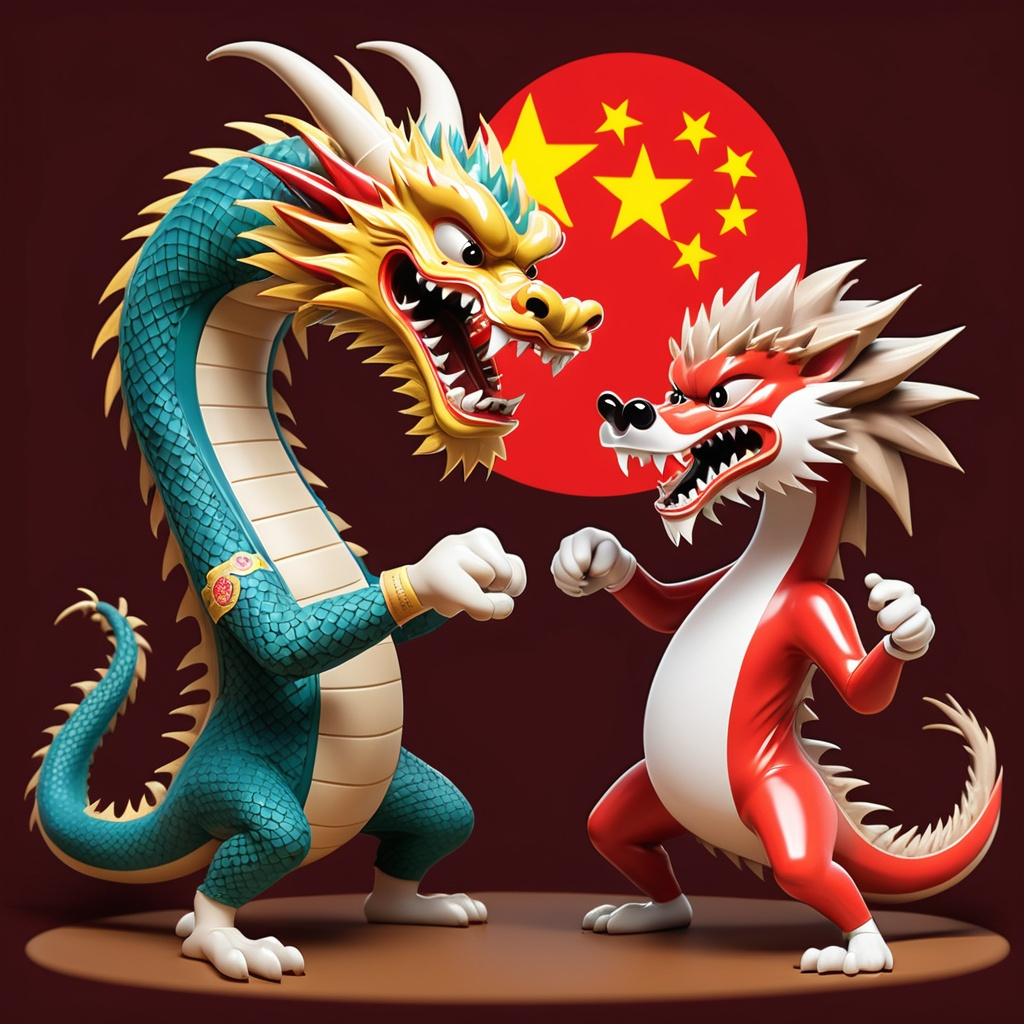
Greymantle’s editor-in-chief recently sat down with contributor Richard Jupa, author of Greymantle’s ongoing ‘China-Taiwan’ series, to talk about tensions in the Taiwan Straits and how China might approach taking back the island nation that its leaders regard as a renegade province. We are calling this discussion “The Dragon versus The Hedgehog” as it seems an apt way ro describe the China-Taiwan confrontation. A transcript of our interview follows below.
Ivor Greymantle: Richard, thank you for joining Greymantle today to talk about your recent articles for our site on the topic of China’s moves to neutralize, incorporate, or intimidate the Republic of China, AKA Taiwan. You’ve been working on a multipart series on this topic. You are also our expert on naval affairs and wrote a great post last November [2024] on the growth of the Chinese navy and whether they are ready for blue water.
Part 1
Part 2
Part 3
Part 4
In this context, we explore the pressing question: Can China Conquer Taiwan?
Your article was prescient because this summer, we’ve seen China’s carrier groups go out beyond the first island chain for the first time, moving into the western Pacific and showing off the growth of their fleet. This is all part and parcel of the broader Chinese naval strategy.
A key element of that is China’s long-held goal to subdue Taiwan, which it regards as a rebellious province. This brings us to the critical question: Can China Conquer Taiwan? They’ve built up their naval forces and, as you argue, the likelihood is that rather than doing a full-scale invasion, the navy of the People’s Republic will start with some kind of blockade.
This would be either a so-called ‘soft’ blockade or possibly even a ‘hard’ blockade of the island that would involve not just Chinese coast guard vessels, but military vessels and firing barrages of missiles at Taiwan without an actual invasion. That would involve trying to destroy Taiwan’s coastal and missile defenses. Can you explain to us the distinction between the hard and the soft blockade, and which option you think China might choose?
Richard Jupa: Sure, Ivor. Thank you for having me here. The distinction will be, and with the greatest likelihood, as the Chinese will have very little chance of justifying any blockade action or amphibious invasion of Taiwan to the rest of the world, unless they first start with a soft blockade, which would basically be conducted by their coast guard – their maritime militia – rather than the warships of the People’s Liberation Army-Navy.
This is how a blockade will start. There’ll be some legal fiction. The Chinese coast guard will start hindering traffic into Taiwan, which is extremely dependent on imports from the outside world. Taiwan’s domestic economy is, by contrast, based heavily on exports.
The goal of a soft blockade would be to start making the Taiwanese so uncomfortable that they would be forced to make political concessions to China. Also, China wants to shift the rather large minority (about 35%) of Taiwanese who want to appease China or strike some kind of deal with them into a majority of the population and shake Taiwan’s government into making political compromises that would allow much more Chinese control [of Taiwan].
I think that would be the ideal consequence – from the Chinese perspective – of a soft blockade. It would be basically stopping ships at the edge of Taiwanese-controlled waters by having lengthy maritime inspections, declaring certain things contraband that would be commonly found on most vessels going into Taiwan. And also generally blocking sea traffic and trade in vital things like fuel. The goal would be to watch the Taiwanese government either successfully maintain its resistance and its popularity, or watch it shake and compromise – basically give in.
Now, the rest of the world will be immensely affected by the soft blockade. And the United States would not necessarily regard it as an act of aggression. It would be less likely to mobilize our own population into a direct action against China, as our population is a bit ‘iffy’ on defending Taiwan anyway. This is all part of the geopolitical strategy debate.
Certainly, without overt violence on the part of China, the motivation for our government to act to defend Taiwan’s shipping interests and naval borders would be fairly moderate. After a certain amount of time, say, a week or even a month of this soft blockade, if things aren’t going the way China wants them to, which is to say the Taiwanese are not giving in and are holding tough, then China can escalate from a soft blockade to a hard blockade.
Let’s also say that the United States has not intervened in any major fashion after the first week or two of a soft blockade. Perhaps diplomatically, allies would not act without the United States leadership. So, China might make its threats to intimidate the Taiwanese. And if those threats are disregarded or assertively defied, then China would shift to a hard blockade, which involves a shift to more naval, missile, and air activity.
Ivor Greymantle: Okay, and let’s stop there for a second. So, the distinction between the soft and the hard blockade is that the soft blockade might just involve the Chinese coast guard. A soft blockade is more or less a quarantine of Taiwan, or of the Taiwanese ‘water space’, so to speak. And maybe airspace to some degree.
But the idea is that the Chinese coast guard would start pulling over Taiwanese and foreign vessels heading into Taiwan and doing these long, onerous inspections of the cargo and vetting of the crews. And not allowing certain ships to go into port and dock in Taiwan and enter the Taiwanese space. But it’s likely to gum up commercial traffic in and out of Taiwan. To put pressure on the Taiwanese government to accede to certain mainland demands.
And you’re saying that without having the United States or its specific allies get involved – if it’s just a quarantine by the Chinese coast guard- then it’s hard to view that as an overt act of war against Taiwan. The Chinese can benefit from that by exerting pressure on Taiwan and, in a less direct way, on other global actors by taking this quarantine measure.
And maybe this lasts for a week, or maybe it lasts for a month. But what you’re saying is that if it doesn’t go China’s way then China could conceivably shift to a hard blockade, which is where the Chinese naval forces and air force get involved and freeze all water traffic, all shipping traffic in and out of Taiwan, and even start taking some shots at Taiwan like striking some of their defenses with long range missiles and things like that. Is that right?
Richard Jupa: Exactly. They’d be cutting off all of Taiwan’s airspace, too. As well as many communications with the outside world. The Chinese would cutting those 14 major undersea cables, which they’ve been practicing doing over the last year or so. They would also specifically target – selectively target – storage areas of food or fuel or overt coastal defenses and things like this, without doing terrific damage — at first.
But China will be applying military pressure as well as a complete cutoff of Taiwan. And they would probably not want to apply this for too long. China will be looking for the point where the bolts start popping and the gears stop shifting.
In addition to this, of course, there’d be a great deal of cyber warfare interfering with the distribution systems and infrastructure of Taiwan and constant fake news flooding the airways, making it as uncomfortable as possible without as much overt damage to Taiwan’s infrastructure that would be involved in a kinetic over-the-beaches physical invasion.
And the hope would be that this kind of direct, physical military pressure makes it more dangerous for other nations to become involved. The United States would be taking it seriously at that point because actual violence is being committed. But whether the U.S. would go to full act of war to break this blockade with its navy, is another thing.
The U.S. would have to coordinate with its allies Japan and the Philippines, and Australia. The idea would be to still give a lot of purchase to what the Chinese could get away with without instigating an act of intervention on the part of the United States. Under the hard blockade scenario, China is still hoping that the Taiwanese population’s morale cracks and that the government accedes to their wishes without needing to shift to a full invasion.
The hard blockade might not last too long, because China won’t want its opponents to start to get enough momentum to come together to directly intervene. This move will be all about global power competition, but the risks to both sides of a strategic miscalculation are very great.
Ivor Greymantle: Okay, so let’s stop there. So, the idea of the shift to the hard blockade is that it’s a way of ratcheting up the pressure dramatically.
Richard Jupa: Yeah, and choking off all trade to Taiwan, doing cyber warfare, firing some missiles, you know, knocking out Taiwan’s radar defenses, and maybe some coastal defenses where the Taiwanese have guns mounted. The Chinese navy or air force would likely take those out. So, it’s now it’s more of an actual act of war, but it’s still short of a kinetic invasion of Chinese troops onto Taiwan. But it’s, like, ramping up to everything but that.
And here the calculation is the Chinese would be looking to see if the U.S. and its specific allies are going to get involved now and do a reverse blockade of China or get like a UN Security Council resolution against them and get a whole bunch of countries lining up against China diplomatically, and then potentially even sending like three U.S. carrier groups out into the South China Sea within a couple of days sailing of Taiwan.
The Chinese are going to be watching what the US is going to do in response at this point. It’s a big gamble now, right? They have a two-way path. One is to fend off the U.S. Navy long enough for Taiwan to crack and capitulate to China’s demands. Remember, all the world’s trade is going to be seriously affected by this.
This hard blockade would affect GDPs all over the world. But the idea would be to pull this off as quickly as possible, to bend the morale of the Taiwanese people against resistance and their government, into cooperation while fending off any real foreign intervention.
A week or so of the hard blockade might go by while Beijing judges how many of its goals it’s been able to achieve. At this point, though, because they were able to shift quickly, they’ve done enough preparatory damage that if they wanted to go for a full amphibious invasion, they might find it a lot easier.
That would have to be done quickly, though. And the hopes would be that the intervention, which would take time for the United States to muster along with coordinating with its allies, would not have proceeded. And China could then shift, if it wanted to, to an actual, kinetic over-the-beaches invasion.
Ivor Greymantle: Right. So, the idea with the hard blockade is that they’re hoping that the Taiwanese government will buckle under quickly. That Taiwan will accede to any demand, or that the existing Taiwanese government or the existing Taiwan presidential administration would be overthrown through some kind of internal peaceful – or otherwise – coup d’etat that replaces the current administration with one more to the liking of China. They would want a new Taiwanese government to exceed to their demands, or even exceed to Taiwan being absorbed into China via this blockade pressure.
Richard Jupa: That’s correct. And the idea is that if the U.S. does nothing and its allies do nothing, then Taiwan could probably not hold up long under this pressure. For a few weeks or a few months – maybe. But if it looks like Taiwan isn’t cracking and the U.S. is mobilizing to take military action, but they’re mobilizing slowly, then China might make a further escalation of its plan. Most likely, especially given the current U.S. administration, the willpower to defend Taiwan with U.S. military assets is tenuous at best. Biden had been clear about his intention to do that. Trump has a different view.
I suspect that President Trump will be much more ambivalent about defending Taiwan from China. Even in the face of direct aggression. But by this point, remember the ideal goal is to capture Taiwan without destroying it and without totally abusing its people so much that Chinese control would be deeply resented and there’d be resistance – potentially internal resistance for a long time.
I mean, not that that would ever bother China totally. But that has to be prevented if possible. The physical damage must be prevented because of the incredible jewel that Taiwan’s economy is. The Chinese want to absorb it into China whole without damage to its chip industry and other important technological industries, shipbuilding, and that kind of thing.
Ivor Greymantle: Taiwan absorbed peacefully into China would be a great asset to Xi Jinping. That would be a boost to mainland GDP. Just having Taiwan Semiconductor Corporation be absorbed into mainland China. So, the idea is you want to avoid doing a full-scale invasion because you’re going to really do a lot of damage to infrastructure. You’re going to mess up the assets that you want to capture, and that’s why they want capitulation and not destruction of Taiwan.
Richard Jupa: Well, remember it’s not just what Beijing will do. It’s the self-sabotage the Taiwanese will do to their own ports, and maybe even to TSMC, if China launches a direct invasion.
Ivor Greymantle: That’s right, the Taiwanese Semiconductor Manufacturing Company, which dominates the world’s chips. High end microchips and I forget the statistic but it’s an enormous amount of the top microchips that power the industrialized core of the world economy are made in Taiwan.
Richard Jupa: In Taiwan. Yeah. So, a blockade or an invasion is going to really slow the world economy. You know, the development of AI and all computer hardware is really going to hit. Even the manufacturing of cars and a lot of other products is going to be hit if the flow of chips is choked off from Taiwan.
Unlike the invasion of Ukraine, which was its own tragedy, a blockade of Taiwan would affect every advanced economy and all the other economies in the world. It would be a far more major event economically than either the Russia-Ukraine War or the Israel-Hamas War have been, and it will have economic repercussions that would be enormous. So, in that sense, the more quickly it’s done – if that can be pulled off, the better for Beijing. It’s a tremendous risk.
I mean, the scale of this is enormous. And I personally don’t think that even with the steps the Chinese have taken over the last three decades to slowly, patiently build up their navy to the point it is now, and their amphibious forces and train their men for this kind of warfare, I still don’t think they’d be able to pull anything off quickly or without enormous casualties and terrific diplomatic and economic damage.
There will be a lot of resentment from the other world powers at choking off these chips.
Ivor Greymantle: I know you’re not a big science fiction fan, Richard, but it’s like, you know, the Dune novels by Frank Herbert, right, where Dune, the planet Arrakis, is the one source in the universe for the spice. The leaders of the Empire and the Choam Corporation they’re writing in memos to each other: they’re always saying, ‘the spice must flow’.
And in our world, it’s the advanced microchips that must flow because they power the 21st-century economy. And if they get choked off, and if China’s able to seize them, then it’s a major problem for everyone else.
And the worst outcome for China, it seems, would be a kind of stalemate where they blockade Taiwan, but the Taiwanese don’t give in. Then the Chinese decide to launch a kinetic invasion to take Taiwan by force. But then, if they’re unable to take it within a matter of a few days, and if it becomes a process that takes months, well then that’s an utter disaster for the world economy and China has egg all over its face.
So we’ve only got a few minutes left here, so let’s shift and talk about the kinetic invasion because you’ve written three articles on this now for Greymantle: Taking Taiwan, Invading Taiwan, Attacking Taiwan, and Defending Taiwan are the names of the articles in the series. It’s quite a good series. We’ve had a lot of readers comment on the website about this. We’ve had a lot of likes on our Facebook page. It’s the best-performing series of articles on the Greymantle website.
So, the idea here is that if China can’t get what it wants, that if the Taiwanese resistance is actually hardening rather than knuckling under to the pressure of a hard blockade, then the Chinese will launch a kinetic, amphibious invasion of the island. And as you wrote — and you made a prediction because we are a predictions website — your prediction was they would choose what we call ‘The Kaohsiung Gambit’. The Chinese forces would move to attack the southern tip of Taiwan first and try to take control of the southern port of Kaohsiung, from where most of the chips flow.
Richard Jupa: Well, actually, that part isn’t quite true. The chip company, Taiwan Semiconductor Manufacturing Company (TSMC) is headquartered in the north of the island. But the biggest port in terms of fuel and goods is Kaohsiung the south.
After considering the Chinese invasion options, which we do in the article, it comes down to whether they should strike in the north and try and decapitate the capital, or go through the softer middle which could be more conducive to an amphibious invasion, or just cut off and occupy the southern port and its immediate surrounding region and hold on to that without doing anything more for a while. Those are the three options.
That by itself would strangle Taiwan within time. Not that long, even. And their government would not be able to retake it. The United States would probably not be into the idea of physically invading to retake a major Taiwanese city. Destroying it from a distance would also probably be anathema to the allies opposing China’s intervention. There would be too much loss of life, especially Taiwanese civilians.
So that was my conclusion after looking at their other options. Given that this occurs during the time period we’re thinking about, which is basically around the end of 2028 or maybe going into 2029 a bit, depending on circumstances in the United States or Xi Jinping’s sense of destiny, which he clearly feels he has. And their strategic patience.
In the meantime, of course, over the next year, they will be continuing to build up their resources. But it does seem difficult for them at this stage to land sufficient men. If you attack several beaches or many places all at once. You have to grab something, make it safe, get your supplies in, and expand from there.
Ivor Greymantle: They could do that best by grabbing the main port in the south and the surrounding region. It would be very difficult to attack. They would have to really concentrate their forces.
One of the points that really struck me about your article was the third article in the series. I think it’s called ‘Attacking Taiwan’. I might be mistaken on the name. But one of the key takeaways from that article was that for China to take Taiwan by force in a kinetic invasion, they need to get a lot of boots on the ground. A lot. I mean, they need to get between 75,000 and 100,000 guys on the ground, land them amphibiously on beaches within the first week or they’re not going to be able to take the island.
But your conclusion was they don’t have enough transport vessels to be able to do that, to be able to land sufficient troops on a tight timetable under a barrage of Taiwanese missiles and artillery that are going to be nailing these Chinese soldiers landing on the beachheads. They’re not ready yet.
You think they need another two to four years to build enough transport vessels?
Richard Jupa: Well, even that might be a little difficult. I think the article concluded that the very first wave, if they were lucky and if the United States wasn’t involved in firing anti-ship missiles from heavy bombers from a distance, for instance, the invasion might get about 20,000 troops trained troops ashore in the first wave.
But they would have to keep their beachhead, which in the article was premised on surrounding and taking the port and the area around it, the beaches around it. Kaohsiung. Kaohsiung in the south. And 20,000 troops probably would not do it. And China will need the port facilities to be working to flow in numbers of troops and armored vehicles to continue their success.
If they make a lodgment there, that could take at least a couple of weeks. And once again, this has to go quickly. It can’t proceed for months. Some war games and other thinkers have projected that if China gets bogged down without capturing Taiwan fully, then its navy and the invasion force become extremely vulnerable to allied counterattack.
Ivor Greymantle: Right. Because the longer Taiwan holds out and the more damage they inflict on a Chinese mainland invasion force, the more likely it is that the U.S. and Japan and South Korea and Australia, and the Philippines – this whole Pacific alliance led by the United States is going to respond with military force and say ‘Hey look, the Taiwanese are hanging tough like the Ukrainians. They’ve got some guts. They’re inflicting a lot of damage on the mainland forces. China can’t take over the whole island’.
The geography of Taiwan is very tough. It’s like this tiny, spiny thing like a porcupine. It’s like it’s got this ridge of high sharp mountains running through the middle of it and very little flat land. Taiwan is built like a hedgehog. You and I have talked before about ‘the dragon versus the hedgehog’. Right?
Richard Jupa: Actually, I didn’t think of that. But it is built like a hedgehog. Taiwan is built like a hedgehog, with this spine of sharp mountains, the sharp mountain range cutting through the middle of it and taking up like two-thirds of the land.
And then Taiwan got this ‘hedgehog strategy’ of building up missiles and missile defenses like the Aegis Defense system. So on one hand, you’ve got China that’s like a dragon, this big threatening, fire-breathing, huge monster fighting against this little hedgehog that’s like a tough little porcupine, really.
Ivor Greymantle: Maybe they call it the ‘Porcupine Strategy’, not the hedgehog strategy, but Taiwan is like a hedgehog taking on a porcupine strategy. But if that strategy works and they’re able to hold out for a month or two, then that would embolden the Pacific Alliance to move in and engage in a naval contest with forces in the South China Sea and try to relieve the pressure on the Taiwanese by directly engaging with Chinese naval forces.
Which is going to be the topic of your next article, which we’re very excited about.
Richard Jupa: Thank you. Exactly, exactly. The Taiwanese have considerable manpower reserves, but they aren’t, let’s say, as hardcore and dedicated a civilian population as Israel is, which is also surrounded by enemies. They are not as hardcore as Israel or Ukraine. But it is not a negligible land force. Probably, the Taiwan navy and its competent air force will be swept aside quickly by the Chinese. But Taiwan’s land forces are considerable. The reserves can be mobilized quickly.
They just recently had a drill wherein they emphasized that size and speed, and if the resistance holds and the morale doesn’t crack — which is saying a lot given the pressure that’s going to be put on them – ammunition stockpiles can’t last that long. Maybe a month if they can be even distributed. But yes, the danger of intervention is what the Chinese would fear most. And the second thing they fear most is being stalled and stuck on the spikes of the porcupine.
Just not being able to finish anything quickly will be terrible for them, and the casualties will be tremendous. This is not anything to be looked at lightly.
Ivor Greymantle: Like if the Taiwanese decide to resist. If they’re offended by this blockading and by this attacking and shooting at them and it swings public opinion more strongly against the mainland than it currently is. Solidifies the public against China. Because it’s possible that it could. Because in Ukraine, before the Russian invasion, in the lead up to the invasion, and even before Russia seized Crimea in 2014, the Ukrainian opinion was kind of 50% divided.
50-50. With a pro-Russian part of the population in eastern Ukraine and a pro-Western anti-Russian part of the population in western Ukraine. But after Russia seized Crimea and a couple of those smaller areas in the east, it really hardened public opinion, even in Eastern Ukraine, against Russia.
And now, Ukrainian public opinion is, like, 95% hostile to Russia. So you can see if there’s a hard blockade and then a botched attempt at an invasion that doesn’t work out for the Chinese, it could swing Taiwanese opinion in a similar way, strongly against the mainland and harden resistance the way Russia’s actions did in Ukraine in the mid-2010s.
Richard Jupa: Exactly. And more recently, the American bombing of Iran’s nuclear facilities actually raised Iranian public support for the government, which was floundering in terms of public support in Iran. Nationalism is a really powerful force. The more violence is applied against these societies, they sometimes respond with anger and resistance that’s much more than expected. Right?
Ivor Greymantle: That’s true. And that’s probably why the war against Iran by Israel and the US was only 12 days long. They kept it really short so as not to increase that popular resistance and popular sentiment against the U.S. and Israel. They wanted to just take out those few facilities and try to keep the public hostile to the regime as much as possible.
Richard Jupa: Exactly. Exactly.
Ivor Greymantle: Okay. Well, Richard, this has been a fascinating conversation. We’re so glad to have you here on Greymantle Television, our new YouTube channel, as our first interviewee, frequent contributor, and expert on naval strategy, Richard Jupa.
You know, we’ve loved your articles. We’re really looking forward to your sixth article in the series and maybe seventh eventually, later this month or early September.
Could you give us a very quick preview, since we just have a couple of minutes left on, what your next article is going to be about?
Richard Jupa: Sure, Ivor. Obviously, up till now, the premise has been that Taiwan is fighting alone for the first few weeks and doesn’t get the assistance. No other ally would act independently other than diplomatically without the United States leadership.
And as I said, this is tenuous, but at the same time, it can’t be totally discounted. And if the United States puts its powerful naval hand onto the scale, China knows, Beijing knows that, oh, the stakes are really raised now, and, whether it’s able to continually resist and pull off the invasion while the United States pressures it is a real question mark.
And even in Xi’s destiny-fueled mind, that is true. But it examines the options for the United States and for China if the United States decides to go in within a week, two weeks, maybe three at the most, that would make a huge difference in terms of the invasion’s success and the blockade’s success.
Not that it would be easy for either opponent in this case.
Ivor Greymantle: Neither for the US nor China. They’d be both hugely pressured, each facing enormous strategic and tactical challenges and huge reputational risk and the risk of major political shocks domestically, regardless, even if they win or lose, particularly if they lose such, if they’re on the losing end of such a military confrontation. This is a very scary part of the China versus West dynamics.
Richard Jupa: Right. Well, true. It’s one little detail that comes out there seems to be in war games, which will be discussed because this has been war gamed a lot about the possibility of a clash between China and the United States. The surface vessels are suffering tremendous casualties on both sides.
And that is in the long run, maybe better for China because they, as you know, are the world’s capital in shipbuilding now. They can build ships about 200 times faster than America can right now. So that’s an important point to talk about.
Ivor Greymantle: So Richard, before we say goodbye for the day, do you have a title in mind for your next article?
Richard Jupa: No. But I’d like it to be snappy. It’s just, actually, I might save that for last because this would be such a tragedy. I don’t feel snappy about titling it.
Ivor Greymantle: None of us feels snappy about the possibility of a China-US Naval war in the South China Sea.
Richard Jupa: Naval, air, cyber, satellite would be in the mix, and all economies would suffer, oil economies, but mainly those of China and the United States. Then there’s always the threat of a miscalculation and the nuclear threshold being crossed. So yeah, it’s a bad situation. We don’t feel snappy about it.
Ivor Greymantle: But you know, we’re going to have to come up with a snappy title because we’re running a blog dedicated to predictive geopolitics here. We want readers, right? So, we’ve got to have snappy titles.
All right. Put our minds to it. Okay. Richard, thank you for being on the show. We really appreciate your time and hope you have a great rest of your weekend.
Richard Jupa: Thank you very much. It’s a pleasure to be on Greymantle TV.
Ivor Greymantle: Likewise. Take care, Rich.
Richard Jupa is a former naval officer and writer specializing in military history with particular interests and publications covering the Iraqi and Angolan militaries and global naval strategy.
**************
Also read: Attacking Taiwan: China’s Land and Sea Invasion Strategy