While the precise motives of Robin Westman, the assassin responsible for the deaths of two children and the wounding of 17 other persons at the Annunciation Roman Catholic Church in Minneapolis, Minnesota, may never been known with certainty, what is known about the shooter’s state of mind prior to the attack — gleaned from Westman’s video diary and written journal entries – suggests an individual who had become completely unmoored from conventional morality, reason, and common sense.
What could motivate a person to shoot dozens of live rounds into a church full of unarmed people attending a religious service? The actions of the shooter seem senseless, as well as inexplicable.
But perhaps that is intentional. The deeper you look at these events, the more the familiar explanations—mental illness, gun access, alienation—start to fray. Something else is happening, and it points toward a grim new cultural phenomenon. To understand it, let’s first lay out the five key ideas that run through this essay:
- The Internet as a breeding ground: Online life isolates young people from real-world relationships, leaving vulnerable individuals adrift in fantasy worlds that can foster nihilism and violence.
- From fandom to initiation: Many mass shooters begin with online role-playing, video games, or dark fandoms, which can evolve into a step-by-step process of identification with violent figures.
- The esoteric dimension: Even if mass shootings appear random, the actions often contain an inner logic—drawing on subcultures, extremist ideologies, or personal mythologies—that gives the violence a ritualistic character.
- 764 and its dark lineage: The shadowy group 764, linked to the Order of Nine Angles, exemplifies how occult-inspired terror networks thrive online, blending cybercrime, sadism, and esoteric beliefs. Groups like 764 are a link between mass shootings and what we have described previously as ‘sinisterianism’.
- Toward “esoterrorism”: When these symbolic killings are understood less as individual pathology and more as cultural practice, they begin to resemble a new form of terrorism—one that seeks the psychic domination of society.
Hence the title of today’s post: “Chaos is the Goal: The Minneapolis Church Shooter and the Aims of Esoterrorism”.
Common Denominators – Minneapolis Church Shooter
Whatever obscure personal motivations underlie the actions of mass shooters, there appear to be two common drivers behind their reigns of terror: a desire to achieve posthumous fame and a desire to spread chaos for the sheer pleasure of it.
We use the term ‘posthumous fame’ because lone shooters rarely survive their killing sprees. Most die by their own hand or in shootouts with police and other armed responders. Their intention isn’t to bask in the dark fame generated by their acts, or to revel in the weird online fan clubs that form around them. For criminals fixated on infamy, to remove themselves from the world is a peculiar goal. Egotists don’t typically seek oblivion.
Greymantle recommends that we focus first and foremost on the second obscure motivation of the mass shooter: the desire to spread confusion, terror, and chaos. We refer to this motivation as esoteric in two related senses.
First, a motivation is esoteric when it is likely to be understood and validated by a very small number of people with similar mentalities and interests. Secondly, we use the word esoteric in the sense in which it is most commonly understood, which is to describe supernatural or occult ideas and practices rejected by the mainstream scientific and religious establishments, but embraced by subcultures opposed to the consensus.
When a violent criminal acts to foment terror in a manner identical to a political or religious terrorist motivated by obscure alignments rather than by political ideology, we will use the word “esoterrorism” to describe those acts. The term was coined by Professor Christopher Partridge of Lancaster University in England in the mid-1990s to describe the motivations of certain occult subcultures active in the UK, particularly when those motivations were expressed in symbolic actions.
The Rise of the Lone Wolf Killer
When we hear about churches, synagogues, and other houses of worship being violently attacked in Africa, Asia, and the Middle East, sectarian warfare and religious terrorism are typically cited as motives. In the West, by contrast, and in America especially, we have become used to regular outbreaks of violence by ‘lone wolf killers’ who attack schools, businesses, and houses of worship seemingly for no other reason than to inflict death and suffering for the perverse pleasure of doing so.
There are clearly a lot of malignly disturbed people out there, or such events would not occur with terrifying regularity. The Columbine High School Massacre of 1999 marked a turning point in the American history of violence. Prior to Columbine, mass shootings in the United States were extremely rare and were almost unheard of outside the U.S.
Since 1999, however, ‘school shooters’ and other mass-casualty-inflicting lone gunmen have become the dominant perpetrators of violence in Western societies, nearly as deadly as the American Mafia at its height (from the 1950s to 1980s) in terms of the number of casualties, but far greater in terms of societal impact. Since 2015, more than 19,000 people have been killed or wounded in mass shootings in the United States.
Without question, lone wolves have collectively created more terror and sown greater social distrust than the Mob ever did. Only the 9/11 attacks perpetrated by Al Qaeda in 2001 have caused more fatalities and led to broader society-wide impacts – the hiring of tens of thousands of school security guards, enhanced safety protocols, and measures to allow teachers to carry concealed weapons.
But these facts leave the central question of motive – or at least rational motives – unanswered.
Less a Question of Motive Than of Process
If you browse through the video recordings and written statements left by Dylan Klebold and Eric Harris – the perpetrators of the Columbine High Massacre – and those of other mass shooters, you come expecting the perpetrators to clearly explain their motivations.
What you find instead are a muddle of fiercely-held but obscure grievances, defiance toward and resentment for authority, violent and disjointed rhetoric aimed at particular groups (Blacks, Jews, women, gays) or at no one in particular, a frequent but not universal fascination with Adolf Hitler and Nazism, and a series of performative displays with weapons that include guns, knives and swords.
The targeting of specific individuals for clearly defined reasons (e.g., revenge for insults and slights, money, jilted romantic attraction) is, in virtually every case, absent.
These mass killers aren’t motivated by revenge. They aren’t motivated by politics. They aren’t motivated by religion – either for or against a particular religious faith (the Tree of Life Synagogue shooting in 2018 being one notable exception). They usually aren’t motivated by racial hatred, although a small number clearly are. In many cases, their motivations remain a mystery long after the acts are committed.
But as time has gone on and these types of killings have proliferated, it is becoming clear that one recurring motif that crops up with unnerving regularity is the desire of these lone wolves to emulate and copycat previous lone wolf killers.
The pattern of these crimes is a latticework of contagion. It is a process of identification, facilitation, radicalization and grooming for the kill.
The process begins with a fascination with other mass shooters that escalates into obsession and ends with emulation. The prospective mass shooter starts out as a ‘fan’ of a prior mass shooter, moves deeper into fandom by recording videos or writing manifestos praising the actions of the prior shooter, and then begins a process of self-radicalization.
The process begins with the preparation for a similar killing spree and ends when the budding shooter commits his or her (mass shooters are mostly male) own mass killing.

The Internet as Breeding Ground
For budding mass shooters, the attraction to this dark sub-universe of rifle-toting killers is akin to joining an online fan club and then inviting oneself – or being invited by others – to join an international fraternity of elite assassins.
The Internet and linked technologies greatly facilitate this process.
It is no accident that the Columbine High Massacre and all the copycat killings that followed in the next quarter century occurred as home computers connected to the Internet became mainstream. Access to the online world skyrocketed between the late 1990s and mid-2000s as billions of people under age 25 jacked in to the Internet.
A sudden severing of connections with the legacy media of books, magazines, and films alienated late Millennials from the written world and traditional narratives. Internet-based technologies then facilitated mass shooters’ ability to record digital videos of themselves prior to the act and livestream recordings while the killings were taking place. This kinetic ‘live video game’ aspect of some shootings appeals to adolescent minds steeped in single-shooter video games and live feeds of sports, hobbyist videos, and pornography.
The virtual, online world of the Internet also provides two additional goods consumed by budding mass shooters: personal anonymity and frictionless communication.
By personal anonymity, Greymantle means the ability of people everywhere to create online avatars, virtual bespoke names (in the interests of full disclosure, even Ivor Greymantle is a bespoke penname used by some authors of this blog), and untraceable email addresses in order to more readily access – with complete anonymity — online chat rooms and other virtual forums wherein they can discuss their fascination with mass shooters and share pointers on the black arts practiced by the practitioners of nexplicable crimes.
The second aspect of the Internet latched onto by budding mass shooters is frictionless communication.
Back in the 1980s, when Greymantle was a teenager, we could barely imagine that a global forum for easy and cheap communication with literally billions of other human beings all around the world would exist. The chatrooms, online avatars, message boards, etc. that have sprung up over the last 30 years are beyond the wildest imaginations of our parents, and at the very edge of what we could imagine.
But this frictionless communication comes at a price – psychologically and socially.
When one can speak to almost anyone, anywhere, then the value of in-person communication with the people in our own communities and even our own families becomes degraded. And chatting with anonymous, unknown people who could be anyone, from anywhere…and with any conceivable motive carries incredible danger. Not the least of which is the weakening of our mental ties to the real world.

The Diet of Illusion and the Rule of Fantasy
As we have discussed previously on this site, with the most complete and detailed reasoning in our February 2024 post “The Diet of Illusion and the Rule of Fantasy”, the Internet and online life in general have a pronounced tendency to decouple human beings from real life and real relationships. Human connection to nature and to the physical world in general begins to atrophy the more time that people spend online.
For young minds still developing and in the process of forging a relationship with the real world, thousands of hours spent online browsing the Internet and speaking with anonymous interlocutors and ‘trolls’ in chat rooms and social media forums are deeply debilitating and corrosive to mental health, not to mention spiritual wellbeing.
It should be unsurprising to learn that Dylan Klebold and Eric Harris, along with dozens of other past (and future) mass shooters spent an inordinate amount of their free time online playing ‘single shooter’ military-style video games, massive multi-player fantasy games, or engaged in ‘doomscrolling’ through thousands of hours of videos devoted to the actions of serial killers, mass shooters, and other violent deviants.
For young people who are otherwise unhappy, distressed, or just plain lonely, this sick online world acts as an accelerator into a process of psychological and moral decline, enabling the crimes that follow.
What kind of person would idolize a mass shooter?
The kind of person who engages in this kind of fandom and online role-playing usually starts out as a typical, albeit lonely, unhappy, and confused – and very poorly socialized – teenager looking to displace feelings of anger and depression. What can begin as role-playing and fantasy can quickly morph into something darker and much deadlier, if the disturbed mind in question is prodded and goaded by other, more sinister personalities down the path of initiation.
Because the process of becoming fascinated with a mass shooter, learning to identify with him, and beginning to emulate his behavior has much in common with an esoteric initiation. It is a step-by-step process of severing one’s mental and moral ties to friends, family, and community in hopes of joining a select, esoteric community devoted to strange gods and obscure rites.
This is true regardless of whether those rites are ersatz (i.e., made up) versus authentic and time-honored, and it is true regardless of whether the esoteric community is mainly a virtual figment – a collective online fantasy – as opposed to real flesh and bone. You can liken it to being sucked into a shared delusion – a folie a deux.
That is certainly one way to consider this monstrous phenomenon. But there are also times when an online chatroom has been constructed with a specific purpose in mind, and when an online community has deeper and darker real-world roots than the sickest forms of online fandom.
Was 764 Behind the Shooting? Would it Matter?
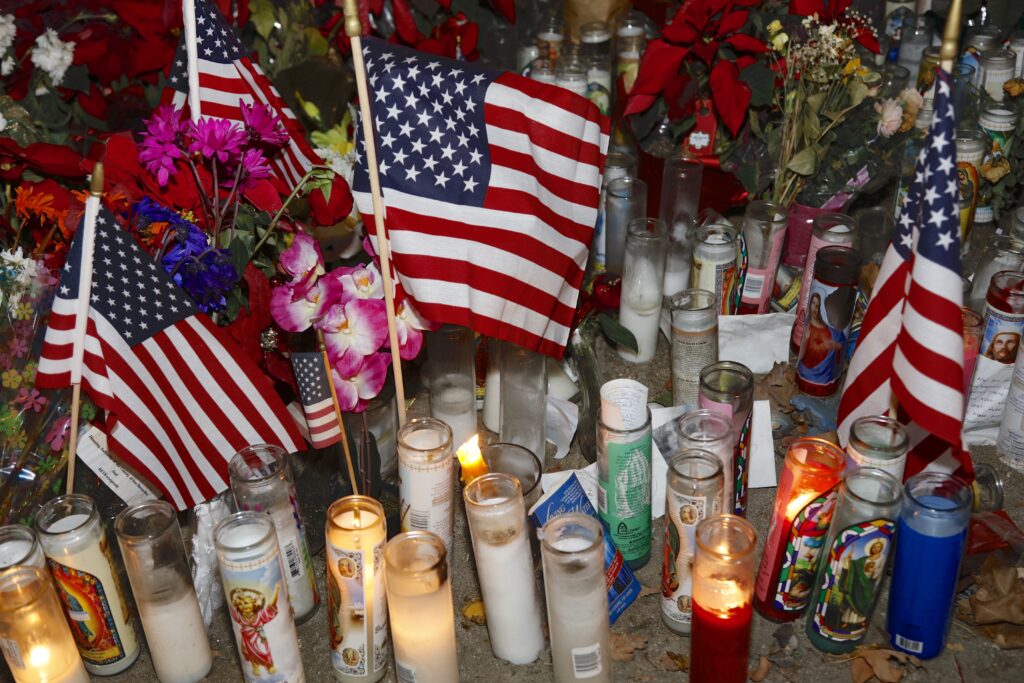
In the immediate aftermath of the Annunciation Catholic Church shooting on August 27, various online voices – on the X platform, particularly — alleged that Robin Westman (born Robert Westman) had been a member of 764, a mysterious online terrorist group with its roots in a branch of modern Satanism known as the Order of Nine Angles (ONA).
The FBI and Minneapolis police have yet to confirm the truth (or falsehood) behind this allegation, as their investigations have barely started. Several news outlets, however, including The Free Press – hardly a hive of foaming-at-the-mouth conspiracy nuts – felt confident enough about the known facts to run two stories on Friday afternoon that linked Westman to 764 with some degree of confidence.
When all the facts are known – assuming they can be known – it seems possible that Westman may turn out to have been more of a 764 ‘imitator’ than a card-carrying member of a group that, in any event, organizes itself virtually with minimal face-to-face interactions between its leaders and foot soldiers. The 764 organization isn’t Al Qaeda. Robert Westman would not have traveled to a training camp in the mountains of…wherever…to be instructed in how to be a 764 terrorist.
Like the entire Internet subculture revolving around mass shooters, 764 and its kindred organizations are diffuse, anonymous, and difficult to trace. They operate via chatrooms, file sharing, emails, and cyber-bullying of actual and prospective members.
If Westman was a member of 764, he likely never saw the faces of his confederates. They were probably just avatars sporting obscure callsigns and email accounts linked to fake names emanating from the darkest corners of the Internet. Their interactions would have resembled creatures whispering to each other in the darkness beneath some forgotten mountain range, rather than a group of men gathered in a room to plot a car bombing.
764 is not the Irish Republican Army circa 1971. It’s a lot weirder.
How Groups Like 764 Operate
The key to understanding how 764 operates – and a couple of good articles that I link to here do a very good job of explaining its modus operandi – is to think of it as a collective of cyber criminals who prey on the weak and vulnerable, primarily in order to extort them into providing money and compromising materials (e.g. nude photos) of themselves in order to give 764 the leverage to create further carnage and extort more money.
The difference between 764 and normal cybercriminal networks (if they can be called ‘normal’!) devoted purely to financial crimes is that 764 has a far more nihilistic outlook.
For these vermin, money is less important than the thrill of causing pain. Sadism is their motivation. Chaos is the point in and of itself. Their view is that human life has no value, meaning, or purpose, and that existence basically sucks. If pain is what defines this world, then why not go out there and cause more pain, just for the thrill of it?
That kind of thinking seems consistent with Robert Westman’s remarks on the video taken down from his YouTube site the day after the shooting (Greymantle has seen portions of the video posted elsewhere).
If It Walks Like a Duck, and Quacks Like a Duck…
In the video, Westman can be heard remarking about the pointlessness of life, the anticipated ‘thrills’ of what he is planning to do, how easy it was to purchase the firearms he will use in the shooting, and how much ‘fun’ he is going to have executing his plan. He also hums showtunes and babbles in Russian.
These ramblings are similar to the rhetoric of other mass shooters and 764 members who have committed violent crimes.
Westman also wrote comments on the barrels of his guns and their ammo magazines in white magic marker or white chalk (it’s difficult to tell which). Among his scrolled words are the names of other mass shooters, including Anders Breivik and Adam Lanza, and Vicki Weaver, a white separatist’s wife shot by the FBI in 1992. He also scrawled “Waco”, “Kill Pedos,” and “Where is your God?” on the sides of his weapons.
It’s difficult to discern any clear political outlook from Westman’s graffiti. Some of it seems extreme right-wing, some left-wing, and the rest a mishmash of nihilism and incoherence. But that incoherence has a strong similarity to 764’s rhetoric.
Some commenters on X pointed to Westman’s use of the Cyrillic alphabet in his written journal, apparently to disguise his thoughts and intentions from his mother, with whom he lived in Minneapolis. 764 has an active presence in Russia and the Republic of Georgia, having executed several notorious crimes there in the past four years. Westman’s use of Cyrillic writing has been taken as evidence of a connection with the Russian branch of 764.
While Cyrillic writing alone doesn’t prove anything, it opens an interesting question. Westman was raised a Roman Catholic in Minnesota and did not take any Russian language classes, having been a college dropout. From where would he have learned to read and write in Cyrillic script? Most likely from some online source – but which source? And why did he latch onto Cyrillic script?
Until the investigation proceeds further and the FBI is willing to release more details, the 764 connection to Robert Westman and the Minneapolis church shooting will remain speculative. What Westman had in common with 764, regardless of whether he was part of their organization or not, was a corrosive and violent nihilism – the belief that nothing really matters. That there are no ‘beliefs’ worth having.
Greymantle isn’t certain this really matters. Robert Westman and 764 were ships sailing in the same direction, whether they knew of each other’s existence or not.
The Real-World Roots of Online Satanism
While nihilism clearly played a large role in last week’s shooting and other mass shootings since Columbine, it’s not the whole story. 764 and groups with whom they are linked have a longer lineage than is generally realized, and correspondences exist between these 21st-century Satanic-nihilist terror groups and older esoteric networks operating at the intersection of organized crime, terrorism, and the occult.
As mentioned above, 764 is an offshoot of the Order of Nine Angles, a Satanic occult neo-Nazi group founded in Great Britain in the mid-1970s by activists associated with the British National Party and UK National Socialist Movement, who apparently took over what was initially a Wiccan coven and transformed it into an underground terror cell. ONA has been linked to dozens of violent crimes in the UK and elsewhere, including assault, rape, destruction of property, and murder.
Originally led by David Myatt, a highly influential far-right theorist in Great Britain, the ONA has produced a broad body of writings that openly advocate for violent revolution to overthrow democratic governments across the West to replace them with an ‘Aryan Imperium’. ONA’s philosophy is a blending together of hermetic, pagan, and Satanic elements drawn from a variety of sources, including the writings of Aleister Crowley, Julius Evola, and Karl Maria Wiligut — an intellectual and esoteric rogue’s gallery if ever there was one.
For a detailed examination of ONA and its belief system, I refer readers to Massimo Introvigne’s ‘Satanism: A Social History’, a brilliant examination of the West’s Satanic underground since the early 1700s, written by the respected historian.
Since the advent of the Internet in the 1990s, ONA has influenced or directly orchestrated the founding of a rapidly proliferating universe of online-based terror groups across Europe and the U.S., including the Atomwaffen Division, Nordic Resistance Movement, Sonnenkrieg Division, and the Rusich Group, with the last being a paramilitary unit based in Russia. All these groups have active online followings, openly embrace some form of Satanic neo-Nazi ideology, and have planned or committed violent terrorist acts.
Conclusion: Brace Yourself for More of the Same
What we witnessed last week was not an isolated tragedy, nor the random work of a single unhinged individual. The ideology of nihilism, the lure of online fantasy, and the predatory nature of occult-inspired networks like 764 and their predecessors form a toxic ecosystem that breeds violence.
Whether or not Robert Westman was a formal member of 764 almost doesn’t matter—the worldview he embraced and the cultural currents that shaped him flow from the same poisoned stream. That stream feeds both into and flows out of the aesthetic and occult currents we term ‘sinisterianism’ and represent its darkest realized forms.
The uncomfortable reality is that such crimes will continue to surface because the forces behind them are not disappearing; they are evolving. The Internet provides anonymity, reach, and endless opportunities for recruitment, while occult-nihilist ideologies offer alienated individuals both a script and a sense of belonging. In this convergence of technology and pathology, we can expect more violence—and more disaffected young people willing to embrace it.
The task for society is therefore not merely to prosecute individuals after the fact, but to confront the deeper cultural, spiritual, and technological conditions that give rise to them. Unless we begin to reckon seriously with the diet of illusion and the rule of fantasy that define our online lives, we should brace ourselves for more of the same—and worse.
Until next time, we remain —
Greymantle
*******************
This article is the second in an ongoing Greymantle series on ‘Sinisterianism’, which we define as a loosely linked set of aesthetic and occult tendencies associated with Satanism or Satanism-adjacent esoteric ideas, ritual practices and sensibilities. Though generally a fringe movement, Sinisterian ideas and aesthetics have been insinuating their way into mainstream consciousness since the 1970s.
Also read: The Sinisterian Impulse: The Infiltration of Occult Aesthetics into Popular Culture