The following are the five key takeaways of this two-part article, sixth in our ongoing series:
*If China chooses to blockade Taiwan, then the United States most likely will not intervene directly; however, an amphibious assault could provoke Washington into a direct military response.
* China’s resources for its “area denial” strategy are sufficient to match a direct intervention by U.S. naval forces in the Taiwan Straits and South China Sea.
*According to wargames conducted by military think tanks, an American rescue of Taiwan would be enormously costly in blood, damage, and treasure– not only for the U.S., but also for China.
*China has a greater ability to recover quickly from the devastation of its navy than the United States does, given China’s current lead in shipbuilding.
*America has a less risky alternative strategy available to it in the event of a Chinese invasion of Taiwan: a counter-blockade against China itself, from a distance.
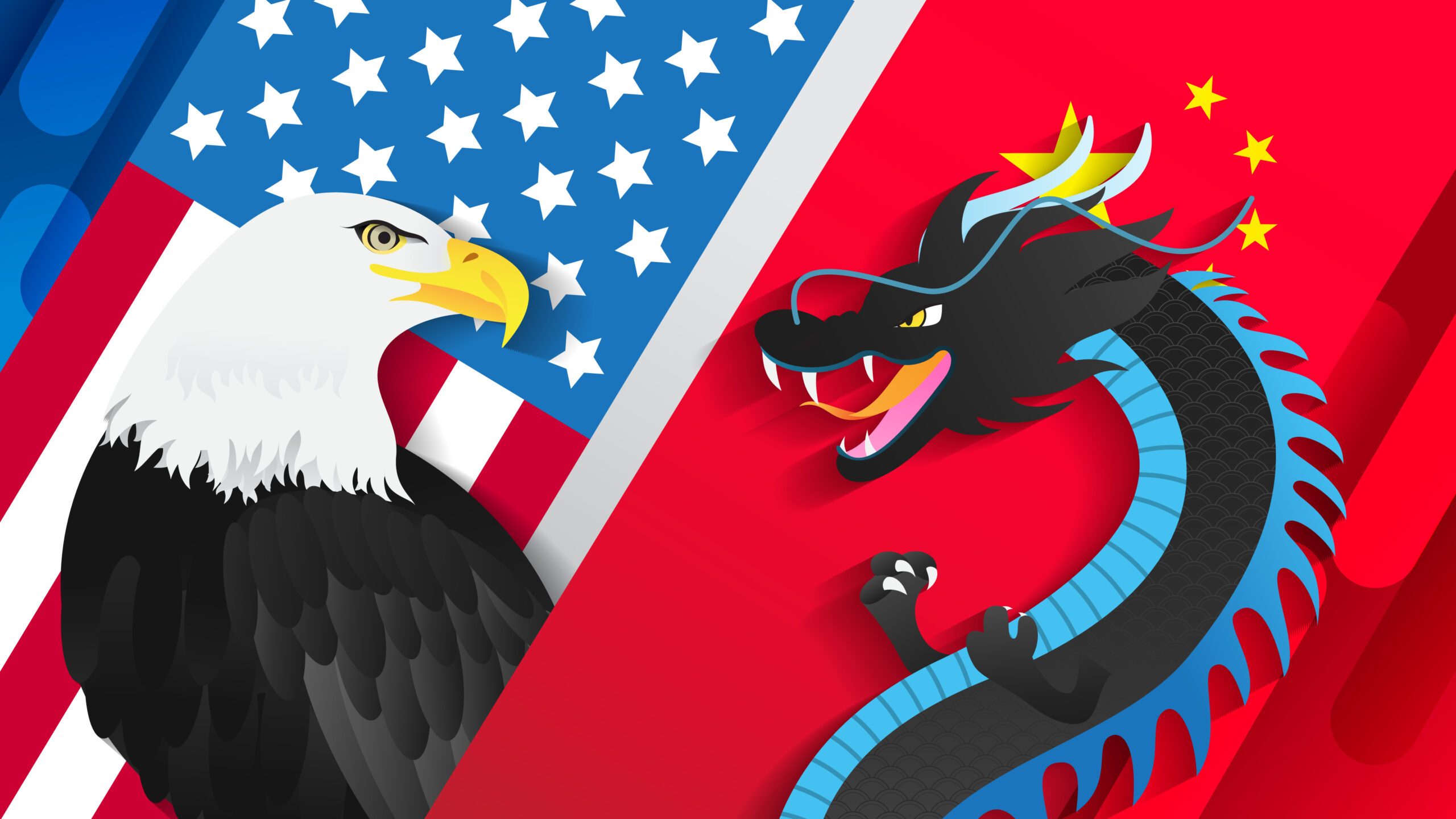
The title of today’s post is: “The Eagle versus The Dragon, Part 1: China-U.S. Naval Conflict Scenarios,” and the content maps out those scenarios as well as the background. Part 2 will explore alternative U.S. strategic options.
Prologue: The Big Parade
On September 3, 2025, China marked the 80th anniversary of World War II’s end in Asia with a massive military parade in Beijing witnessed by several key foreign leaders, including Russia’s Vladimir Putin and North Korea’s Kim Jong Un. Xi Jinping, China’s unquestioned leader, emphasized the Chinese Communist Party’s (CCP) role in Japan’s defeat (ignoring the key parts played by the CCP’s rival Nationalists and their American partners).
The parade allowed Xi to display an array of shiny new arms, including hypersonic missiles, the latest air and undersea drones, as well as new laser and microwave weapons. From Xi’s point of view, it was important for China’s general population, not to mention the world at large, to see how far China has advanced towards achieving its self-proclaimed goal of possessing a “world-class” military.’
Along with showcasing the extent of China’s arms build-up, Xi’s main intent in parading China’s new, cutting-edge military hardware appeared clear: he was showing Taiwan, the United States, and the world’s other major military powers exactly what they will have to deal with in the future…and that they should all be concerned.
Xi Jinping: ‘Man of Destiny’?
Many military experts believe that Xi Jinping wants his legacy to be that of the man who nullified 19th-century imperialist ‘snatches’ of Chinese territory and made China whole again.
Xi reportedly had the following exchange with the current U.S. President, who afterwards said: “He told me, ‘I will never do it [i.e. blockade or invade Taiwan] as long as you are president’, President Xi told me that….” This was on August 16, 2025.
Okay. So, the matter is settled—nothing to worry about until late January 2029. Right?
The same U.S. president, however, chose to accept- over the advice of his own intelligence agencies – Vladimir Putin’s assurance that the Russians did not interfere in the 2016 U.S. elections.
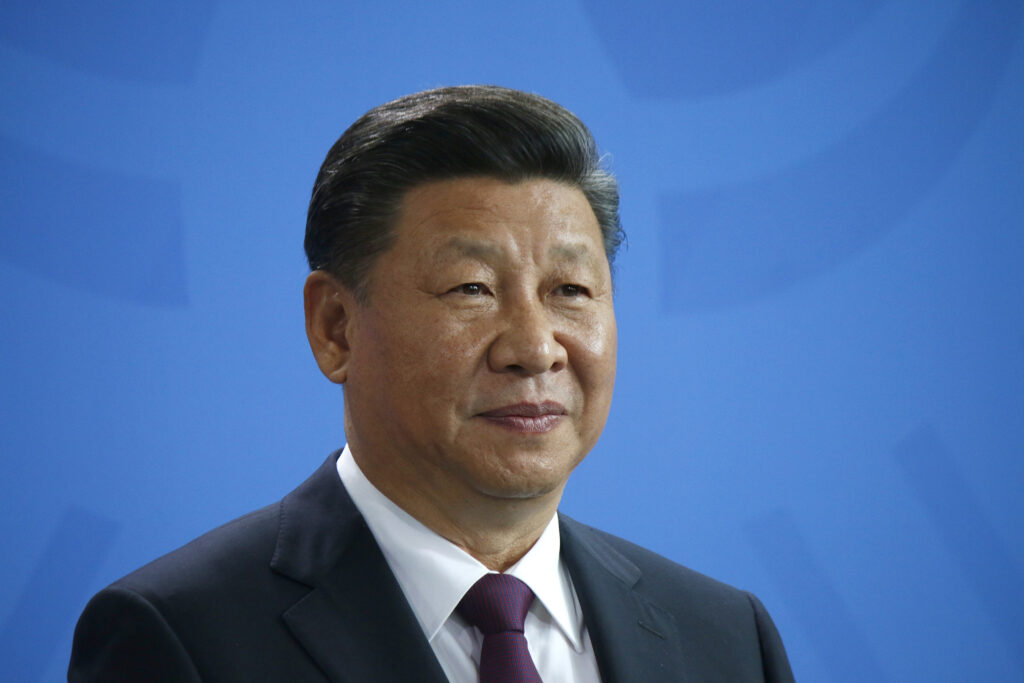
Suspicious of advice given by enemies, Greymantle predicts that mainland Chinese pressure on the Republic of China (ROC), i.e., Taiwan, will intensify steadily while such a transactional individual occupies the White House.
We also continue to believe, in line with our earlier predictions, that Mr. Xi will act before – maybe just before — January 20, 2029, as that would be the best time during which China cam act (i.e. during a presidential transition).
“Hold Out Until the Americans Arrive” Now In Doubt
This Greymantle series has so far reviewed the military resources of China and the ROC, as well as the strategies and tactics each would deploy against the other in either of two naval blockade scenarios, or in a direct, head-to-head military conflict, with Taiwan standing alone.
Until now, our detailed examination of China’s likely aggressive steps has excluded consideration of material U.S. interference. In this article, Greymantle explores the probable events that would occur if Xi Jinping’s ultimate assault takes place — and provokes an American response.
Taiwan’s unofficial motto for seven decades had been “Hold Out Until the Americans Arrive.” Now, 60% of those Taiwanese surveyed believe the United States will not show up – and that survey was taken before the current U.S. administration took office.
As of early September 2025, frequent “training” rehearsals and naval/air drills have occurred near or into Taiwan’s territorial waters. Not-quite-war “grey-zone” or mini-aggressions have frequently tested the limits applied against both the ROC and states that might move to support it, like the Philippines.
The implicit threats are amping up. China’s clear intent is to “persuade” the Taiwanese people to cooperate more closely with Beijing’s assimilation process – one way or the other. The ultimate “boots-on-the-beach” threat always dangles over the republic’s government if it stubbornly insists on independence.
Let us now consider what happens if the United States does indeed choose to intervene to frustrate a mainland Chinese assault on Taiwan. We will examine the motivations of all parties involved, their principle strategic options, and the likely military consequences of a U.S. intervention.
What Will It Take to Spur U.S. Military Action?
As discussed in earlier articles, Greymantle believes that China will gradually tighten its quasi-military noose around the island nation, pausing at points to give political disintegration a chance.
A soft blockade, or “quarantine,” may be imposed to stifle imports and trade. This would also pose a test to the United States to see if it will intervene.
If Taiwan’s national resilience remains firm and the international reaction is tolerable, then Mr. Xi’s next logical step will be a hard blockade. (Technically, this is an internationally recognized act of war.) Such an operation would use overt military means to halt all sea commerce; to cut off the ROC’s external communications; and to reduce its coastal and missile defenses, while disrupting vital infrastructure and internal transmissions by cyberwarfare.
The Chinese would then be likely to announce a unilateral ceasefire to see if the Taiwanese people will force their government to make peace on Beijing’s terms. If not, Greymantle believes that the next step would be an amphibious invasion. It is not in Xi’s interest to disrupt world trade for months if the blockade is failing to have the desired results.
He would have already gone this far. Mr. Xi’s next step, showing that China is deadly serious this time, would be a kinetic invasion.
The current U.S. administration and American popular opinion, however, probably would not be provoked into war by a Chinese ‘hard’ blockade alone, no matter how destructive such an operation was to Taiwan’s people and infrastructure, and to international commerce.
An actual D-Day-style amphibious assault on Taiwan, however, could ignite a very different reaction.
U.S. Military Intervention: First Steps
The shift from a hard blockade to direct invasion could not be cloaked for long. As mentioned, both sides – China and the U.S. — would first attempt to cripple their opponent’s ‘space eyes’ by means of electronic interference, cyber-attacks, or even anti-satellite actions. Even when American spy satellites are compromised or destroyed, the invasion of the ROC’s outlying protectorate islands and the preparations of an invasion fleet will be impossible to hide.
The attack alone would signal a major event. That event would soon be evident to the U.S. and allied militaries through other means of ISR (Intelligence, Surveillance, and Reconnaissance).
Besides beginning the diplomatic work to rally its Pacific allies, Washington’s first step would be to immediately apply all its surveillance and intelligence assets, sharing their findings with Taiwan’s government.
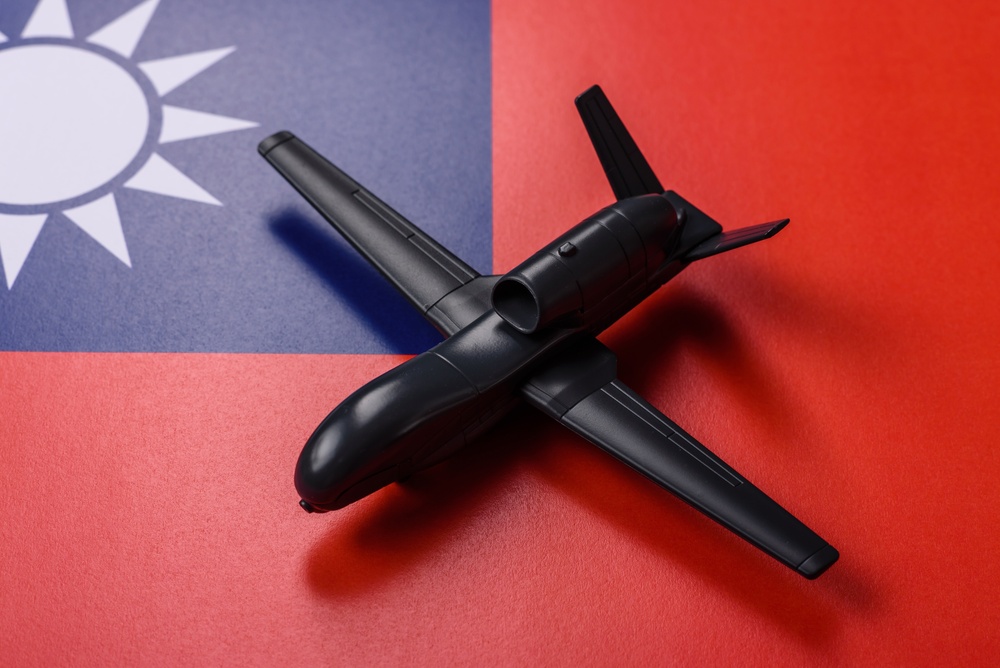
Both China and the U.S might quickly shift to more earth-bound means for ISR, such as tapping electromagnetic signals, launching scout drones, or deploying submarines to reconnoiter the South China Sea. The United States would likely send RC-135 Rivet Joint reconnaissance aircraft and Golden Hawk drones to the region; these would gather real-time information on enemy naval and air deployments.
American units would also begin cooperating with Taiwanese counterparts to disrupt the cyber and communication networks required to control Beijing’s vast and complex endeavor, as well as defending their own. The U.S.’s extensive network of underwater acoustical sensors will also be utilized (until the Chinese degraded it).
Early American responses at this vulnerable juncture could be crucial. If the mainland invasion force were still concentrating its assets before moving toward the ROC’s coastline, it would be at its most vulnerable. Flying from Guam, Alaska, or Hawaii, U.S. Air Force (USAF) stand-off bombers would launch cruise missiles, staying just outside of the PRC’s farthest ‘threat ring’. U.S. nuclear submarines patrolling near Taiwan could add their cruise missile salvos.
The United States is the only world power that could manage a successful non-nuclear strike on China’s coast. Conventional attacks on the assembly and first launch of the invasion force are one possible option available to the U.S. Such early direct attacks could cause immense – and perhaps crippling—damage to the Chinese invasion fleet, along with high casualties.
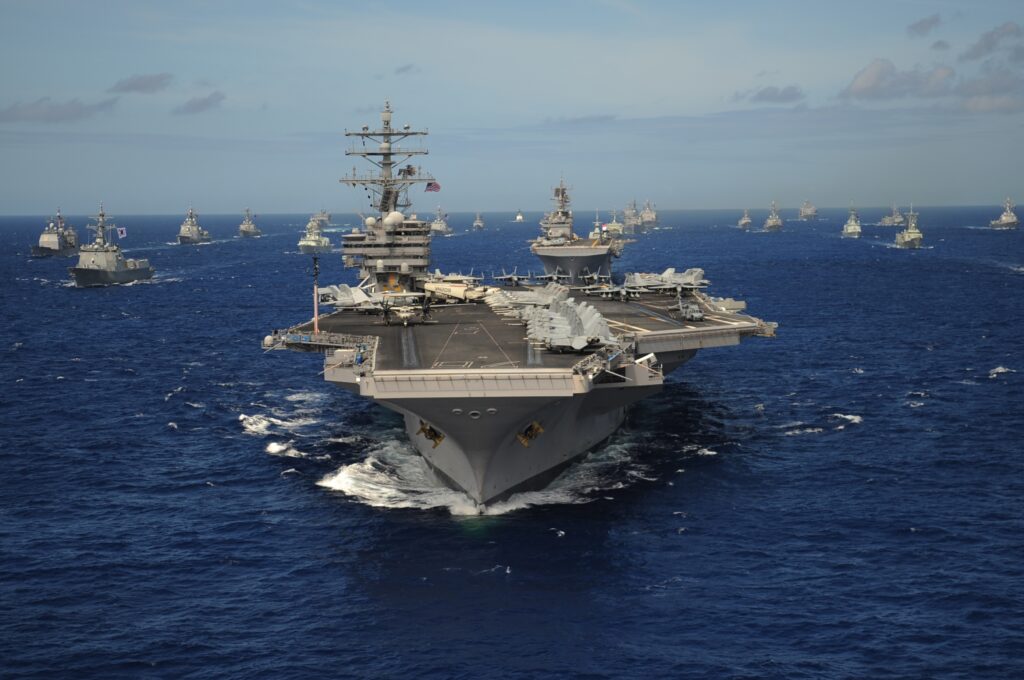
Above: A Nimitz-class aircraft carrier – pride of the U.S. navy
Greymantle believes, however, that Washington probably would not act immediately to strike the embarkation sites, given the extreme provocation inherent in such a move. The administration would fear the potential risks involved with a miscalculation of this magnitude – the foremost being a nuclear exchange.
It is not hard to imagine an alternative scenario in which Beijing would strike U.S. military assets in the region first, Pearl Harbor-style. It isn’t in the Dragon’s interest, however, to poke the Eagle in the eye while its posture still appears indecisive. In any event, preemptive U.S. strikes against Chinese coastal bases would certainly ignite fierce and overwhelming Chinese counterattacks on all U.S. military assets in the Western Pacific.
American Power, And Its Limits
Analyst Michael McDevitt writes in the Naval War College’s Study No. 8, Chinese Amphibious Warfare: Prospects for a Cross-Strait Invasion, about the current, hard realities of Chinese naval power in the Western Pacific:
“Today, no one talks about the U.S. Navy having, or gaining, sea control in the Taiwan Strait. Instead, the mission today would be sea denial—a mission that would prevent the People’s Liberation Army-Navy (PLA) from controlling the Taiwan Strait long enough to conduct a successful amphibious invasion.” (P.464)
The China-United States clash would involve operations featuring new, often untested-in-combat weapons, such as hypersonic missiles, killer drone swarms, anti-satellite systems, and/or electronic warfare, as well as naval and air encounters on a scale that the world hasn’t seen since World War II.
Simultaneously, the largest amphibious military operation in 81 years would be proceeding against dug-in resistance. The overall military and geopolitical situations in the South China Sea and Taiwan Strait would be unprecedented and exceptionally combustible. There is no way all these balls can be juggled at the same time.
Before proceeding further, let us quickly review the most obvious strengths and weaknesses of each side.
(For those with an interest in digging deeper, see” Study No. 8, Chinese Amphibious Warfare: Prospects for a Cross-Strait Invasion, November 8, 2024; Authors: Andrew S. Erickson, Conor M. Kennedy and Ryan D. Martinson.}
China’s Formidable Military Strengths
- Missile and Drone Numbers (Estimated)
| DF-21D (Anti-ship Ballistic Missile) | ~80–100 launchers | Road-mobile; forms backbone of China’s A2/AD strategy |
| DF-26 (Anti-ship Long-range BM) | ~150–200 launchers | Includes both land-attack and anti-ship variants; growing rapidly |
| YJ-18 (Cruise missile) | ~500–700 units | Deployed across submarines, destroyers, and coastal bases; saturation attacks are possible with this model. |
| YJ-21 (Hypersonic; maneuverable) | ~50–100 units (early deployment) | Mounted on Type 055 destroyers and H-6N bombers; still expanding |
China has rapidly expanded its arsenal of attack drones, blending conventional unmanned attack vehicles (UAVs) with stealth and AI-enabled platforms. The Chinese armed forces can now deploy several key systems, whose capabilities range from suicide/strike missions to swarm attacks to “wingman” partners or to stealthy reconnaissance tasks.
Operational ranges, as of 2025, go from 1000 to 3000 kilometers.
The underwater naval drones, patterned on Russian versions, that were flaunted in the September 3rd parade are estimated to move within 500 to 1000 km (although they may be mock-ups for show at present).
It is impossible at this juncture to estimate the number of these drones available to the PRC. It should be remembered, however, that China is the world’s leading manufacturer of UAVs. The use of AI to perfect drone swarms is also being actively explored by the Chinese military.
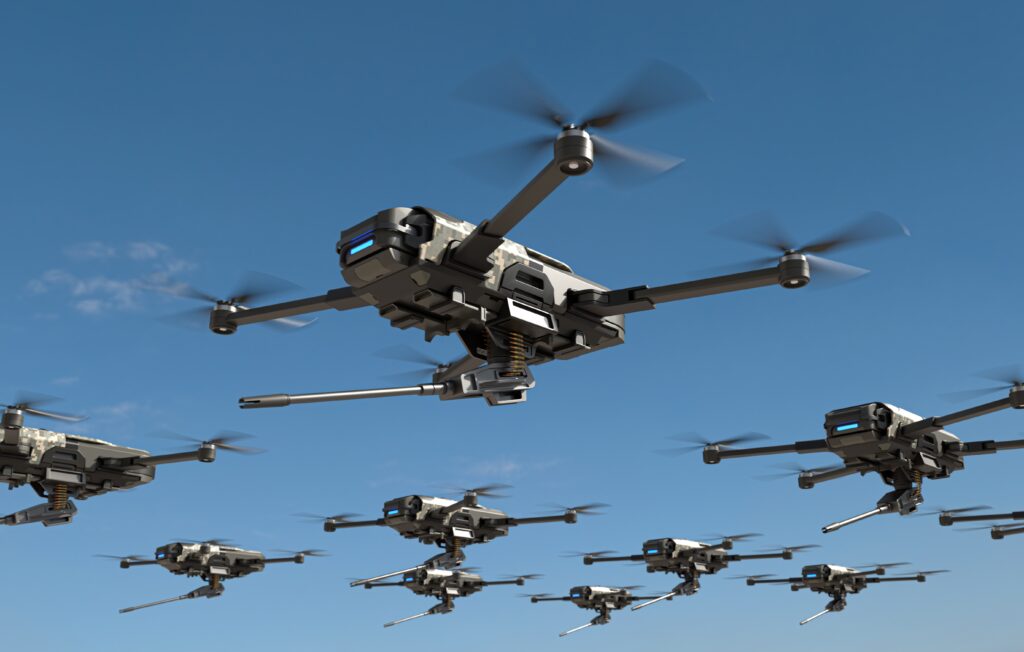
China would likely launch swarms of aerial drones at the U.S. Seventh Fleet
The portion of America’s cruise/intermediate-range missile and drone strength that can be brought to bear on this conflict cannot equal China’s. This battlefront may be near a few US regional bases, but this war zone is China’s backyard, and America’s missile strength is spread all over the world.
Disturbingly, expert sources have concluded that China may be capable of firing 1,400 missiles a day, not counting drones, during a relatively short conflict.
The portion of America’s cruise and intermediate-range missile and drone strength that could be brought to bear in this conflict cannot equal China’s. America simply does not have the manufacturing capacity or the number of drones to match China, uncrewed device to uncrewed device, as of this writing.
- Ships and Planes
China’s naval fleet numbers 370 warships, according to most reckonings. The USN can deploy 293 vessels. However, America – once again — cannot bring its full naval might to bear in this theatre alone. As of 2025, the U.S. Seventh Fleet—the Navy’s forward-deployed force in the Pacific — normally musters between 50 and 70 ships and submarines at any given time, as well as carrier aircraft and over 27,000 sailors and marines. A portion of this personnel and equipment is always down for maintenance for one reason or another.
Some analysts, including the Rand Corporation, believe that just 10% or so of China’s long-range bomber armada (the H-6n) could manhandle a single carrier task group with its stand-off missile fires.
The United States can call upon competent naval allies in the region, however.
Japan’s fleet of naval warships is considerable, numbering more than 100 fighting vessels. The others—Australia, the Philippines, and South Korea – may be able to add a couple of dozen more fighting vessels each — at most. (Taiwan’s navy and air force will be pretty busy on their own, fending off Chinese attacks.)
Given the evidence of Xi’s recent summit meetings, India might not support America in a Sino-U.S. conflict, either militarily or diplomatically. At the same time, it appears evident that Russia and North Korea will stand with China – although it is not clear to what extent they would contribute military forces of their own, if at all.
Mainland China possesses between 250-300 5th-generation J-20 stealth warplanes, plus thousands of older models. If there is no surprise attack on their bases, the US regional forces and the Japanese air force could initially launch up to 450 attack aircraft, perhaps 50 to 60 of which would be stealth F-35s, our 5th-generation aircraft.
- Logistical Edge
Outside of its main bases in Japan, Okinawa, and Guam (upon which enemy missiles may quickly descend in the early stages of this conflict), America’s supply lines are thousands of miles long. China’s supply lines will be close at hand.
How does a U.S. fleet replenish weapons and fuel after combat? It can only do so through vulnerable supply ships or by sailing back to port hundreds of miles away. The latter option will not be realistically available to it during a fiercely drawn-out naval engagement.
- Preparation
It is no secret that Beijing has been planning for the possibility of a military takeover of Taiwan for decades, basically since the Chinese Revolution of 1949, following which the Nationalist forces retreated to and established their headquarters on Taiwan. Over the intervening decades, China has been methodically assembling its naval/air resources, training its amphibious forces, and staging ever-more-aggressive drills and “grey-zone” operations.
- Staying Power
China has the resources to repair and replace any damage to its navy much faster than America can. Its shipbuilding industry outproduced that of the United States by 200% in 2023 alone. China’s proximity will also allow it to continue to apply pressure on the ROC via other means much more easily than the U.S. can provide resources to counteract that pressure.
China Has Four Notable Weaknesses
*The Scale of the Task Itself
The immense difficulty of accomplishing the largest amphibious assault since World War II, in the face of determined opposition, is daunting, even against a modest-sized opponent like Taiwan. These issues were discussed at length in the immediately prior article of our series, “Attacking Taiwan: China’s Land and Sea Invasion Strategy”.
*Combat Inexperience
Much has been made of the fact that the Chinese military has not fought an actual shooting war since 1979 (a short-lived conflict with Vietnam). Less is made of the fact that the Taiwanese armed forces are also innocent of real warfare.
Nevertheless, most modern wars involve pushing buttons to launch or guide shiny new weapons, some of which have not been proven outside test beds. The true challenge for China’s military will be coordinating the million different moving parts of an amphibious invasion – all while under extreme duress. We touched on this issue at length in a recent YouTube interview. The transcript was published on Greymantle on August 28 with the title: “The Dragon versus the Hedgehog”.
*Not Enough ‘Lift’ to Land its Assets Safely
Greymantle previously concluded that the Chinese navy – at this point – likely does not have enough amphibious and airborne resources to land sufficient forces on Taiwan in the initial stages of an amphibious invasion. What it can get ashore, in other words, appears inadequate to conquer the mountainous, densely urbanized island republic completely. The reasoning behind this conclusion was presented in Article 3 of Greymantle’s China-Taiwan series.
If the United States decides to defend the ROC early in the amphibious invasion, then it could ensure that even fewer mainlanders get their boots on Taiwanese sand.
*Time – The Most Precious Resource
A Chinese invasion of its so-called ‘renegade province’ has to be launched and concluded very quickly, or a variety of military reversals might befall the Chinese.
We think it unlikely that Beijing — without serious U.S. provocation — would want to complicate its already complex assault by initiating a surprise attack on U.S. bases in the Western Pacific. To take Taiwan, China has to get a foothold on the island as fast as possible. The last thing the Chinese military wants is for the U.S. to intervene on the ROC’s behalf – and it does not need to give the U.S. an inflammatory reason for doing so.
The more time an invasion takes, the more bogged down everything gets. If the amphibious assault stalls, then the Americans may decide to show up after all – even after sitting out the first couple of weeks. Beijing does not want U.S. cruise missiles hurled at and around its tenuous beachheads midway into the invasion.
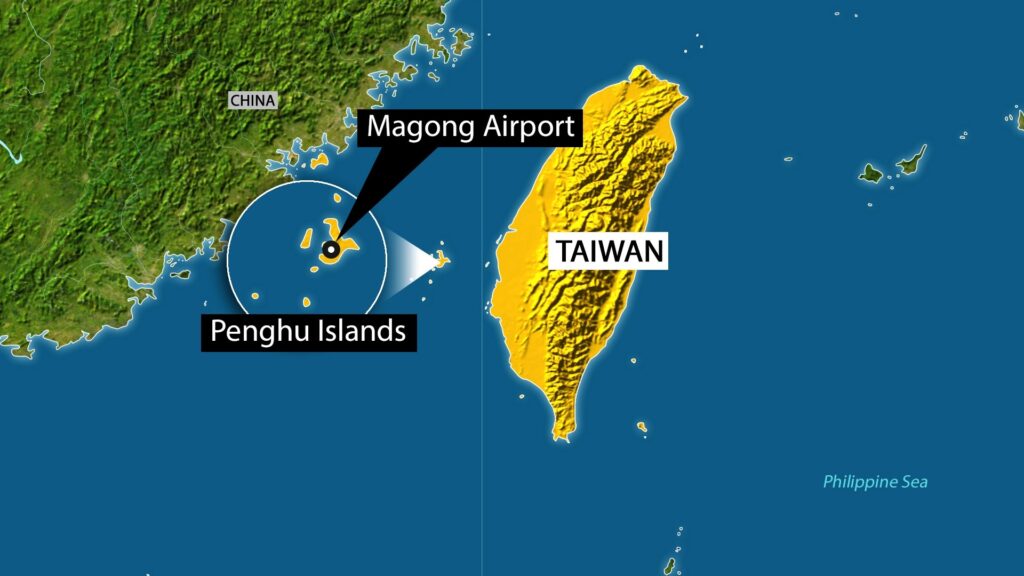
America’s Biggest Weaknesses: Vulnerability to Chinese Missile Attacks and Elongated Supply Lines
We have reviewed China’s strengths, which are the opposite of America’s. Now, let’s examine America’s weaknesses.
First, Chinese warships, fighters, missiles, and drones outnumber those of the United States. Second, America’s fleets have to punch through heavily layered Chinese defense rings to have any hope of approaching Taiwan and providing relief. Thirdly, America’s naval forces cannot be easily reinforced or replenished once they reach their target area.
America’s strengths have also been mentioned: a) years of training and experience with proven equipment and doctrine, under hostile conditions (e.g. versus the Houthis in the Red Sea); and b) competent regional allies. The question is whether these strengths will be sufficient to offset the notable weaknesses outlined above. Greymantle is not alone in judging a direct Taiwan rescue operation would be stalemated at best.
Conversely, U.S. airfields in the region have nowhere near enough hardened, anti-missile shelters for their aircraft.
There are other concerns surrounding U.S. preparedness, as well. Military analyst and former admiral Michael McDevitt points out several additional aspects of poor U.S. planning in the aforementioned 2024 Naval War College report.
He believes that the U.S. Navy has to become better “at operating without friendly space-based reconnaissance because the Chinese will be compromising it”.
McDevitt identifies two other U.S. failings: “a) the Navy must field organic air-wing tanking as soon as possible…fighters have to be able to conduct long-range sorties [because their carriers have to stay outside the missile ring]”; and b) “the Navy has to expedite the introduction of long-range (500–600 nm) anti-ship cruise missiles (ASCMs) and land-attack cruise missiles (LACMs) that can be launched by F-18s and F-35Cs.” [For the same reason as before.]
Wargaming Results: A Direct U.S. Military Intervention Would Be Bloody For Both Sides
There aren’t many good options available for Washington if it decides to challenge a Chinese hard blockade and invasion of Taiwan directly. The full-frontal rush to push U.S. naval forces through to Taiwan — counter-attacking an amphibious invasion — has been war-gamed by the U.S. and by independent analysts many times.
The results aren’t pretty.
Imagining the scale and possible permutations of the conflict that would erupt if China tries to overwhelm Taiwan and encounters direct American resistance is difficult at best.
The numerous strategic and technical issues of a U.S. intervention were highlighted in 2021 in an extensive series of wargames conducted by the Center for Strategic and International Studies (CSIS). That exercise was – and still is – the most comprehensive publicly available study, and it implied the probable outcomes.
Formally titled “The First Battle of the Next War”, the CSIS’s war games simulated a Chinese invasion of Taiwan countered by direct U.S. military intervention. The CSIS ran 28 iterations of the resulting clash, using varied assumptions, skilled players, and detail-rich modeling.
Some scenarios posited different time frames for U.S. intervention; some applied different weapons systems; some ramped up or drew down the capabilities of each side; and one allowed Taiwan to stand alone without U.S. assistance.
There have been some significant changes in the four years since the games were played – particularly regarding advances in drone warfare, in missile production, and in the expansion of Chinese military capabilities. Even so, these changes only tend to magnify the probable scale of the destruction that the games revealed.
The good news was that Taiwan – but not all of it — stayed independent under most of the 28 scenarios, though always because of American and allied military support.
The bad news was a grim tally of casualties to pay for this success: enormous devastation and massive loss of life (not even counting civilians) on both sides. After the conflict, the U.S. would no longer have much of a 7th Fleet left to back up its Pacific alliances – a glaring strategic weakness.
U.S. losses in the wargames included dozens of warships, including two aircraft carriers, and hundreds of non-stealth fighters. Most of these were destroyed on the ground under these scenarios because U.S. military bases in Japan, Okinawa, and Guam weren’t – and aren’t –sufficiently hardened against enemy missile attacks.
Dead and wounded U.S. military personnel were in the tens of thousands under most CSIS scenarios. Japan also lost much of its navy and air force, as well as sustaining considerable damage to its property and civilians located near U.S. and Defense Force sites.
Under all 28 scenarios, however, China lost even more assets and men than the United States, including 90% of its amphibious fleet in the worst cases, as well as thousands of non-stealth warplanes. Air control by either side was tenuous. Tens of thousands of China’s troops and sailors became casualties, but the People’s Liberation Army-Navy (PLAN) still managed to land forces on Taiwan, in the south of the island. That would be foreboding for the island’s future.

This 2021 series of extensive war games dramatically spotlighted the relative frailty of surface ships in a missile-dominated sea. This vulnerability would only increase with the denser presence of anti-ship missiles of all kinds, not to mention the proliferation of drones and the enhanced sophistication of undersea mines and autonomous smart torpedoes.
On the other hand, the importance of nuclear submarine units became significant. Even in victory, then, the butcher’s bill for the Chinese armed forces resulting from a direct U.S. military intervention would be considerable.
Conclusion: The U.S. Would Risk More in A Direct Military Intervention Than Would China
China has prepared for decades to deny the U.S. Navy an entry into the ROC’s air/sea zone during a blockade and/or invasion of Taiwan. This vaunted “Anti-Access/Area Denial” strategy appears to have finally come to fruition.
An objective look at Beijing’s powerful new arsenal supports the conclusions generated by recent war games. The cost in blood and weaponry would be too high for the United States to commit itself to a full-frontal intervention to rescue the beleaguered island republic.
Standing outside the conflict and simply laying out punitive economic sanctions, or engaging in performative diplomacy, however, will not be enough to reassure America’s already vacillating Pacific allies. The basic trustworthiness and firm commitment of the United States have been the linchpin for the collective security of East Asia and the Western Pacific for those eight decades after WW2, and even benefited China’s rise.
After all, what are the U.S. 7th Fleet and all those bases on allied soil for, really?
There is an alternative offensive scenario, however, that could result in far less damage to the 7th fleet and fewer U.S. casualties. At the same time, this strategy may contain Chinese overreach. Moreover, such an operation would assure allies that the U.S. will act to defend their territory and interests from the PRC’s expansionist aims.
This alternative scenario would be a distance counter-blockade of China’s sea commerce, concentrating on faraway choke points like the Straits of Malacca. The PRC presently imports 70% of its crude oil and one-third of its food by sea through these precise trade routes. These facts present significant strategic vulnerabilities for the Chinese.
But how would the U.S. implement such an operation, and how would the Chinese attempt to counteract it? Moreover, would such a strategy blunt or prevent the subjugation of Taiwan by Chinese forces? And how much is America’s caution around its use of carriers now shaped by the PRA’s new missiles and drones paraded so proudly a few weeks ago?
These questions will be answered in Part II of this article.
Until the next time —
Richard Jupa
********************************
Prior articles in Greymantle’s ongoing China-Taiwan Conflict series:
The main sources used as background for writing this article included:
- The Eurasian Times, “China’s DF-21D, DF-26 Anti-Ship Ballistic Missiles Could Trigger Mayhem on U.S. Aircraft Carriers – CRS Report,” by Ashish Dangwal, March 23, 2022
- Global Times, “Weapons of Mass Destruction,” by Liu Xuanzun, Fan Wei and Liang Rui, September 3, 2025
- Rand Corporation, Project Air Force, “An Interactive Look at the U.S.-China Military Scorecard”, 2025
- Center for Strategic and International Studies, “The First Battle of the Next War: Wargaming A Chinese Invasion of Taiwan,” Mark F. Cancian, Matthew Cancian, Eric Heginbotham, January 9, 2023
- Center for Strategic and International Studies, “Space Threat Assessment 2025”, by Clayton Swope, Kari Bingen, Makena Young, and Kendra LaFave, April 25, 2025
- The World Dictionary of Modern Military Warships, “2025 Global Threat Report”, March 10, 2025
- CSIS Missile Defense Project, Missile Threat, “Missiles of China”, last updated April 12, 2021