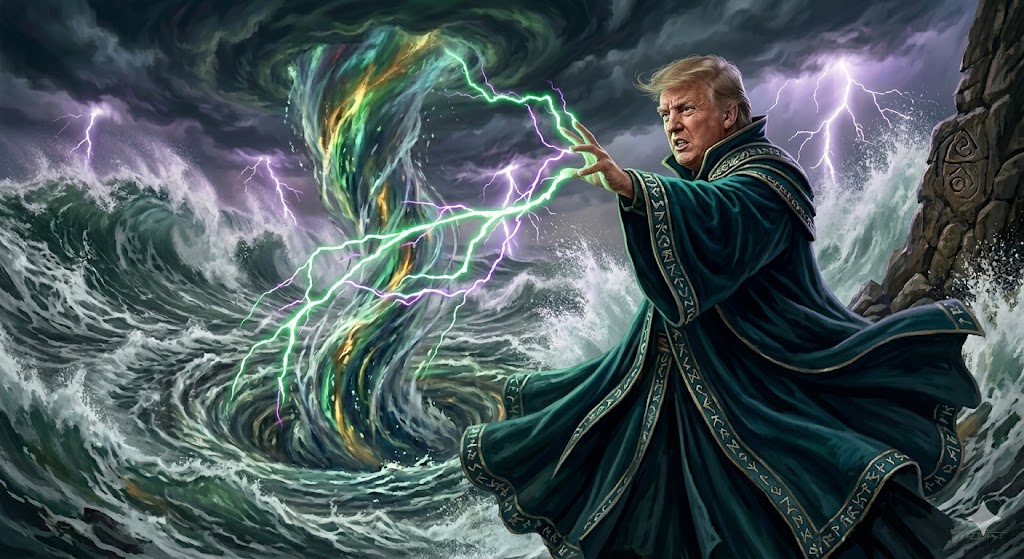
In November 2024, days before Donald Trump’s improbable return to power, I published an article on these pages titled Lord of Illusions: Donald Trump as Master Magician. I argued then that Trump was an individual so sinister that he possessed certain “Anti-Christ” like qualities. His behavior, I alleged, bore more than a passing resemblance to the infamous Aleister Crowley — an assessment most readers dismissed as hyperbole.
In that article, I focused on Trump’s pseudo-spiritual roots in Norman Vincent Peale’s “Power of Positive Thinking,” a philosophy that teaches that reality is not an objective fact, but something to be conquered by the individual will.
It is a philosophy that does not align well with Christian orthodoxy.
Yet Reverend Peale was a popular Presbyterian minister in the Manhattan of Donald Trump’s youth of the 1950s and 60s, and a prominent supporter of the Republican Party’s extreme right-wing. Peale repeatedly spoke out in favor of the John Birch Society, Senator Joe McCarthy and General Douglas MacArthur.
Today, as we stand in the shadow of May 2026, the conservative Christian voters who ignored my earlier warnings about the linkages between Donald Trump’s complete indifference to truth and the occult philosophies of Thelema and Chaos Magick may be feeling the first tremors of regret. It’s about time! Long past time, in fact, to note the similarities between Crowley’s and Trump’s belief systems.
“Do what thou wilt shall be the whole of the law.” Those words, taken from Crowley’s seminal magical tome, The Book of the Law, are central to Thelema. Arguably, they constitute its entire doctrinal structure.
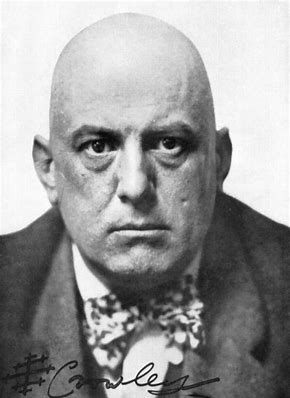
The “Illusionist” that I described in 2024 has fully manifested himself as “the Chaos Magick President” of 2026. The stage tricks are gone; what remains is a raw, blasphemous attempt to overwrite the firmware of our shared reality with the apparent goal of shattering the post-1945 international system. Hence the title of this week’s post: “The Chaos Magick President: Trump’s War on Reality”.
The Greenland Sigil
The year 2026 began with a territorial demand that defied every rule of 21st-century diplomacy. In January, President Trump issued a chilling ultimatum to Denmark: The United States of America would acquire Greenland “the easy way or the hard way.”
While the “War Department” in Washington spoke of rare earth minerals and U.S. national security, Trump soon revealed the true, esoteric motivation for his desire to possess Greenland. In a January 9 interview with The New York Times, he admitted that he himself – not the United States — needed the island. Not for strategic depth, but because it was “psychologically needed for success.”
In the vocabulary of the occult, Greenland had become Trump’s Sigil—a physical anchor for Trump’s growing megalomania and a means of using a single word and a discrete place as a talisman to amplify Trump’s occult energy and personal power.
By demanding a sovereign territory from a NATO ally, Trump was performing a ritual of dominance, attempting to manifest a world where his desires are the only law. And desire of this kind is evidence of motivations deeper than the usual Trump media spectacle politics: a Thelemic desire to direct the world by his will.
The Hormuz Spell
More recently, we see this same dark alchemy at work in the blood-slicked waters of the Strait of Hormuz.
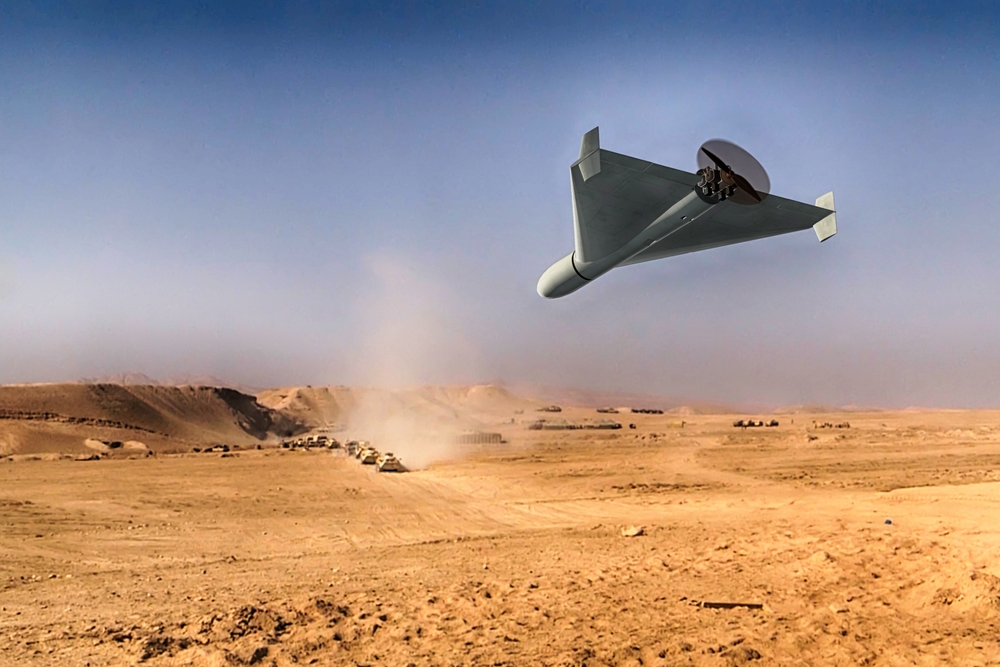
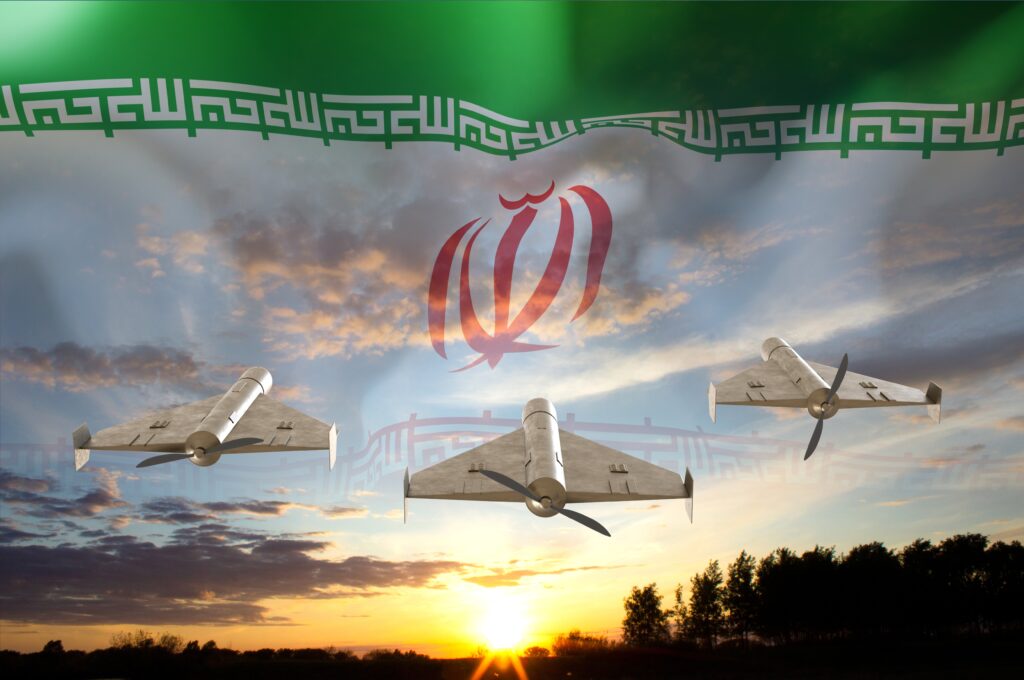
Currently, the President is “stuck,” holding a losing hand in a military conflict governed by Iran’s aerial drones and floating anti-ship mines. It’s a conflict that Trump cannot win with conventional steel (i.e. with overwhelming military might).
America’s carrier strike groups in the Persian Gulf have sunk Iran’s navy but are powerless to protect commercial shipping from $10,000 Iranian attack drones. Without a guarantee of protection, few of the more than 100 trapped oil tankers are willing to maneuver through the Strait of Hormuz, risking Iran’s wrath.
Trump’s response to this dilemma has been a relentless barrage of “bullshit“—a term philosopher Harry Frankfurt defines as statements that reveal a total indifference to truth or even the most easily verified facts.
On May 1, Trump stood before reporters and claimed that while he was “not satisfied” with Iran’s proposals, the hostilities “have terminated” and the leadership in Tehran is “fractured” and “desperate for a deal”. These words are not merely lies; they are magical spells.
Trump is attempting to project a reality of Iranian disunity and weakness to compensate for his own lack of strategic leverage in the Strait of Hormuz. Trump is trying to “think” the blockade out of existence because he cannot sail through it. We’ll get back to Mr. Trump’s dilemma in a moment. But before we can dive deeper into our Trump Chaos Magick analysis: a bit of background.
A Primer: What is Chaos Magick?
To understand Trump’s behavior, one must first understand what Chaos Magick is.
As the author Gary Lachman notes in his seminal work Dark Star Rising: Magick and Power in the Age of Trump, Chaos Magick is a postmodern occult practice originated in the United Kingdom during the 1970s which suggests that “beliefs are merely tools” in the hands of the magician seeking to “make things happen”.
Chaos Magick discards the traditional rituals used in older forms of ceremonial magic in favor of what some of its practitioners have dubbed “meme magick”—the use of images and catchphrases to concentrate the practitioner’s mental energy with the goal of producing real-world results.
The magician’s state of mind is the key. If he believes that he can achieve a certain goal just by imagining it, then stating so explicitly under the right conditions can bring it about – especially if millions of other minds share that belief.
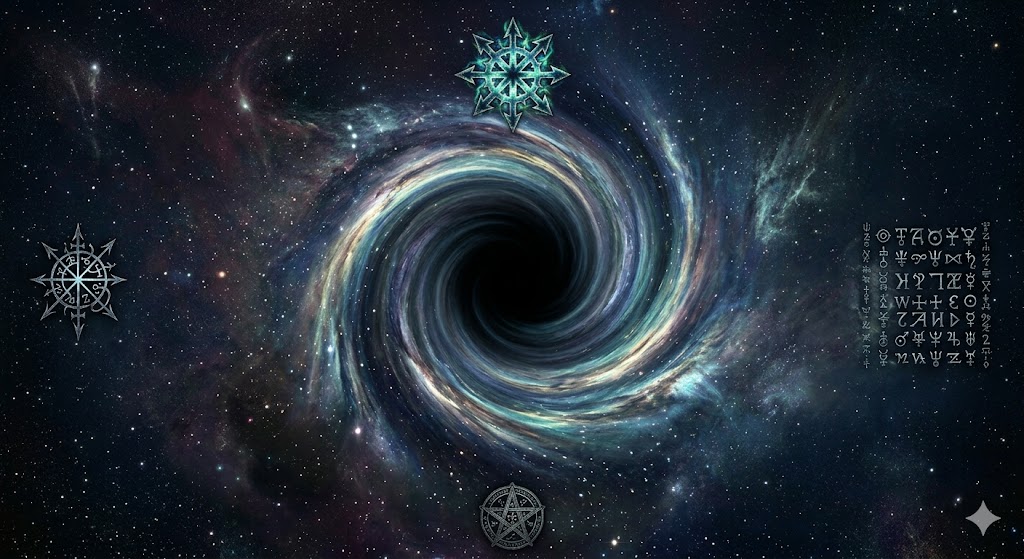
Lachman traces a direct line from Peale’s New Thought in the 1950s to the originators of Chaos Magick in the 1970s and onward to the current “post-truth” era of the early 21st century. In Lachman’s eyes, contemporary Chaos magicians, along with their kindred demagogues and propagandists, are mechanics using tools from the same kit.
In the 21st century political environment they are attempting to create there is no “consensus reality” — only the reality that the strongest wills can impose. In recent years, in fact, there have been several developments abroad that speak broadly to the influence of chaos magick in modern politics.
Post-Truth and the New Authoritarian Order
Lachman and others have observed that the propaganda techniques and apparatus of several formerly Marxist-Leninist nations have been repurposed as mouthpieces for extreme right-wing successor regimes. These have arisen in Russia and other formerly communist countries since the early 1990s.
In his 2015 bestseller Nothing is True and Everything is Possible, former television producer Peter Pomeranstev writes about his experiences in post-Soviet Russia during the 2000s decade. He describes how Moscow public relations flacks worked together with former communist bureaucrats to construct a slick propaganda machine around Vladimir Putin.
It’s aim: to make sure Russians would be unable to tell the difference between fantasy and reality. A population with no grounding in either facts or truth – a citizenry so disoriented that they cannot tell what is real or fake from one moment to the next – would be unable to speak out against the new regime because they would be unable to construct a shared version of reality, let alone a shared narrative.
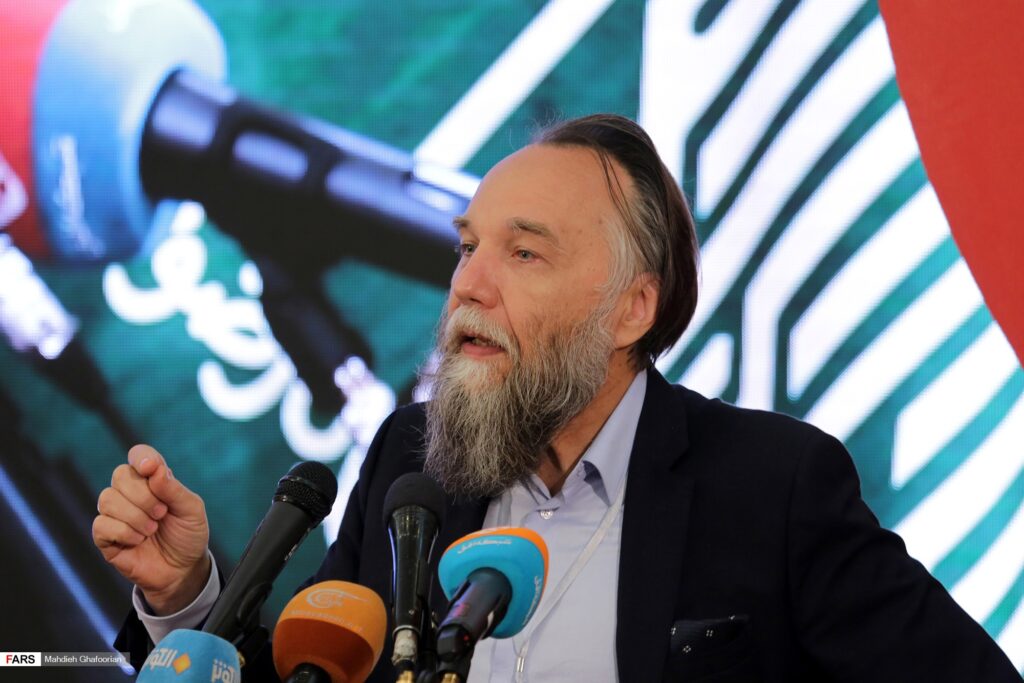
“Nothing is true and everything is possible” is, in fact, a central credo of Chaos Magick, which seems to have been introduced to Russia by a fringe esoteric group in Moscow to which Alexander Dugin belonged in the early 1980s. For those who have never heard of him, Dugin is sometimes referred to as “Putin’s Philosopher” and is a noted far-right geopolitical theorist popular in Russian military circles.
Like Vladimir Putin, President Trump does not care if his statements are factually inaccurate; he only cares if they are effective. If enough people believe the war in Iran is over, or at least that the United States is winning, then the financial markets will react as if that is the case. The “bullshit” itself is the ritual.
So far, the financial markets appear to be cooperating with Mr. Trump. But will they continue to cooperate if the spot price of oil is $150 a barrel? In his war on reality, there are limits to how far the Chaos Magick President can go before reality bites back.
Conjuring Up Non-Existent Negotiations
As mentioned above, the pattern of President Trump’s statements since the start of “Operation Epic Fury” on February 28 is a dizzying patchwork of lies, threats, bullshit, and wishful thinking writ large – a veritable textbook of Chaos Magick. As examples of Trump’s political performance and use of symbolism, the last 10 weeks have been something of a ‘master class’.
Let’s look at a few highlights:
February 28, 2026: President Trump posts an 8-minute video on Truth Social as the first U.S. and Israeli missile strikes are hitting Tehran. Trump claims that “the hour of freedom for the Iranian people is at hand” clearly suggesting that America’s overriding goal is regime change in Iran.
After three weeks of airstrikes, the Iranian regime does not surrender and launches over 40,000 missile and drone attacks hitting Israel, U.S. military bases in the region, and U.S. allies such as Saudi Arabia and the UAE. Iranian forces then blocked all shipping in and out of the Strait of Hormuz using aerial drones.
March 19, 2026: In a Truth Social post, Trump signaled the end of “limited” warfare against Iran and stated “We are offering a very fair and reasonable deal. If they don’t take it, then the U.S. is going to knock out every single power plant and every single bridge in Iran. No More Mr. Nice Guy!”
March 23, 2026: In a public statement to the press, Trump claims that a senior regime official had called him “begging for a deal” to end the war, contrary to Iranian denials that negotiations of any kind had taken place.
March 30, 2026: Trump extends his threats to Iran’s civilian infrastructure to its main oil depot on Kharg Island and desalination plants, upping the economic stakes of the war.
April 5, 2026: During an Easter Sunday ‘press gaggle’, Trump claimed that Iran was “folding like a cheap suit” under the pressure of the U.S. counter-blockade.
April 6, 2026: Trump claims that Iran is making “significant” but “insufficient” proposals in confidential negotiations. Trump states “The entire country could be taken out in one night, and that night might be tomorrow night.”
April 7, 2026: In a morning Truth Social post, Trump states: “A whole civilization will die tonight, never to be brought back again. I don’t want that to happen…but it probably will.” Late on the same day, Trump posts again: “We are blasting Iran into oblivion, back to the Stone Ages! Every power plant and bridge will burn.”
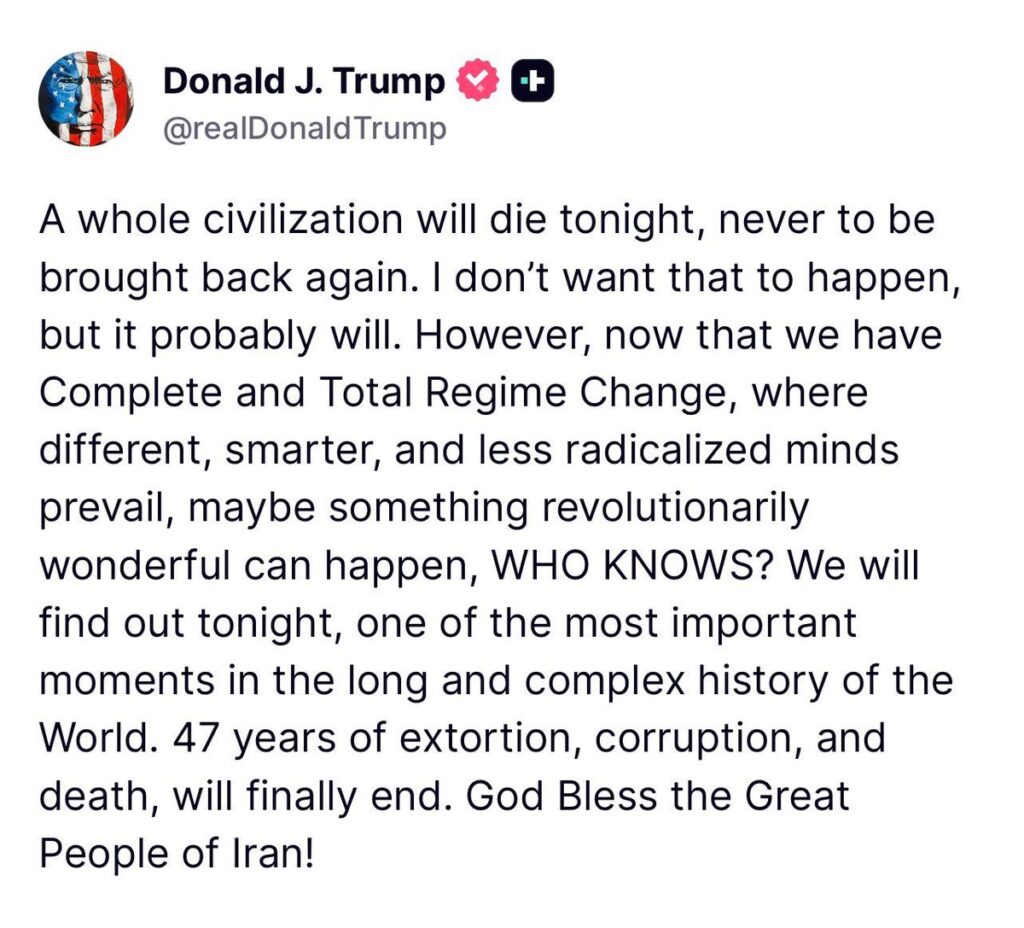
April 8, 2026: Trump relents in his threat to ‘destroy Iran forever’ by 8pm Eastern Time by claiming to be engaged in “very productive back-channel negotiations”. The Iranians deny negotiations have taken place.
April 12, 2026: On Orthodox Easter, Trump posts an image of himself in the likeness of Jesus Christ, apparently healing an injured U.S. soldier.
May 3, 2026: Trump announces the launch of “Operation Freedom”, under which U.S. naval ships will escort commercial vessels out of the Persian Gulf.
May 6, 2026: Trump announces a pause in the shipping escort mission, claiming “Great Progress” in negotiations with Iran.
May 11, 2026: Trump rejects the latest Iranian peace offer as “garbage”.
Consider the pattern above. Trump’s justifications for the war and his claims about the status of negotiations oscillate wildly from day to day, and sometimes from hour to hour. But the Strait of Hormuz remains closed to global shipping.
Who is President Trump trying to convince he has the upper hand? The Iranians? Or himself?
The Blasphemy of the False Physician
The most sinister manifestation of Trump’s “meme magic” appeared on April 12, when the President posted a shocking AI-generated graphic on Truth Social. The image depicted Trump wearing a white robe and red sash, a ball of light in his hand, appearing in the likeness of…none other than Jesus Christ.
This bizarre image was linked to a post wherein Trump attacked Pope Leo XIV, claiming that the pontiff was “soft on crime” and “wanted Iran to get a nuclear weapon”, both of which qualify as absurd statements. But Trump was angrily responding to Pope Leo’s comments criticizing the effects of the war and, as usual for Trump, he was not inclined to stick with the facts.
In the linked image, Trump appeared with his hand resting on the forehead of an injured or comatose U.S. soldier lying in a hospital bed, while two U.S. paratroopers and a strange horned figure sporting what might well be taken for…bat wings…descends from the sky in the background. See for yourself.
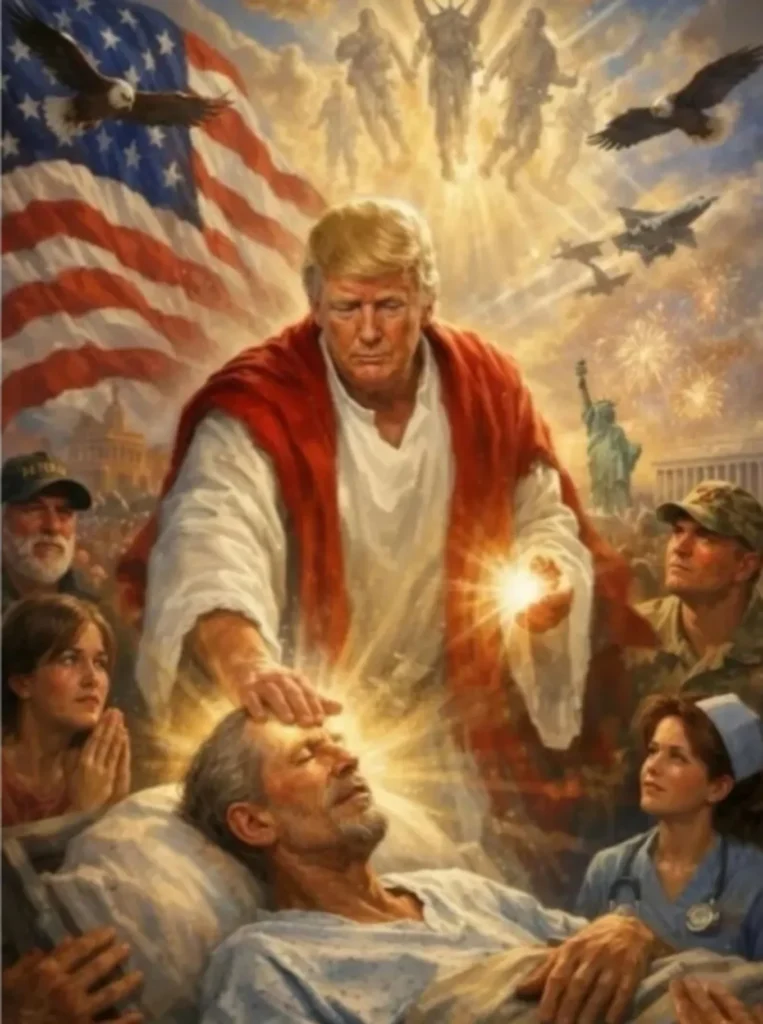
When the backlash hit, the President’s defense was a masterclass in gaslighting. “I thought it was me as a doctor,” he told reporters on April 13. “And, you know, I do make people better.”
Let us be precise: one cannot blaspheme a Pope. Leo XIV is a man—a Chicago-born monk, bishop and manager of the Roman Catholic Church. But it is possible to blaspheme against God or, if you are a Christian, against Jesus Christ, and that is exactly what Trump did.
By co-opting the iconography of Jesus, on Easter Sunday, to serve his personal grievances against the Vatican, Trump signaled that he no longer sees himself as a flawed human vessel for the divine, but as a manifestation of divine — or at least supernatural — forces, himself.
The “Presence” and the Propagandist
Finally, let us address the May 2 interview in the New York Times with Tucker Carlson. To speak of Carlson is to speak of a man who has accelerated his own bewildering descent into conspiracy theories and demagoguery.
Back in the late 2000s Carlson used to speak in facts, but now he speaks the forked-tongued cant of innuendo, rumor and wild hyperbole. Gone is the engaging, bowtie-wearing libertarian of century’s end. That man has been replaced by a hostile and sullen figure – a kind of preppy Joseph Goebbels.
Yet even a broken clock is right twice a day. Carlson’s description of Trump’s “occult-like” power to warp reality for those in his presence carries a certain patina of truth. Carlson spoke of a “thickness” in the air around the President – with whom he has spent much one-on-one time – a gravitational pull that forces those in the room to “inhabit Trump’s internal narrative”, letting go of their connection to reality.
“Being in Trump’s presence for a day is like entering a dreamworld,” Carlson said to NY Times journalist Lulu Garcia-Navarro. “It’s a bit like smoking hash. You come out of it thinking, like, where have I just been?”
“It’s like he puts people under a magical spell,” Carlson continues. “In fact, I actually think that it is a spell.”
Carlson, a quite considerable bullshitter himself, clearly recognizes another master of the craft.
In contrast to how Trump characterized himself after the April 12 Truth Social ‘Jesus incident’ as someone who ‘helps people’, Tucker Carlson made the diametrically opposed claim in his NY Times interview, stating that to his knowledge, “Trump has really harmed the people around him. I mean, like, some of them have become very ill after working closely with him. Gotten cancer – things like that. It’s frightening.”
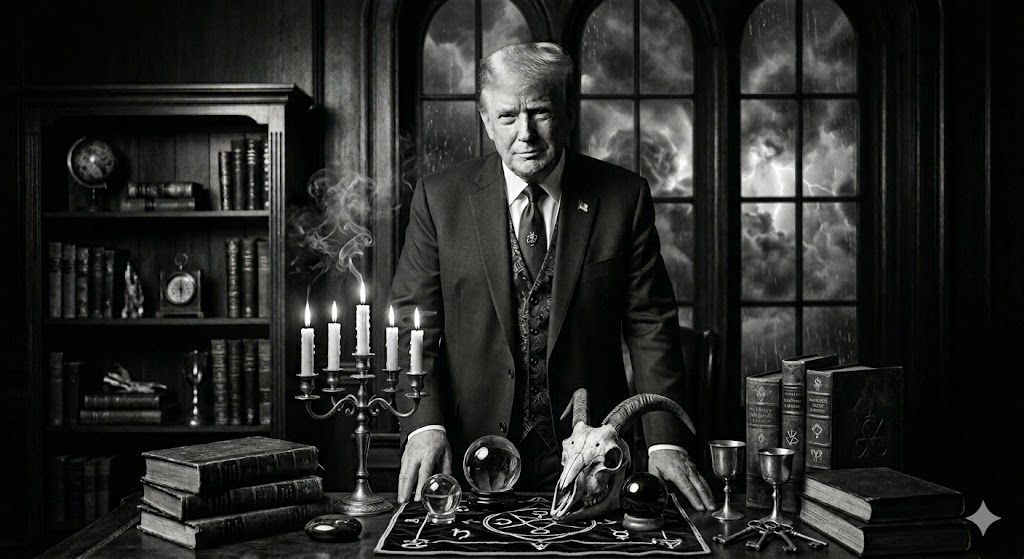
Between the statements of two practiced liars, it is hard to know who to believe, or whether to completely dismiss the statements of both. But say what you like about Carlson, in his interview he accurately described the “Sacred Space” of the chaos magician—a zone where objective truth is dissolved and replaced by the will of the practitioner. This is the sinister energy we first identified in 2024, now fully manifested.
The “Chaos Magick President” is no longer just running a country; he is attempting to rewrite reality itself. In the annals of Trump’s rhetoric and psychological influence campaigns, the last few weeks have gone far beyond his past provocations and entered truly dark spiritual territory.
And it’s not over yet.
As regret begins to seep into the pews of the Heartland, MAGA voters and the world may learn that the snap-back from a failed magical performance can sometimes be far more violent than the original illusion.
Until next time, we are —
Greymantle